
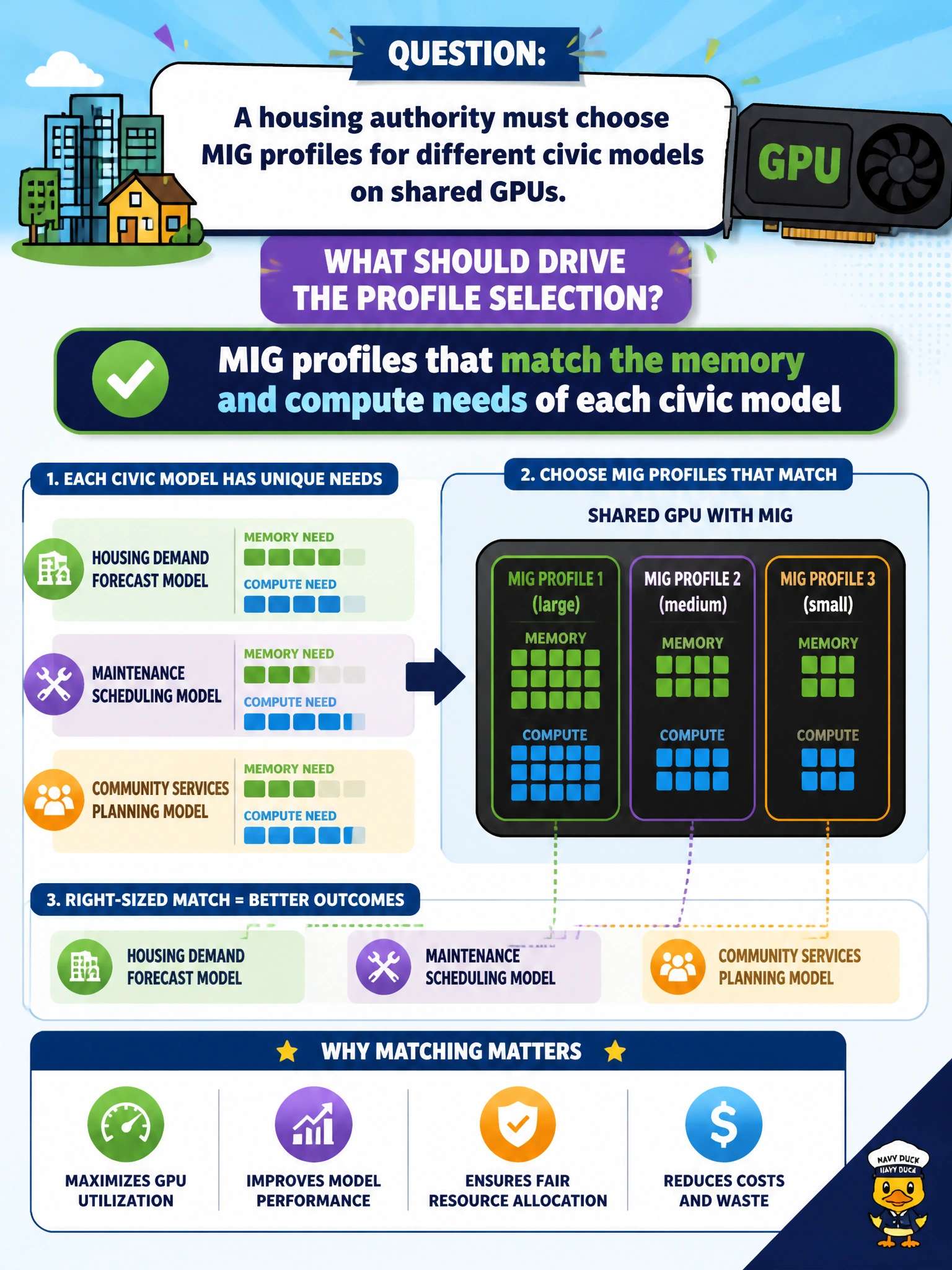
A housing authority must choose MIG profiles for different civic models on shared GPUs. What should drive the profile selection?
Select an answer to reveal the explanation.
Short Explanation
Size MIG profiles to what each civic model actually needs—memory and compute—like assigning apartment sizes by household, not by logo color.
Full Explanation
A housing authority choosing MIG profiles for different civic models on shared GPUs must size profiles to the memory and compute needs of each model. Undersized profiles cause OOM or latency failures; oversized profiles waste shared municipal GPU capacity that other civic models need. Profile selection is a capacity-planning decision driven by measured model requirements, not by cosmetic attributes of the dashboard. Alphabetical order of model names only fails by concept: naming order has no relationship to memory or SM requirements. Color of each model’s dashboard icon fails by concept: UI cosmetics are not GPU resource metrics. Identical tiniest profiles for every workload regardless of memory need fails by concept: one-size-smallest ignores heterogeneous civic model footprints and will break larger models. Exam caveat: profile choice must also respect which MIG profiles the specific GPU SKU supports; wishing for a profile shape the hardware cannot create does not satisfy the requirement. Operational check: measure memory/compute needs for each housing civic model, map models to supported MIG profiles that fit those needs, deploy and validate under load, and adjust if latency or OOM signals show mismatch.