
Emergency management must recover a BlueField DPU while the host OS is being rebuilt. What management approach is correct?
Select an answer to reveal the explanation.
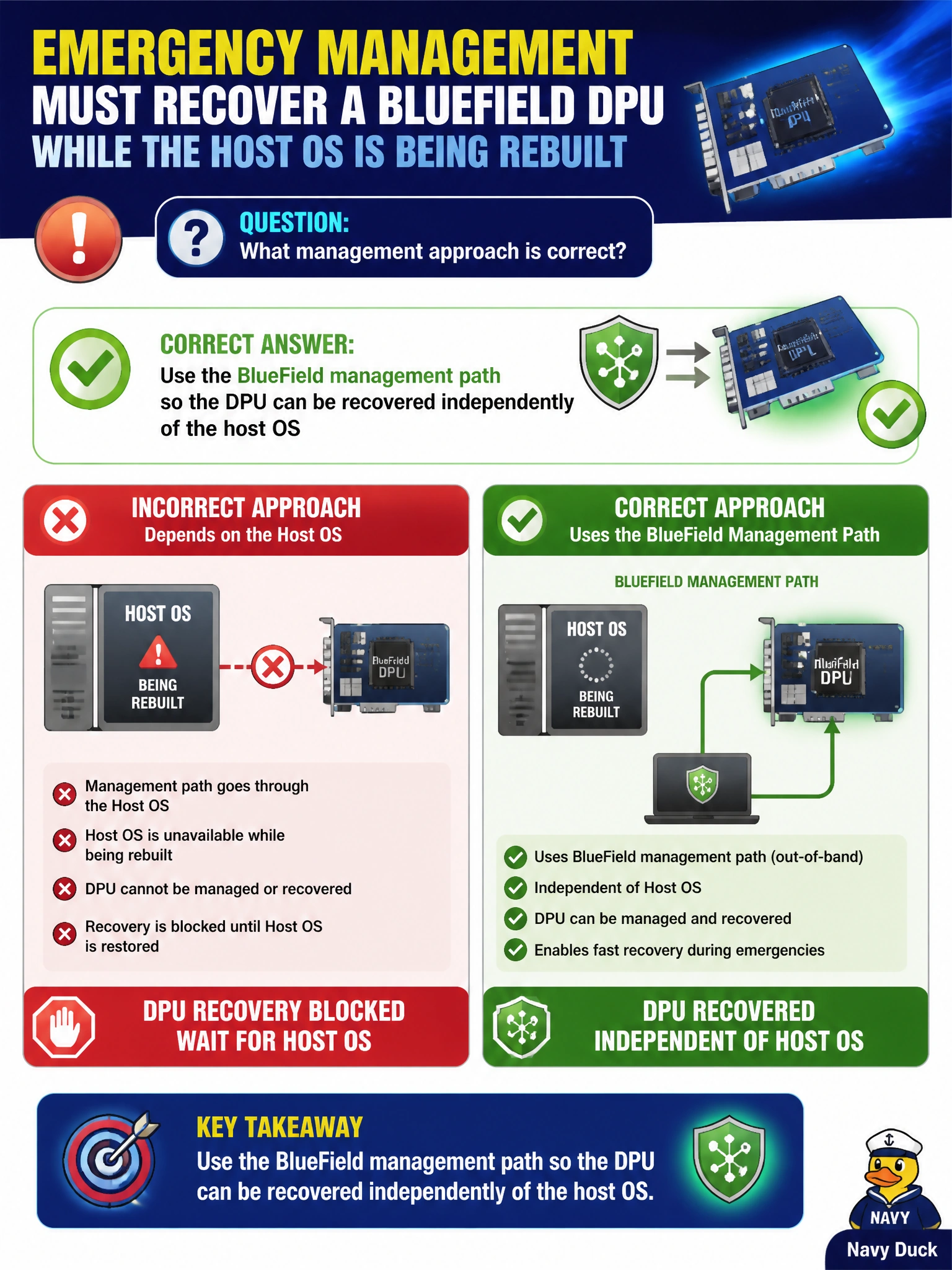
Short Explanation
When the host OS is in pieces, talk to BlueField on its own management path—like radioing the pump house even if city hall is dark. Do not wait on a dead host GUI.
Full Explanation
Emergency management recovering a BlueField DPU while the host OS is being rebuilt must use the BlueField management path so the DPU can be recovered independently of the host OS. DPUs are designed with out-of-band or platform management routes precisely so networking/offload firmware and OS can be repaired when host userspace is unavailable. Waiting on a broken host GUI freezes recovery of a component that does not need that GUI. Waiting indefinitely with no DPU action until a user logs into the broken host GUI fails by concept: host GUI availability is not a prerequisite for BlueField management recovery. Only managing BlueField through a crashed host userspace process fails by concept: crashed userspace cannot be the sole control path for DPU recovery. Discarding the DPU hardware whenever the host OS needs reinstall fails by concept: host OS reinstall is routine; DPU hardware replacement is not the default response. Exam caveat: independent DPU management still requires network or BMC reachability to the BlueField management interface and correct credentials; “independent of host OS” does not mean unmanaged or anonymous access. Operational check: during host OS rebuild, reach the BlueField management path, recover or re-image the DPU as needed, verify DPU health without relying on the broken host userspace, then complete host rebuild and rejoin the emergency-management cluster.