
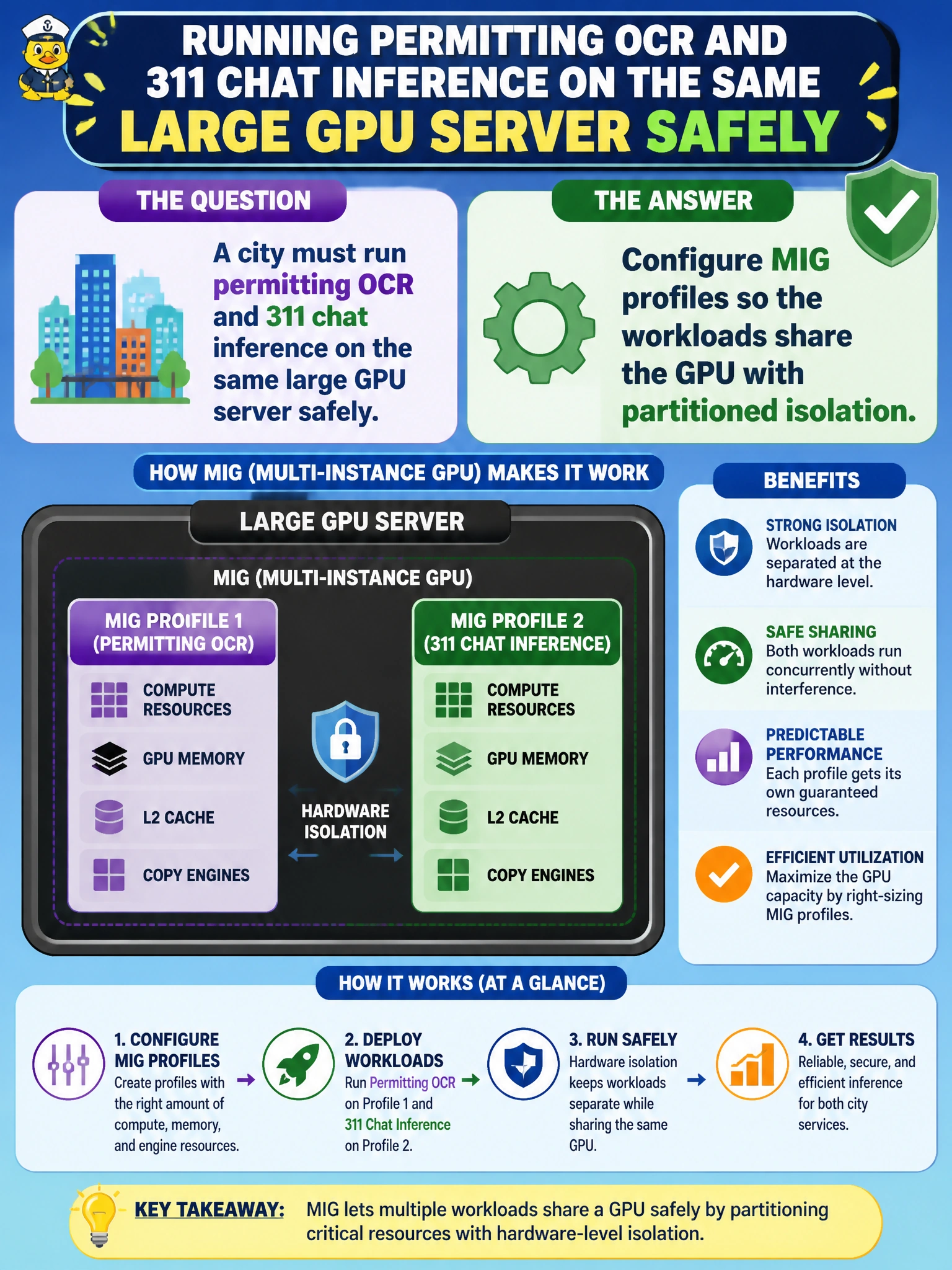
A city must run permitting OCR and 311 chat inference on the same large GPU server safely. Which physical-layer feature applies?
Select an answer to reveal the explanation.
Short Explanation
MIG is like splitting one big gym into lanes—OCR in one, 311 chat in another—so the city shares a GPU without them crashing into each other.
Full Explanation
A city running permitting OCR and 311 chat inference on the same large GPU server safely needs partitioned isolation at the GPU physical layer. Configuring MIG profiles so those workloads share the GPU with isolation prevents one civic service from exhausting memory or compute belonging to the other, which is the practical answer when one large GPU must host multiple production inferences without full dedicated cards. MIG turns one physical GPU into isolated instances sized for each workload. Disabling all GPU memory accounting and hoping for fairness fails by concept: hope is not isolation, and unrestricted sharing lets one job starve or crash the other. Assigning both jobs to the same full GPU with no isolation controls fails by concept: co-location without MIG (or equivalent isolation) is exactly the unsafe pattern the scenario asks to avoid. Removing the GPU and running both models on CPU only by policy fails by concept: abandoning GPU acceleration is not the required physical-layer sharing feature and may miss municipal SLOs. Exam caveat: MIG provides hardware-partitioned instances; it is not a substitute for application auth or network tenancy controls, and not every GPU SKU or driver combination supports every MIG profile. Operational check: enable MIG, create profiles for permitting OCR and 311 chat, launch each workload into its instance, verify memory/compute isolation under concurrent load, and confirm both city services meet their latency targets.