
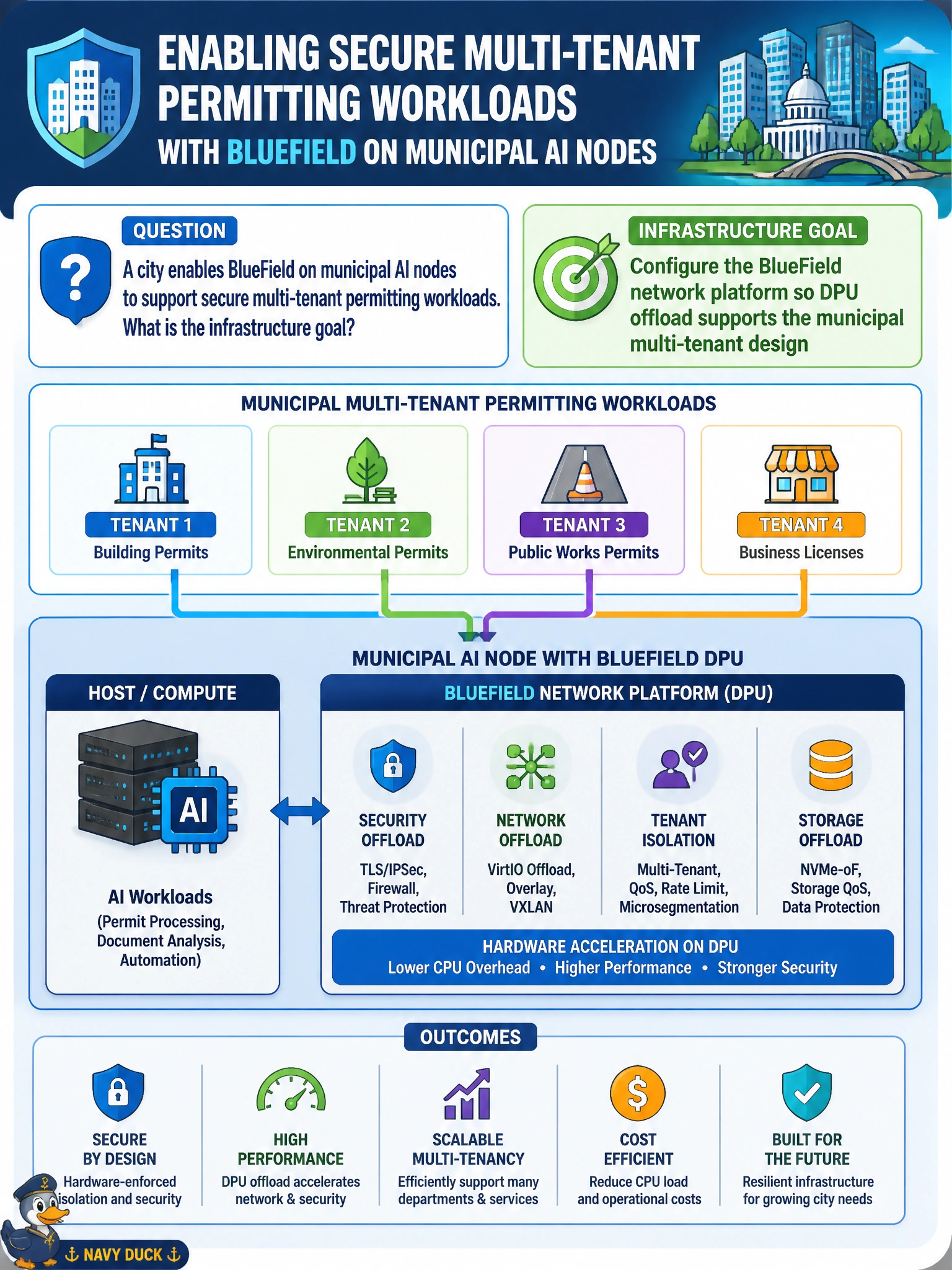
A city enables BlueField on municipal AI nodes to support secure multi-tenant permitting workloads. What is the infrastructure goal?
Select an answer to reveal the explanation.
Short Explanation
BlueField is the DPU sidekick that can offload and harden the city’s multi-tenant permitting fabric—not a faceplate sticker and not a GPU replacement. Configure the platform for that job.
Full Explanation
A city enabling BlueField on municipal AI nodes for secure multi-tenant permitting workloads is configuring the BlueField network platform so DPU offload supports the multi-tenant design. BlueField’s role is to provide DPU-based networking, isolation, and offload capabilities that help separate tenants and reduce host networking burden—not to replace GPUs and not to sit unused as decoration. Platform configuration must align DPU behavior with the city’s permitting tenancy model. Replacing all GPUs with BlueField cards exclusively fails by concept: BlueField is a DPU/network platform component; it does not substitute for GPU compute in permitting AI. Disabling the DPU so the host NIC always owns every packet path fails by concept: that abandons the offload and isolation goal that motivated enabling BlueField for multi-tenant design. Using BlueField only as a decorative faceplate with no platform config fails by concept: hardware without configuration delivers neither offload nor tenant controls. Exam caveat: BlueField modes and ownership models vary (NIC mode, DPU mode, and related DOCA workflows); the exam-relevant idea is configuring the platform for multi-tenant offload, not treating the card as a GPU or ignoring it. Operational check: configure BlueField for the municipal multi-tenant permitting design, verify DPU/host networking roles match the intended mode, validate tenant isolation on a test flow, and confirm host GPU workloads still reach the network through the designed path.