
A courts OCR farm configures third-party storage for new GPU servers. Which initial parameters should follow the vendor guide?
Select an answer to reveal the explanation.
Short Explanation
Use the storage vendor’s default block size and mount options—like following the fridge manual before you stock vaccines—not random laptop NFS folklore.
Full Explanation
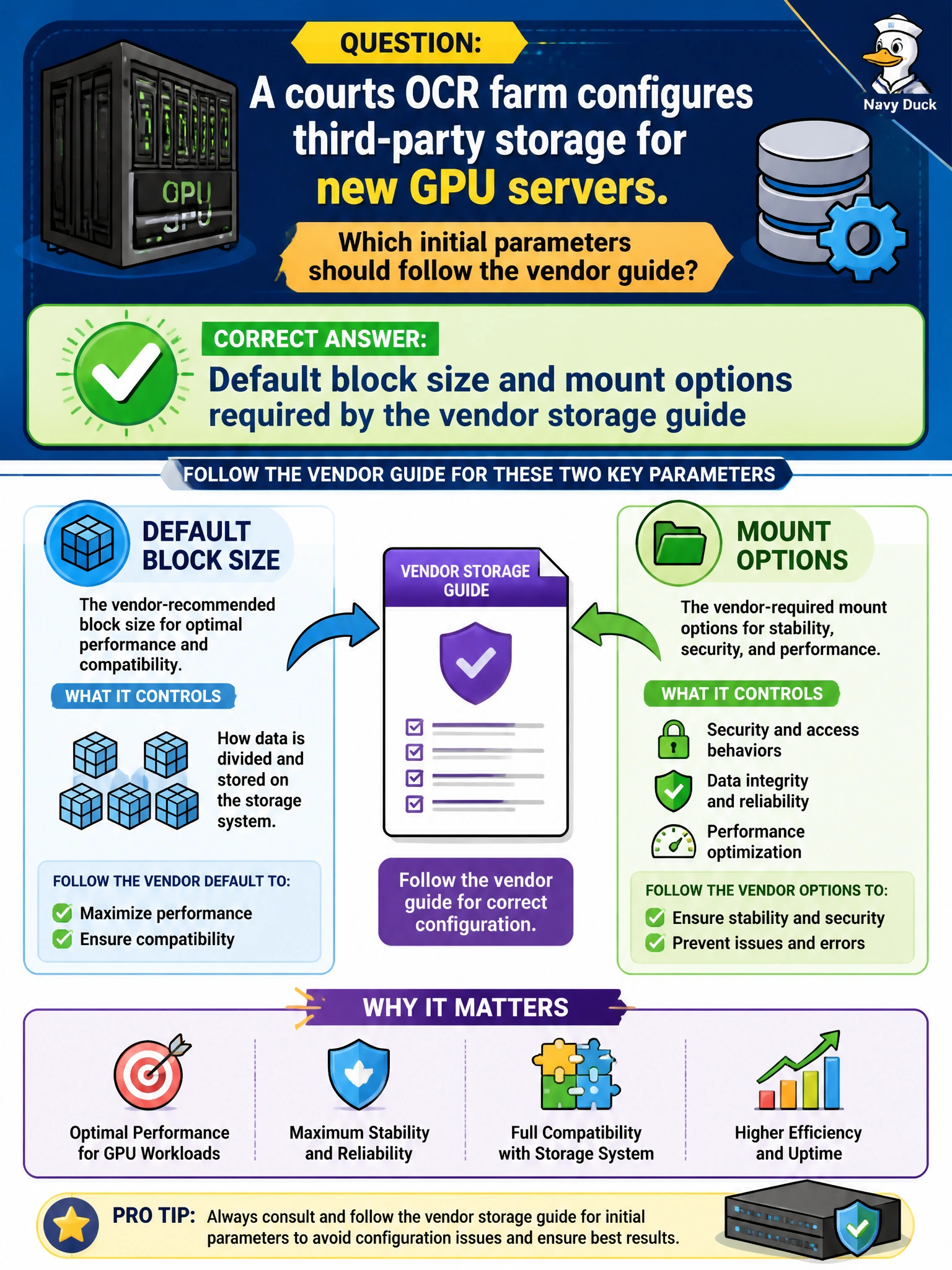
A courts OCR farm configuring third-party storage for new GPU servers should apply the default block size and mount options required by the vendor storage guide at initial config. Vendor defaults encode interoperability assumptions for that array or parallel filesystem; starting from those defaults gives a known-good baseline before any courts-specific tuning. Random folklore from unrelated clients is a common source of silent performance and integrity problems on bring-up. Choosing random block sizes for aesthetic symmetry fails by concept: block size is a functional I/O parameter, not a visual preference, and wrong sizes can crush throughput or break alignment. Copying mount options from an unrelated laptop NFS share fails by concept: laptop home-directory mounts rarely match datacenter AI/storage vendor requirements for locking, rsize/wsize, or protocol versions. Disabling checksums on every volume to speed photos of the rack fails by concept: integrity controls are not optional cosmetics and must not be removed to simplify photography. Exam caveat: vendor-required defaults are the starting gate; later OCR workload tuning may adjust parameters, but deviations should be deliberate, measured, and documented—not accidental copies from unrelated systems. Operational check: set block size and mount options per the storage vendor guide on the courts GPU servers, mount the OCR dataset volumes, run a short read-heavy validation job, and record the applied parameters for audit and later compare.