
A water-utility digital twin points new GPU servers at storage for checkpoint writes. What endpoint choice is correct at initial config?
Select an answer to reveal the explanation.
Short Explanation
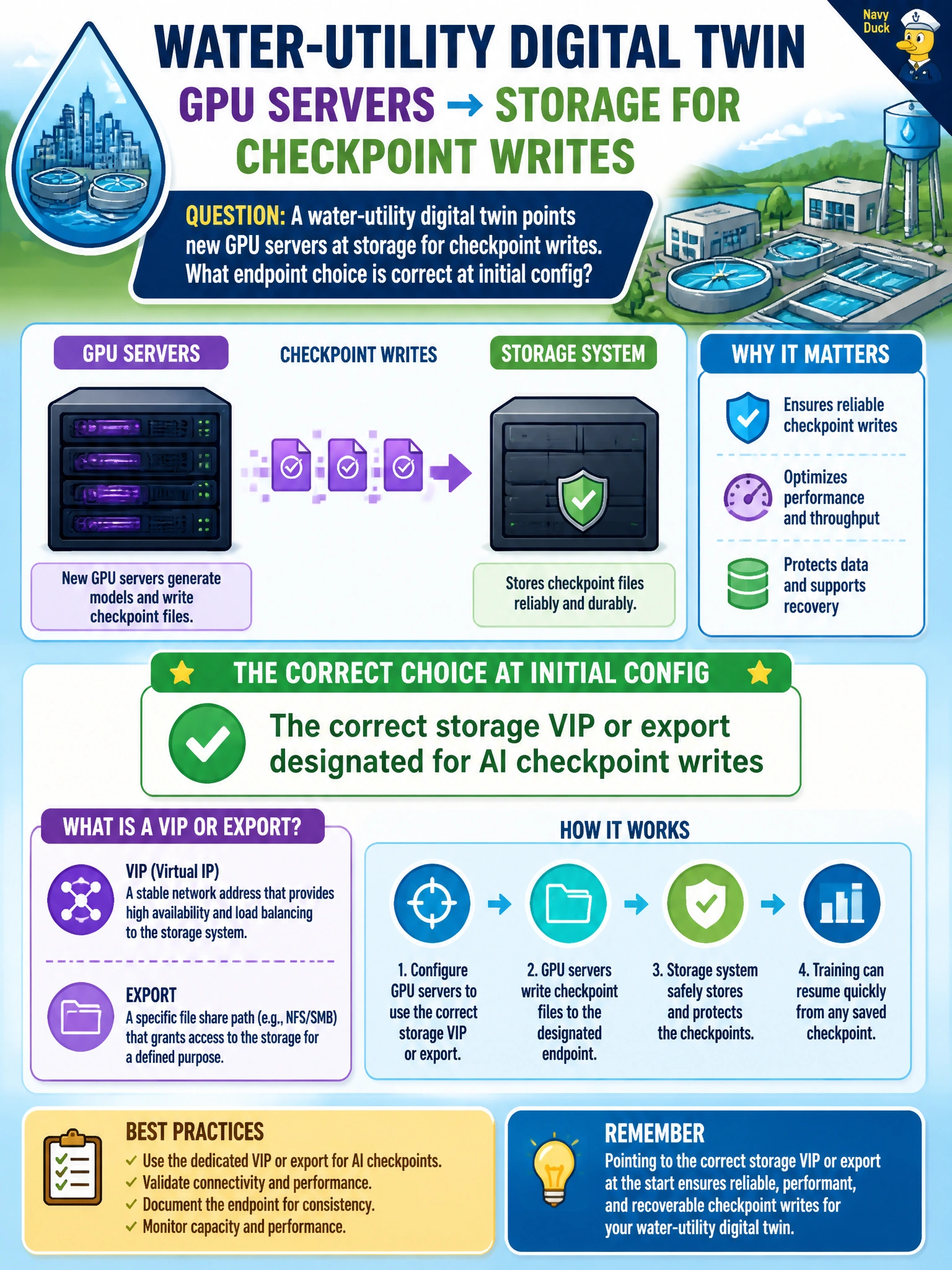
Send checkpoints to the designated storage VIP or export for AI checkpoint writes—the right endpoint for your twin. An anonymous Internet FTP host, a desktop USB stick, or the guest Wi-Fi SSID can leave you with lost twin state.
Full Explanation
A water-utility digital twin’s new GPU servers must send checkpoint writes to the correct storage VIP or export designated for AI checkpoint writes. Checkpoints preserve recovery state for the twin; writing them to an unapproved or ephemeral endpoint risks silent data loss, wrong tenancy, and unrecoverable training or simulation progress. Initial configuration should connect the GPU nodes to the municipal checkpoint endpoint whose capacity and security are designated for that role. An anonymous FTP host discovered on the Internet is uncontrolled, untrusted, and unsuitable for utility operational state. A desktop USB stick labeled temporary forever is not a resilient shared checkpoint target for clustered GPU servers. The guest Wi-Fi SSID is neither the designated storage path nor appropriate for operational checkpoint integrity. Exam caveat: a correct VIP or export requires both network reachability and authorization; a DNS name that resolves to the wrong tenant export remains the wrong endpoint even if it mounts. Practical check: configure checkpoint paths to the designated water-utility AI storage VIP or export, verify a test checkpoint can be written and read back from the new GPU servers, confirm the path survives VIP failover if applicable, and document the endpoint in the twin runbook.