
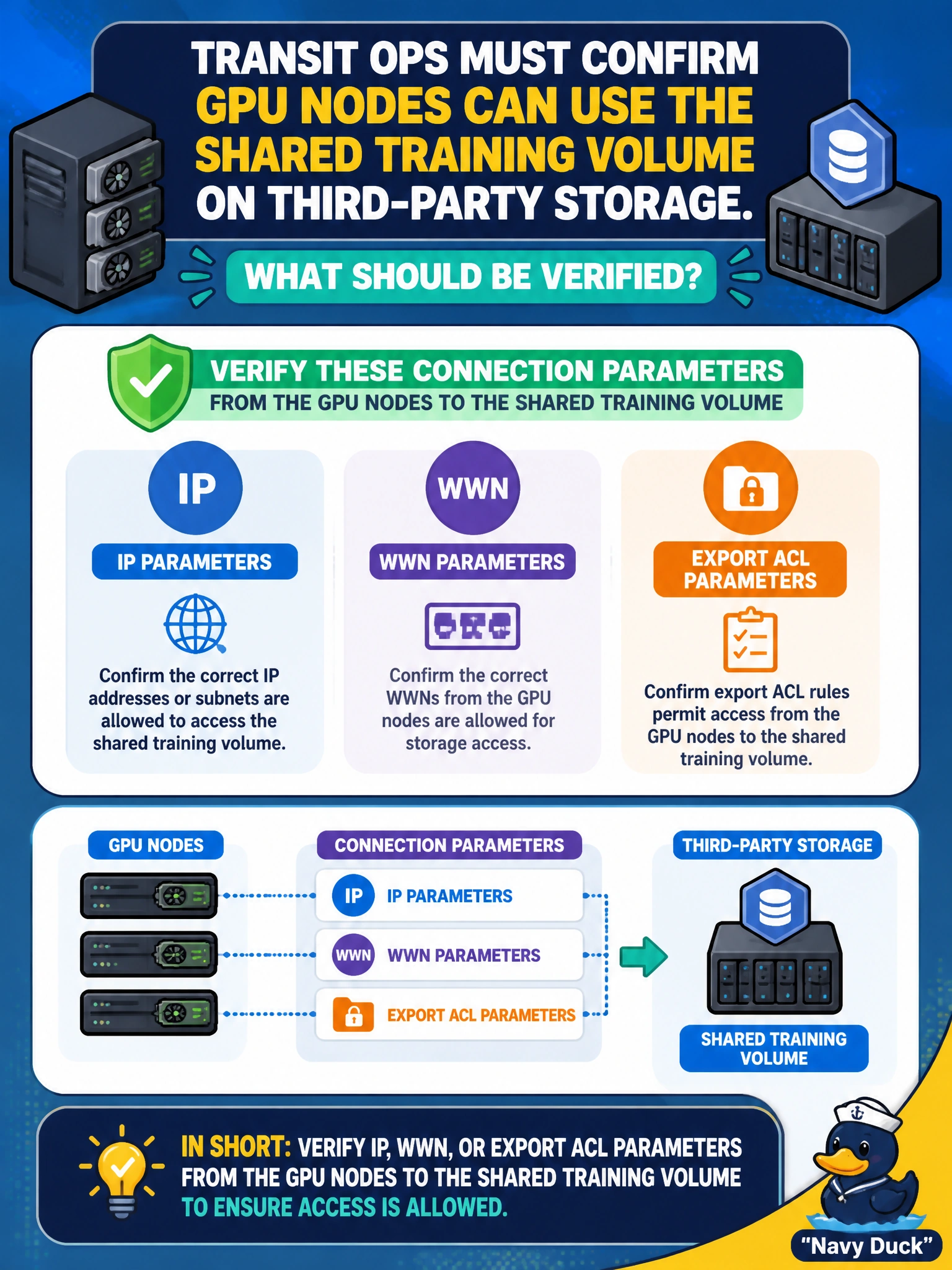
Transit ops must confirm GPU nodes can use the shared training volume on third-party storage. What should be verified?
Select an answer to reveal the explanation.
Short Explanation
Check the actual tickets to the shared volume—IPs, WWNs, export ACLs—from those transit GPU nodes. A glowing power LED is not access proof.
Full Explanation
Transit ops confirming GPU nodes can use the shared training volume on third-party storage must verify the actual access parameters: IP, WWN, or export ACL entries from the GPU nodes to that volume. Storage readiness for AI bring-up is proven by authorized, working paths—not by facility aesthetics. Those parameters define whether the municipal training volume will accept the nodes’ initiators or NFS clients and whether multipath/export policy matches the AI row design. Verifying only that the storage array has a lit power LED fails by concept: power presence is not access, zoning, or export proof. Relying on a storage vendor marketing video that mentions AI once fails by concept: marketing claims do not configure or validate node-to-volume connectivity. Firewall rules that deny all node access permanently fail by concept: permanent deny contradicts the requirement that GPU nodes use the shared training volume. Exam caveat: which identifier matters (IP, WWN, export ACL) depends on protocol—block fabrics emphasize WWN/zoning; NFS/export paths emphasize IP/host ACLs—but in all cases the node-to-volume authorization must be verified. Operational check: from the transit GPU nodes, confirm initiator/client identity is allowed to the shared training volume, mount or discover the volume successfully, run a small read/write probe, and archive the ACL/zoning evidence with the change record.