
County health needs datasets reachable on new GPU nodes before BCM imaging finishes. How should storage initial config be treated?
Select an answer to reveal the explanation.
Short Explanation
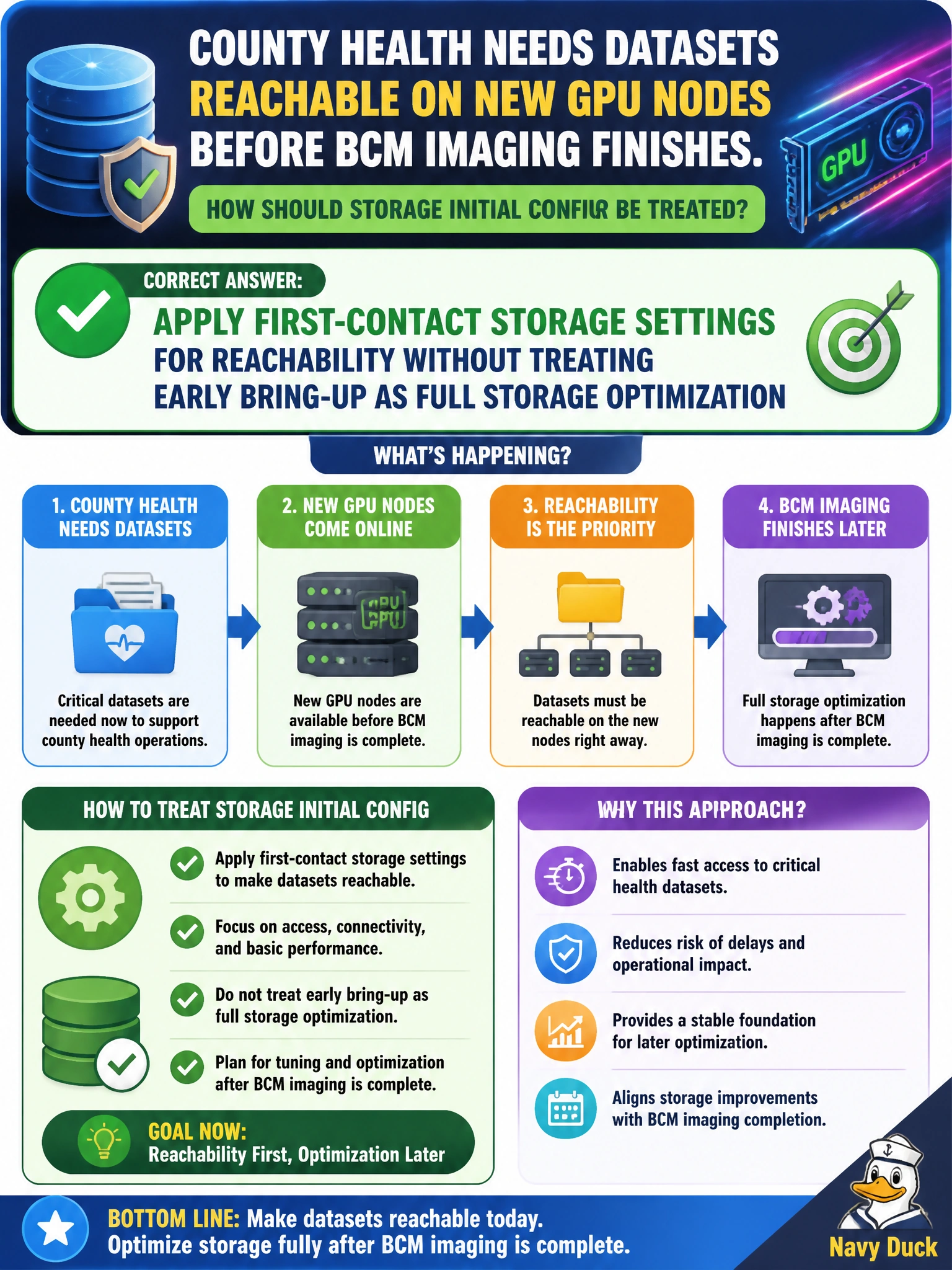
You need the datasets reachable on the new GPU nodes before BCM imaging finishes, not a fully optimized storage setup. Start with reachability; deeper tuning can wait until early bring-up is complete.
Full Explanation
Apply first-contact storage settings to make the county health datasets reachable on the new GPU nodes without treating early bring-up as full storage optimization. At this stage, the goal is a correct, usable path to approved datasets so imaging and early validation can proceed—not a multi-week performance project that blocks other bring-up work. Blocking all storage access until every cluster burn-in completes fails because imaging and other early workflows may need dataset reachability before full burn-in ends. Spending weeks micro-tuning every I/O scheduler before the first mount fails because premature optimization delays first contact and confuses bring-up needs with long-term storage engineering. Deferring configuration until BCM imaging finishes and using removable media as the sole transfer method fails because it does not scale, breaks controlled access paths, and is inappropriate as the standing way to deliver county health datasets. Exam caveat: first-contact settings must still use the correct county-approved exports and credentials; temporary access to an arbitrary share is not acceptable. Practical check: apply initial mount and client settings, verify that the GPU nodes can access the designated datasets, record the interim configuration, and schedule deeper storage optimization after BCM imaging and core bring-up gates pass.