
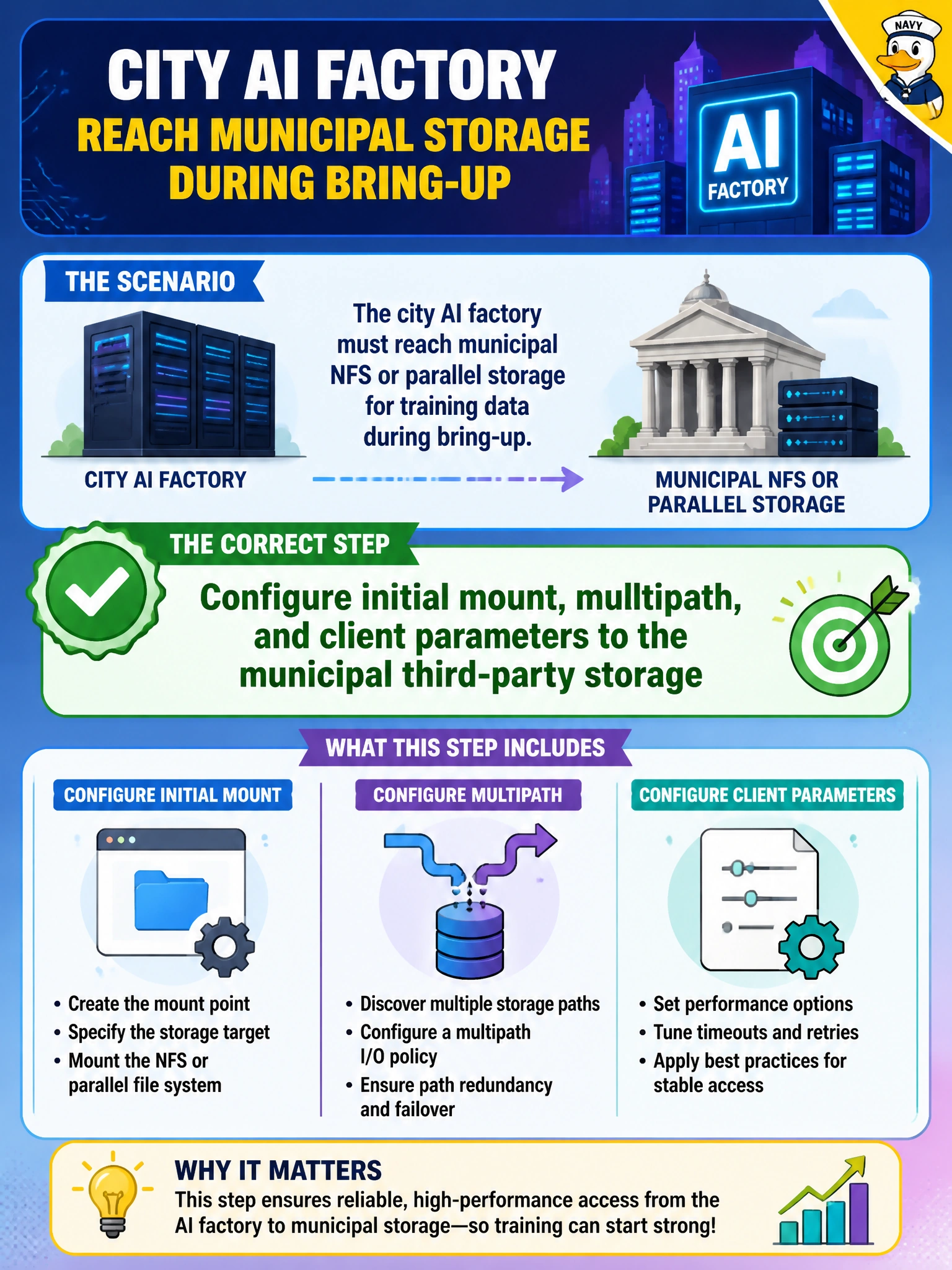
A city AI factory must reach municipal NFS or parallel storage for training data during bring-up. Which storage step belongs here?
Select an answer to reveal the explanation.
Short Explanation
Get the training data hose hooked up early—mounts, multipath, client knobs—to the city’s storage, not a random public share. Bring-up needs a real path to datasets.
Full Explanation
A city AI factory reaching municipal NFS or parallel storage for training data during bring-up must establish a real client path early: initial mount, multipath, and client parameters to the municipal third-party storage. Training and checkpoint workflows depend on reachable datasets; deferring all storage wiring until late capacity planning leaves GPU nodes compute-ready but data-starved. First-contact storage configuration is part of system bring-up, not an optional year-one afterthought. Deferring all storage settings until after year-one capacity planning only fails by concept: bring-up validation and early training jobs need dataset reachability now. Pointing every node at a random public Internet file share fails by concept: public shares lack municipal integrity, access control, and performance assumptions required for city AI training data. Disabling multipath permanently to simplify cabling photos fails by concept: multipath is a resilience and pathing control for storage access, not a cosmetic obstacle. Exam caveat: initial bring-up storage config establishes reachability and sane client defaults; it is not a claim that every I/O scheduler and stripe parameter is fully optimized for peak training. Operational check: configure mounts/multipath/client parameters to the municipal storage, verify the city AI factory nodes can list and read the training volume, confirm multipath path state, and document the initial settings for later hardening.