
A library consortium completes day-0 workload validation on NLP GPUs. What documentation practice supports later regression compares?
Select an answer to reveal the explanation.
Short Explanation
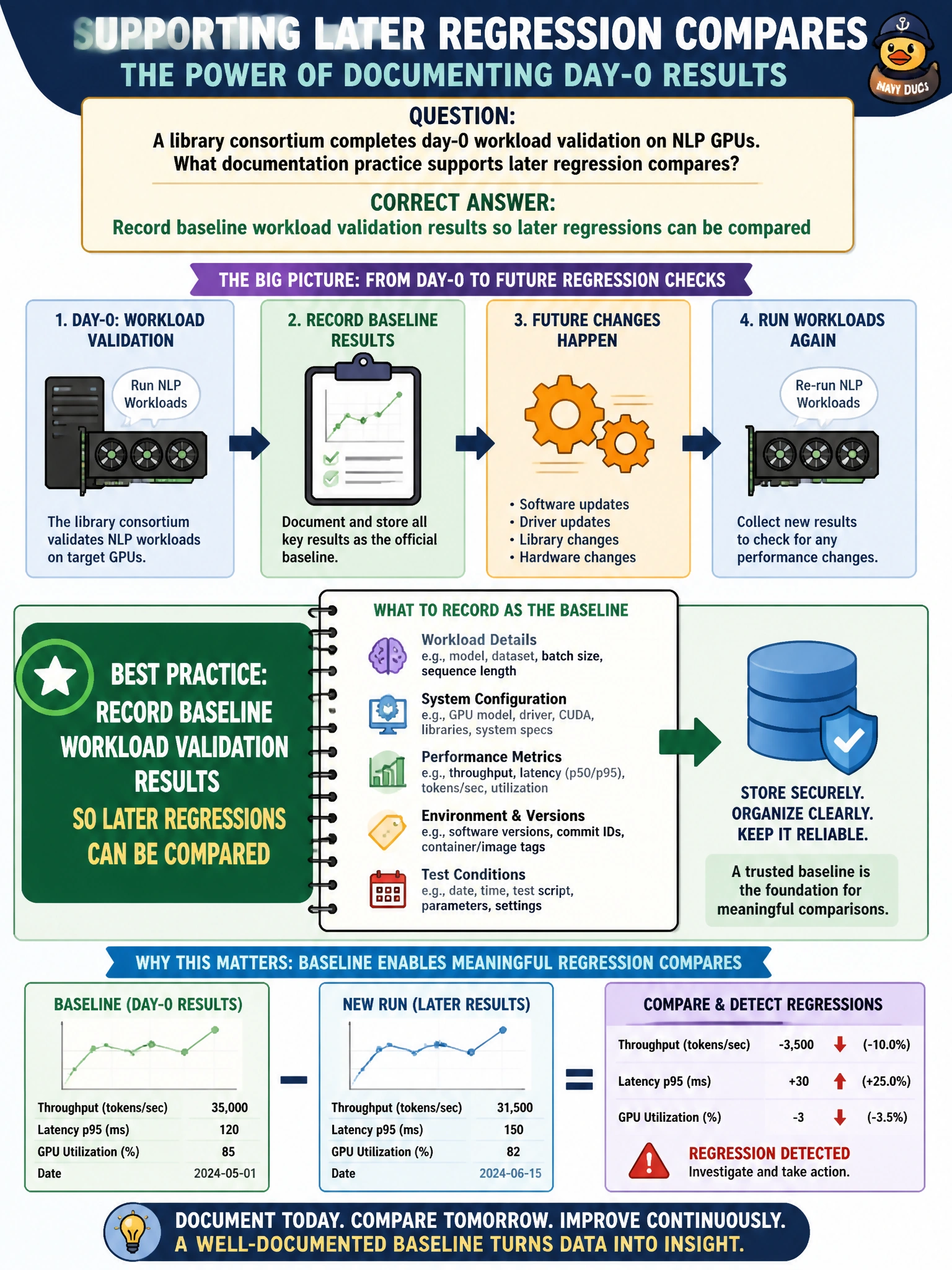
Write down the day-0 numbers—like marking the high-water line after the first flood drill—so the library can spot regressions later. Hallway memory is not a baseline.
Full Explanation
A library consortium completing day-0 workload validation on NLP GPUs should preserve the measured results as a baseline for later regression compares. Recording baseline workload validation results lets operators detect performance or error regressions after firmware, driver, cooling, or workload changes, which is essential for civic NLP capacity that must stay predictable across updates. Day-0 numbers are the reference ruler; without them, later “it feels slower” debates replace evidence. Deleting all metrics after the first successful job fails by concept: success without retained metrics cannot support regression detection. Storing only verbal hallway recollections of the run fails by concept: oral memory is not reproducible, auditable, or comparable across operators and quarters. Overwriting baselines weekly without keeping the day-0 snapshot fails by concept: continuous overwrite erases the original reference and can normalize gradual degradation. Exam caveat: baselines should include enough context (driver/firmware, job definition, clocks/power/thermals, error counters) that a later compare is apples-to-apples; a lone FPS-like number without context is weak evidence. Operational check: archive day-0 validation artifacts for the library NLP GPUs, protect them from casual overwrite, and re-run the same validation after significant changes to compare against that municipal baseline.