
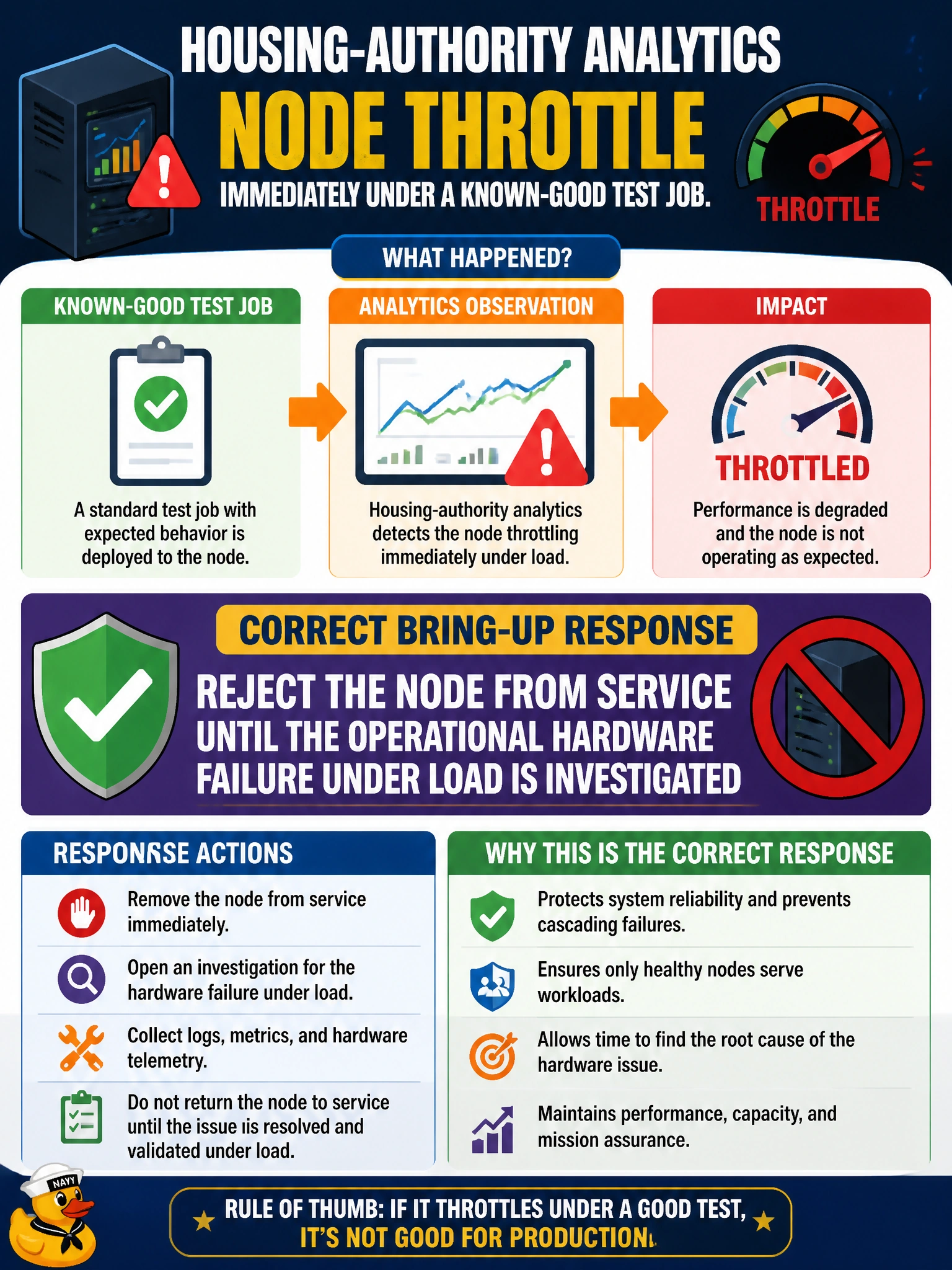
Housing-authority analytics sees a node throttle immediately under a known-good test job. What is the correct bring-up response?
Select an answer to reveal the explanation.
Short Explanation
Instant throttle on a known-good job means that housing node fails the road test—park it until you find the fault. Idle SMI glory does not override load failure.
Full Explanation
Housing-authority analytics seeing a node throttle immediately under a known-good test job has an operational hardware failure under load, not a green-light idle inventory story. Rejecting the node from service until the failure is investigated protects shared municipal capacity from a host that cannot sustain expected performance and may be masking cooling, power, seating, or silicon faults. Immediate throttle on a known-good job is a hard stop for bring-up acceptance. Accepting the node because idle nvidia-smi once listed the GPUs fails by concept: idle enumeration does not override load failure and would promote a defective host into housing workloads. Raising the power limit blindly without diagnosing cooling or hardware faults fails by concept: raising limits can hide or worsen thermal and power-delivery problems instead of finding root cause. Hiding throttle events from the municipal change log fails by concept: suppressing evidence blocks auditability and repeat diagnosis. Exam caveat: some workloads intentionally hit power or thermal limits at design max; the key here is throttle under a known-good bring-up job that should not immediately hit those ceilings on a healthy node. Operational check: quarantine the housing node, collect throttle/thermal/power and seating data, remediate or RMA as indicated, re-run the known-good job without immediate throttle, then only return the node to service.