
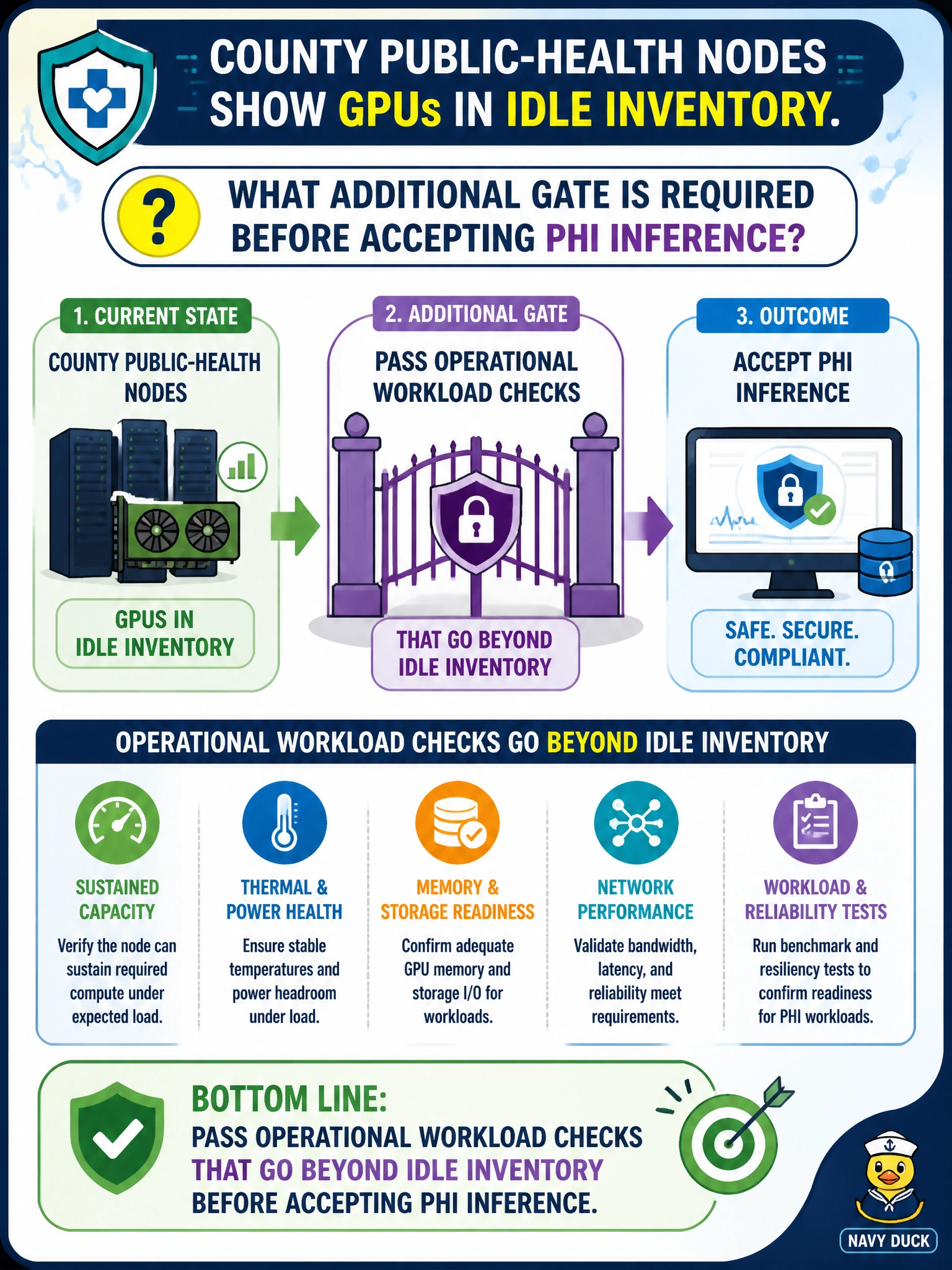
County public-health nodes show GPUs in idle inventory. What additional gate is required before accepting PHI inference?
Select an answer to reveal the explanation.
Short Explanation
Seeing GPUs at idle is like noticing the clinic fridge is plugged in—you still check it holds temperature under real use. Run operational checks before PHI inference rides those county nodes.
Full Explanation
County public-health nodes that show GPUs in idle inventory have not yet earned acceptance for PHI inference. Passing operational workload checks that go beyond idle inventory is required because PHI workloads demand confidence in stability, error behavior, and performance under real compute—not just that nvidia-smi listed devices once. Idle presence is a necessary early signal; operational checks are the gate that protects clinical and public-health inference from hardware that only looks healthy at rest. Treating idle discovery as the only required operational check fails by concept: idle success does not exercise memory bandwidth, thermal limits, or sustained error paths that PHI jobs will hit. Disabling all health sensors to reduce alert noise fails by concept: sensors are the early-warning system for GPU and node faults; silencing them increases undetected risk rather than proving readiness. Publishing the idle GPU list to the public website as certification fails by concept: public inventory disclosure is neither a validation method nor an appropriate control for PHI acceptance. Exam caveat: operational checks must still respect PHI data-handling rules—use synthetic or approved non-production payloads for bring-up stress, then apply separate application security controls before live PHI inference. Operational check: run approved workload validation beyond idle inventory, review health/ECC/throttle signals, document pass criteria for the county public-health node, and only then accept the host for PHI inference scheduling.