
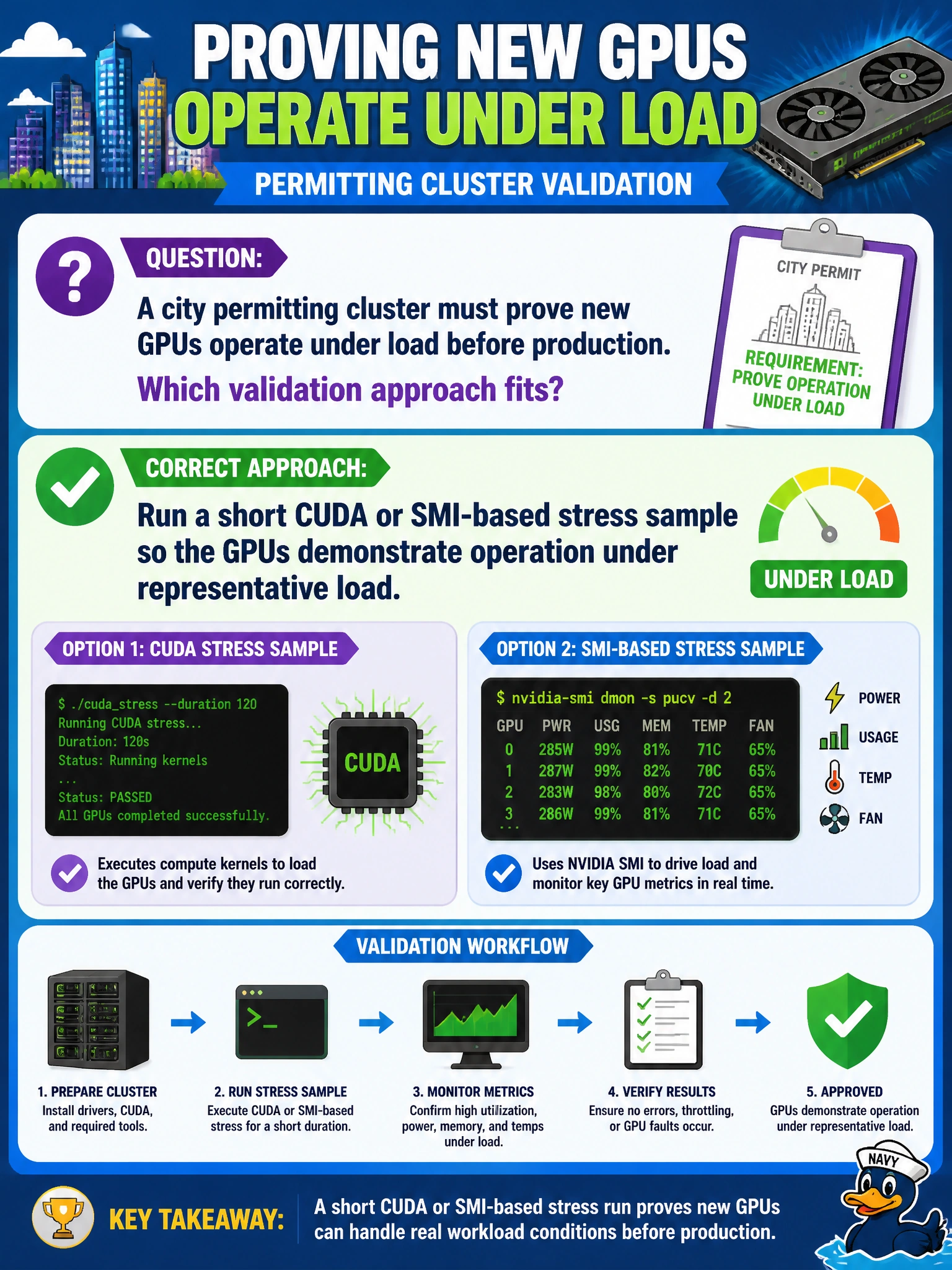
A city permitting cluster must prove new GPUs operate under load before production. Which validation approach fits?
Select an answer to reveal the explanation.
Short Explanation
Idle inventory is like counting fire trucks in the bay—you still need a short drill under load. Give those permitting GPUs a quick CUDA/SMI stress sample before production.
Full Explanation
A city permitting cluster proving new GPUs before production needs evidence that adapters operate under load, not merely that they were counted in a crate. Running a short CUDA or SMI-based stress sample demonstrates clocks, power, thermal behavior, and error counters under representative work, which is the gate that separates installed inventory from production-ready capacity for permitting OCR and related civic models. Idle discovery confirms presence; load samples confirm the GPUs can do useful work without immediate fault. Relying only on the packing-list count of GPUs fails by concept: shipping counts do not prove seating, PCIe link health, or thermal headroom on the installed node. Assuming idle discovery equals full workload readiness fails by concept: idle enumeration can succeed while throttling, ECC faults, or link training problems appear only under compute. Skipping load tests because the data-center lights are on fails by concept: facility power indication is unrelated to GPU functional validation. Exam caveat: a short stress sample is a bring-up gate, not a substitute for full endurance soak or application-level acceptance of the permitting models; failing early under a known-good sample still blocks production acceptance. Operational check: after install, run a brief CUDA/SMI stress on each new GPU, compare clocks/power/thermals to expected ranges, capture error counters, and only then mark the city permitting node ready for production scheduling.