
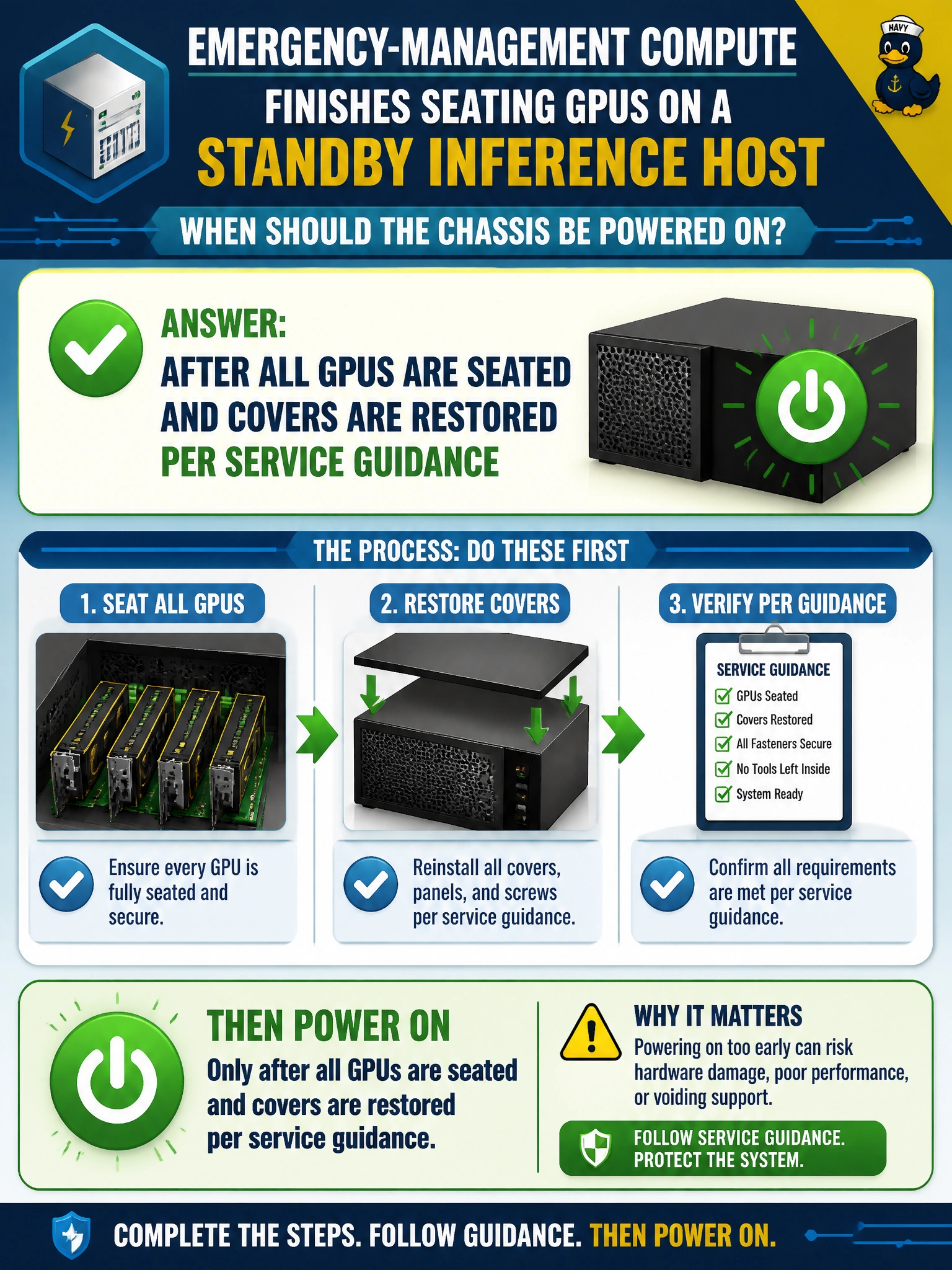
Emergency-management compute finishes seating GPUs on a standby inference host. When should the chassis be powered on?
Select an answer to reveal the explanation.
Short Explanation
Power comes after the mechanical story ends—GPUs seated, covers back on—like closing the ambulance bay doors before you start the generator. Do not light the chassis mid-install.
Full Explanation
Emergency-management compute finishing GPU seating on a standby inference host must restore covers and complete mechanical install before applying power, following vendor service guidance. Powering on after all GPUs are seated and covers are restored reduces risk of foreign objects, incomplete riser engagement, and thermal or EMI paths that open-chassis operation was never designed for. The standby host is intended to carry civic inference when primary capacity fails; bringing it up mid-install trades a few minutes of LED watching for preventable hardware risk. Powering immediately while covers remain off to watch LEDs flash fails by concept: service procedures treat cover restoration as part of a safe power-on state, and open chassis operation is not a substitute for post-install health checks. Powering before seating finishes so firmware can discover loose boards fails by concept: discovery under incomplete seating can mask faults or create intermittent contacts that appear healthy until load. Powering anytime the UPS is online regardless of mechanical install state fails by concept: UPS readiness is an electrical precondition, not proof that the chassis is mechanically complete. Exam caveat: some maintenance modes allow limited powered diagnostics with covers off under explicit vendor procedures; that exception does not redefine general bring-up power-on order for a standby municipal inference host. Operational check: complete GPU seating and torque/engagement checks, restore covers and airflow paths per the service guide, then power on and validate presence via BMC and nvidia-smi before declaring the emergency standby node ready.