
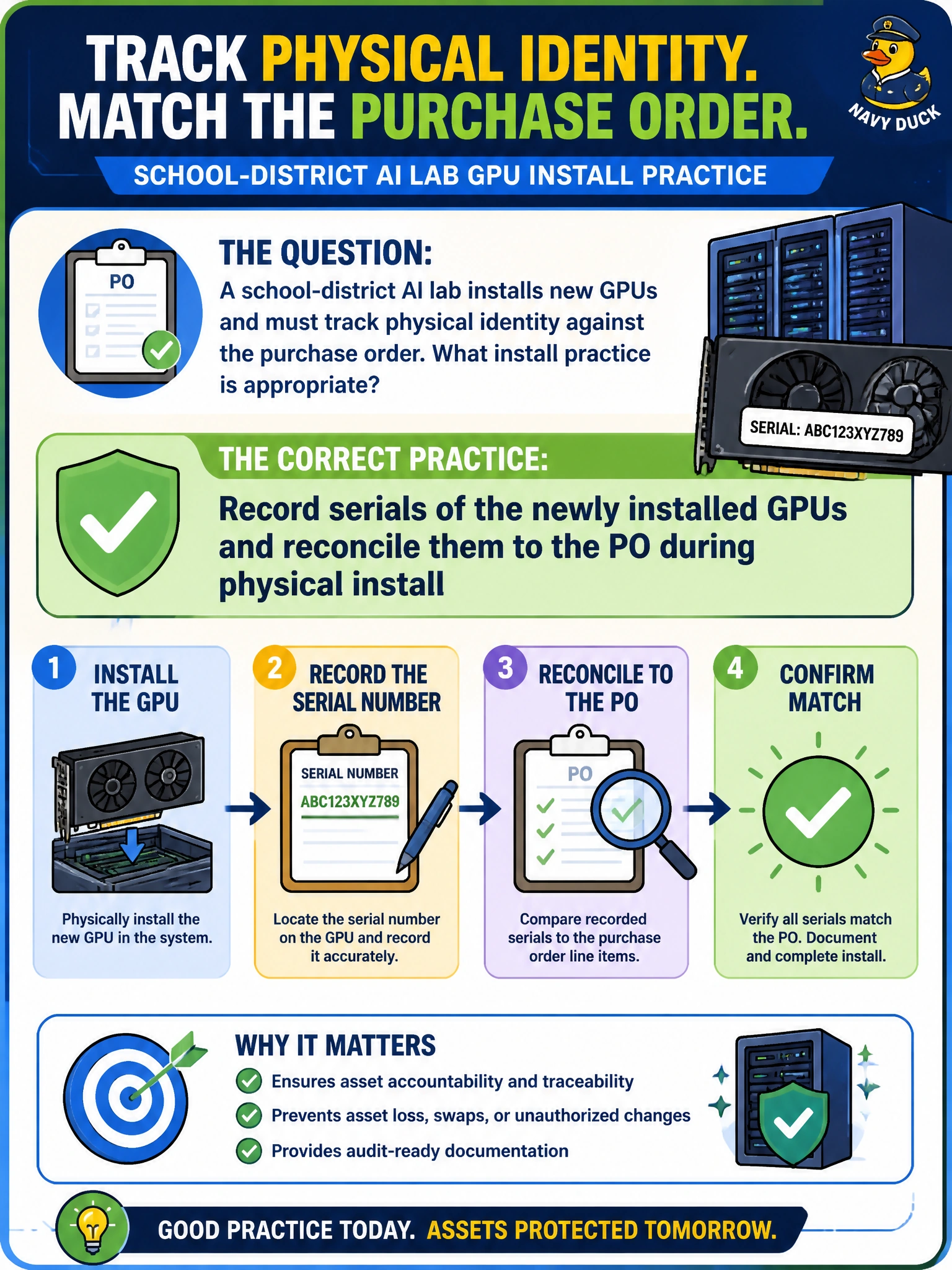
A school-district AI lab installs new GPUs and must track physical identity against the purchase order. What install practice is appropriate?
Select an answer to reveal the explanation.
Short Explanation
Think of it like logging the VIN when the school bus gets a new engine—not just snapping a photo of the hood. Capture those GPU serials and match them to the PO while you install.
Full Explanation
A school-district AI lab installing new GPUs must bind physical hardware identity to the purchase order at install time, not after the fact from shipping paperwork alone. Recording serials of the newly seated GPUs and reconciling them to the PO during physical install proves which assets entered the chassis, supports warranty and RMA paths, and keeps municipal asset systems aligned with what operators actually racked. That reconciliation is part of bring-up discipline: the PO lists what was ordered; the serials on the GPU labels list what was installed; matching them closes the gap between procurement and the live lab. Skipping serial capture because the shipping carton barcode is enough forever fails by concept: carton labels travel with packaging, can be reused or mixed across shipments, and do not identify which GPU is in which slot after install. Inventing serial numbers in a spreadsheet so inventory looks complete fails by concept: fabricated identity breaks audit trails, masks missing or wrong parts, and creates false confidence for finance and security reviews. Only photographing the chassis front bezel and ignoring GPU labels fails by concept: bezel photos show enclosure identity, not the discrete GPU serials that RMA and capacity tracking require. Exam caveat: serial capture must use the GPU label or BMC/SMBIOS inventory fields that correspond to the installed adapters; chassis or motherboard serials alone do not satisfy GPU identity reconciliation. Operational check: during install, capture each GPU serial into the school-district asset record, match every serial to a PO line, flag mismatches before the node joins the municipal cluster, and retain the reconciliation artifact for later warranty and audit use.