
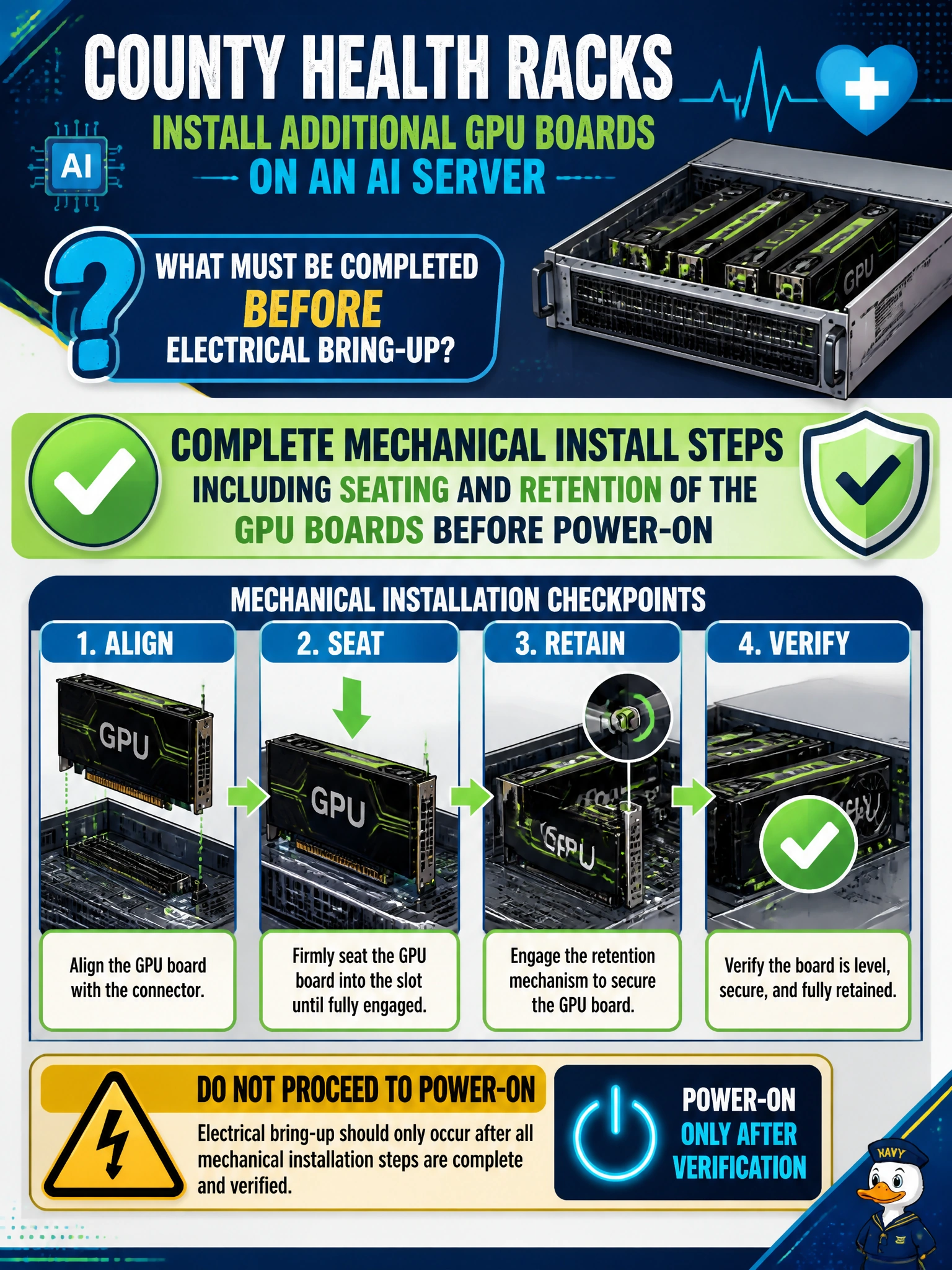
County health racks install additional GPU boards on an AI server. What must be completed before electrical bring-up?
Select an answer to reveal the explanation.
Short Explanation
Mechanical first, electricity second—like locking a vaccine fridge door before you plug the compressor back in. Seat and retain those county GPU boards before power-on.
Full Explanation
Before electrical bring-up when county health racks install additional GPU boards on an AI server, mechanical install steps including seating and retention of the GPU boards must be completed first. Boards that are loose, partially inserted, or unretained are not ready for power: energizing early risks incomplete contacts, arcing, or boards shifting under fan vibration. Mechanical-complete-then-power is the ordered bring-up rule that keeps added capacity from becoming a first-power incident.
Powering the chassis immediately to watch LEDs while boards are still loose inverts the sequence and uses live indicators as a substitute for mechanical finish. Leaving covers off permanently for easier photo documentation may be temporarily useful for inspection but is not a substitute for completing seating/retention before energization, and permanent open covers violate normal service closure. Skipping retention clips if boards appear roughly aligned accepts partial mechanical install and fails under vibration or shipping-like shocks in the rack.
Exam caveat: additional GPU boards require full mechanical seating and retention before electrical bring-up—LED sightseeing on loose boards, permanent open covers, or “roughly aligned” without retention do not qualify. Operational check: seat each added GPU on the county health AI server, engage all retention, close or secure covers per procedure, visually confirm engagement, and only then apply power and run post-install hardware checks.