
A city field technician seats a replacement GPU in a municipal HGX server during bring-up. Which physical install practice is required?
Select an answer to reveal the explanation.
Short Explanation
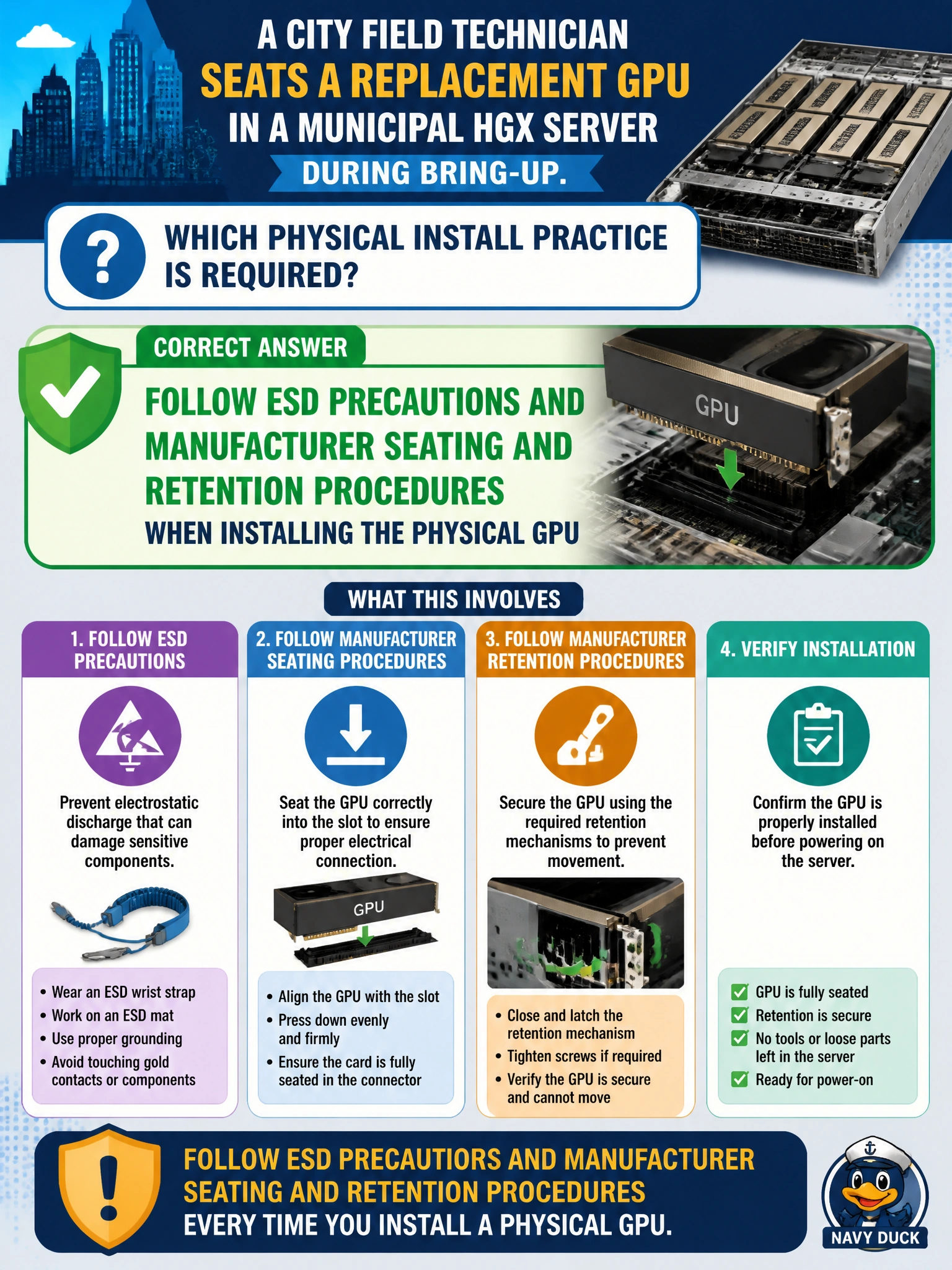
Seating a city GPU is careful shop work—ESD strap on, align, seat, retain—not a powered angled shove. Carpet myths do not replace grounding discipline.
Full Explanation
When a city field technician seats a replacement GPU in a municipal HGX server during bring-up, the required physical install practice is to follow ESD precautions and manufacturer seating and retention procedures. GPUs are ESD-sensitive, high-value boards that must align to the connector, seat fully, and lock with the designed retention hardware while the platform is in a safe service state. Those procedures protect both the accelerator and the HGX baseboard and are non-negotiable in municipal maintenance windows.
Forcing the board in at an angle while the chassis is fully powered risks bent connectors, live shorts, and personal hazard. Skipping ESD controls because municipal carpet is considered grounding is a myth: carpet is not an ESD workstation, and uncontrolled discharge can latent-damage GPUs. Leaving retention mechanisms open so airflow “feels stronger” leaves the board mechanically insecure and can worsen vibration or disconnect risk rather than improve cooling design.
Exam caveat: physical GPU install requires ESD discipline plus manufacturer seating and retention—powered angled force, carpet “grounding,” and open retention are all failures. Operational check: power down or follow hot-swap rules only if the platform explicitly allows them, wear ESD protection, align and seat the city HGX GPU per the service guide, engage retention, inspect for full seating, then proceed to power and SMI verification.