
A courts OCR cluster designs short-reach GPU links versus longer runs in the same municipal row. When do different cable or transceiver classes apply?
Select an answer to reveal the explanation.
Short Explanation
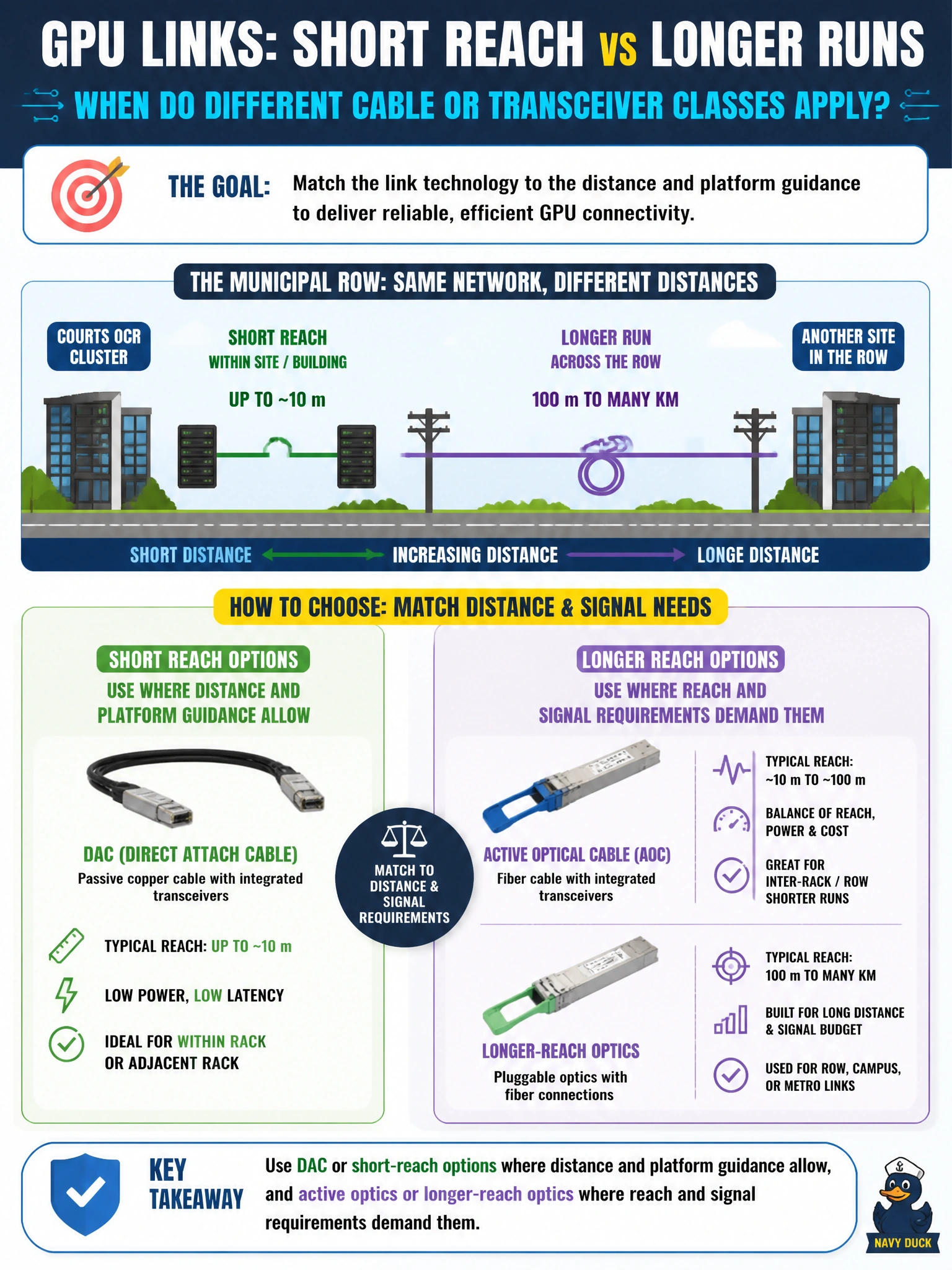
Short hop versus long haul is why DAC and active optics both exist—like walking across the clerk’s office versus sending a courier across the courthouse campus. Match media class to reach and the platform guide, not vibes.
Full Explanation
In a courts OCR cluster that mixes short-reach GPU links with longer runs in the same municipal row, different cable or transceiver classes apply when distance and platform guidance say so: use DAC or short-reach options where distance and guidance allow, and active optics or longer-reach optics where reach and signal requirements demand them. Reach, power class, and platform qualification—not convenience—decide whether a one-meter DAC or a longer optical path is correct. Matching class to distance keeps OCR GPU links inside signaling and support rules across the row.
Always forcing active optics on every one-meter intra-chassis jumper regardless of platform guidance overspends and can violate preferred short-reach practice where DAC is specified. Using only DAC across the entire building to avoid reading reach charts ignores length limits and will fail longer paths. Treating fiber and DAC as interchangeable without checking distance or power class erases the engineering distinction the question is testing.
Exam caveat: DAC/short-reach versus active/longer-reach optics is a distance-and-guidance decision—blanket optics, building-wide DAC-only, or unexamined interchangeability are wrong. Operational check: for each courts OCR GPU link, measure or plan the path length, select DAC or optics per platform reach tables, confirm power class and SKU qualification, install accordingly, and validate link speed before accepting the municipal row cabling.