
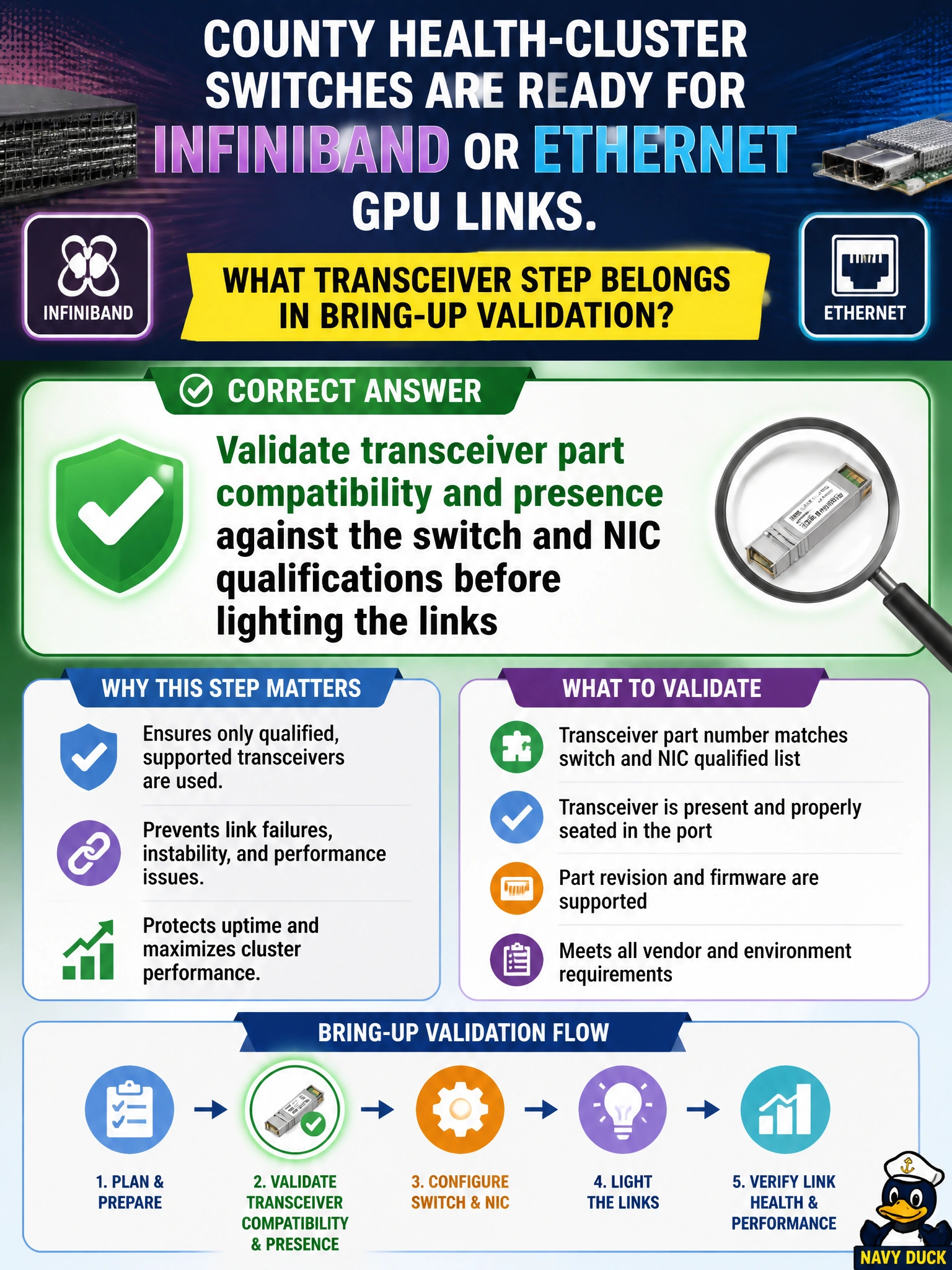
County health-cluster switches are ready for InfiniBand or Ethernet GPU links. What transceiver step belongs in bring-up validation?
Select an answer to reveal the explanation.
Short Explanation
Optics have to be on the guest list—check part compatibility and that the right modules are seated before you light county health fabric links. Whatever fits in the cage is not the same as qualified.
Full Explanation
When county health-cluster switches are ready for InfiniBand or Ethernet GPU links, bring-up validation must include validating transceiver part compatibility and presence against switch and NIC qualifications before lighting the links. Optics and DACs are not universal: switches and NICs publish qualified part lists, and seating an unqualified module invites intermittent links, wrong speeds, or hard failures under collective traffic. Checking compatibility and that the right modules are actually present is the civic bring-up control that precedes “links are green.”
Inserting any SFP that physically fits and ignoring compatibility lists confuses mechanical fit with electrical/optical qualification. Leaving cages empty and relying on Wi-Fi for all-reduce abandons the GPU fabric for an unsuitable wireless path. Validating only after six months of flapping production jobs postpones the compatibility gate until clinical cluster reliability has already suffered.
Exam caveat: transceiver validation for GPU fabrics is pre-light compatibility and presence against switch/NIC quals—not “fits in the cage,” Wi-Fi substitution, or post-incident discovery. Operational check: before enabling county health GPU links, verify each cage has the qualified part, cross-check SKUs to the switch and NIC lists, seat modules firmly, bring links up, and confirm negotiated speed/health before releasing fabric to jobs.