
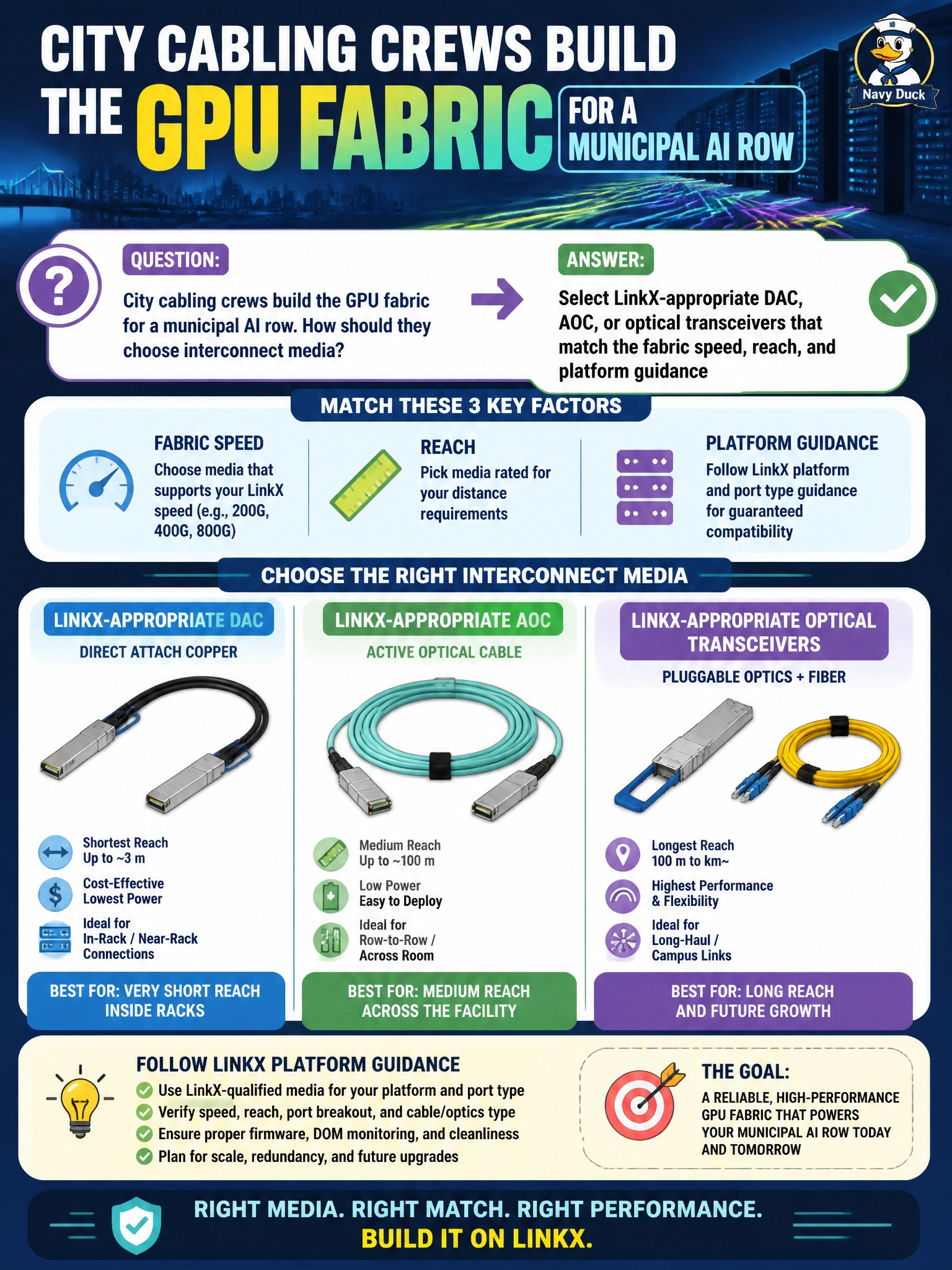
City cabling crews build the GPU fabric for a municipal AI row. How should they choose interconnect media?
Select an answer to reveal the explanation.
Short Explanation
GPU fabric media is not phone-closet leftovers—pick LinkX-appropriate DAC, AOC, or optics that match speed and reach for the city’s AI row. Rainbow incompatible parts are not a strategy.
Full Explanation
City cabling crews building the GPU fabric for a municipal AI row must select LinkX-appropriate DAC, AOC, or optical transceivers that match the fabric speed, reach, and platform guidance. GPU fabrics are sensitive to media class, length, and qualification lists; choosing the right DAC, active optical, or transceiver combination keeps signaling margins and interoperability inside NVIDIA/platform guidance for the city’s row. Media selection is therefore an engineering decision tied to speed and distance, not a scavenger hunt through leftover IT copper.
Reusing random Cat5 patch cords from the desk phone closet for GPU fabric ports puts low-speed office cabling on high-speed accelerator links and will not meet fabric requirements. Selecting the longest copper available regardless of reach and signal class ignores attenuation and qualification limits. Mixing incompatible optics so every pull-tab color appears prioritizes aesthetics over interoperability and commonly produces flaky or non-qualifying links.
Exam caveat: municipal GPU fabric media must be LinkX-appropriate DAC/AOC/optics matched to speed, reach, and platform guidance—phone-closet Cat5, arbitrary long copper, or mixed incompatible optics fail the design. Operational check: for each city AI-row link, pick media from the qualified list for the port speed and measured distance, verify part numbers against switch/NIC guidance, install and validate link-up with expected speed, and reject non-qualified substitutes.