
Transit authority hardware validation on a multi-rail GPU node finds a missing NIC. What should operators do?
Select an answer to reveal the explanation.
Short Explanation
A multi-rail node missing a NIC is like a train missing a coupler—do not green-light it because the GPUs still wave hello. Fail the hardware check and fix the adapter before acceptance.
Full Explanation
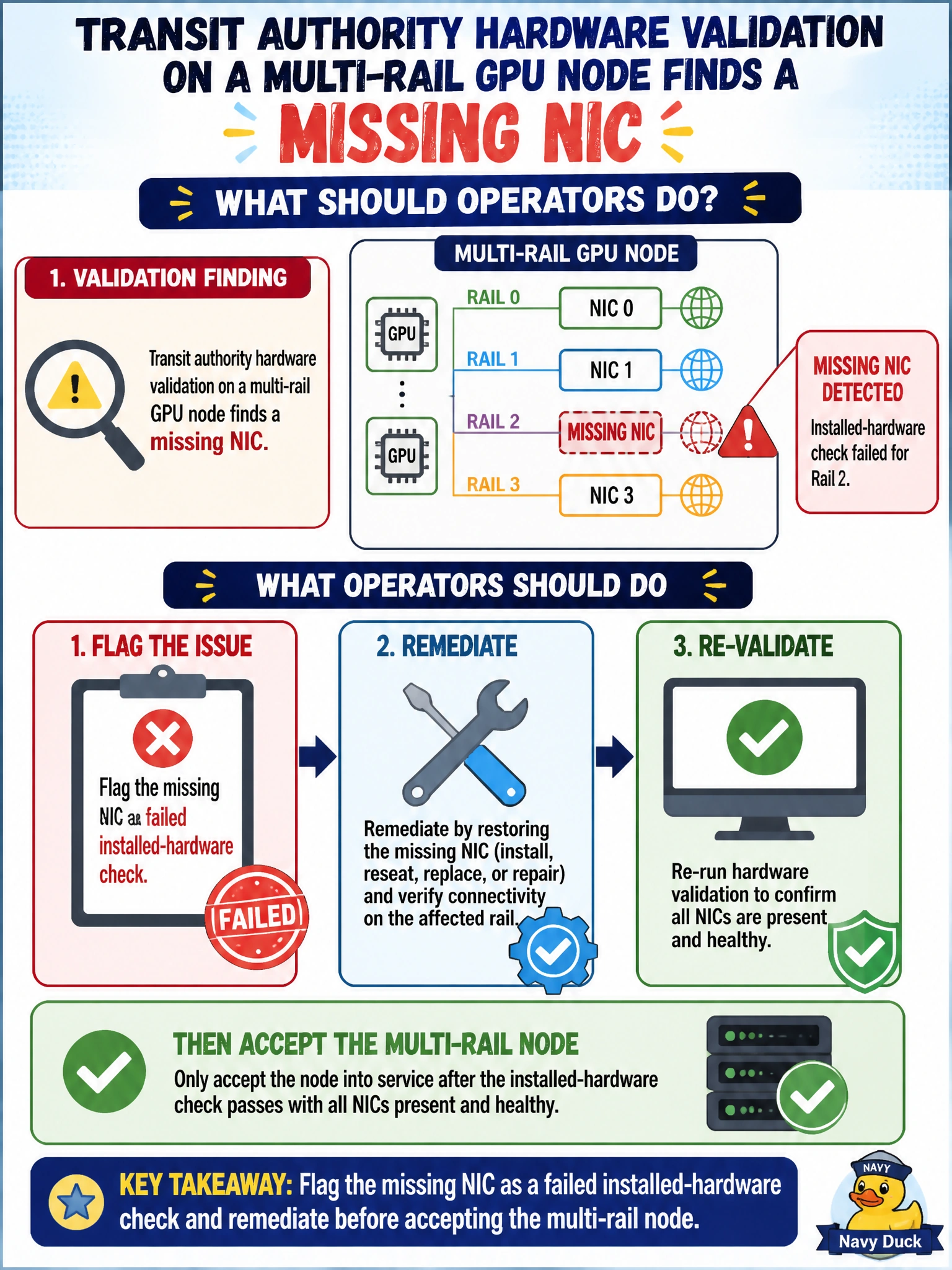
When transit-authority hardware validation on a multi-rail GPU node finds a missing NIC, operators should flag the missing NIC as a failed installed-hardware check and remediate before accepting the multi-rail node. Multi-rail designs assume each rail’s NIC is present so east-west or rail-isolated paths can scale as planned. A node that still enumerates GPUs but lacks a fabric NIC is incomplete hardware: collectives and rail mapping will not match the municipal AI factory design. Failed-check-and-remediate is the correct acceptance posture.
Ignoring the NIC and hoping east-west fabric training still scales leaves a known missing path in production topology. Bonding unrelated USB Ethernet dongles as a permanent fabric plan substitutes consumer adapters for qualified high-speed NICs and does not restore rail design. Marking the node production-ready because GPUs still enumerate treats GPU visibility as sufficient while ignoring fabric completeness required for multi-rail operation.
Exam caveat: missing NICs on multi-rail GPU nodes fail installed-hardware validation even when GPUs enumerate—do not accept on GPU-only optimism or USB workarounds. Operational check: inventory NICs against the transit multi-rail BOM, flag missing ports/adapters as failed checks, install or reseat qualified NICs, re-run discovery and link checks, and accept the node only when all rails’ NICs are present and healthy.