
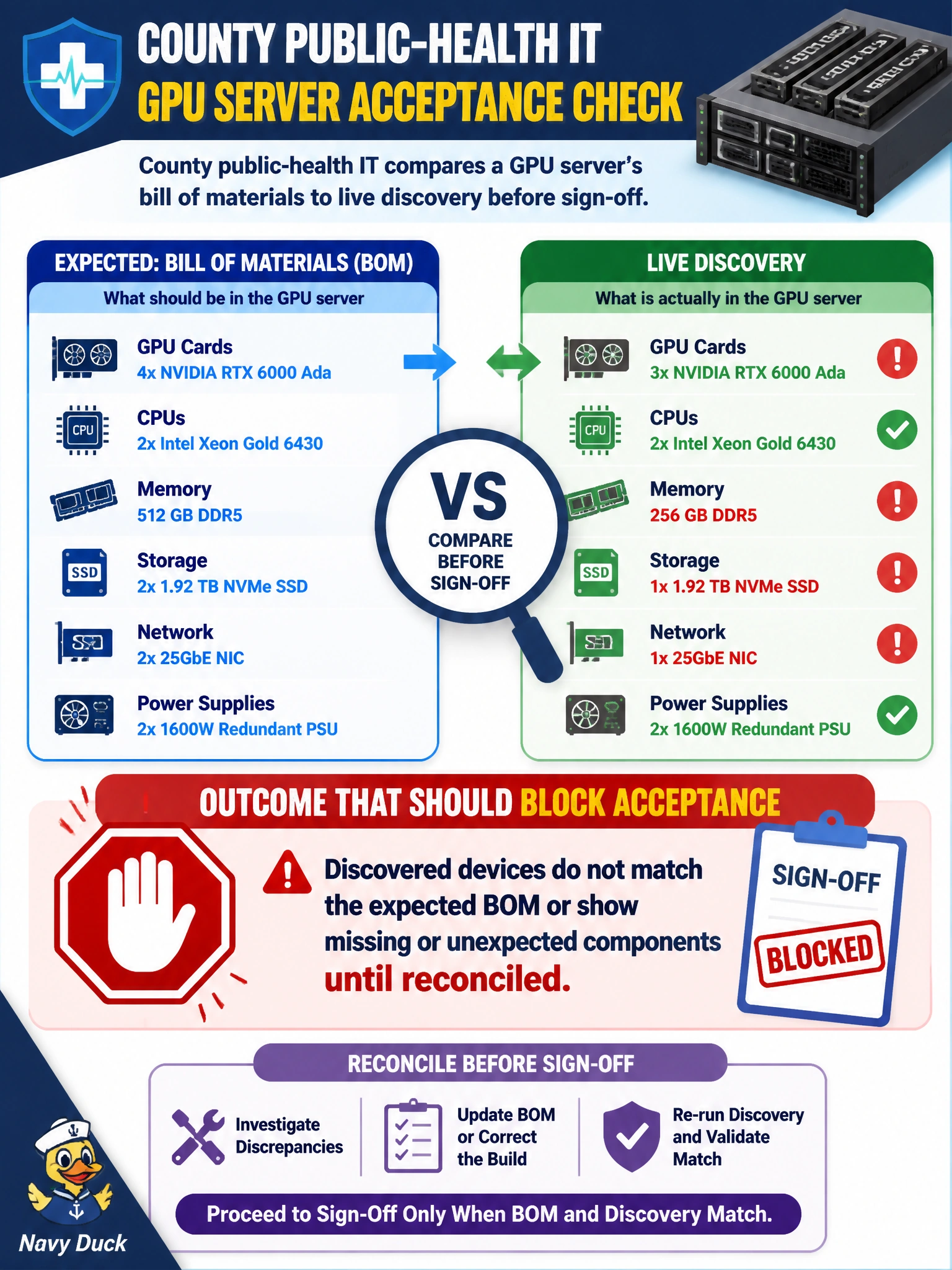
County public-health IT compares a GPU server’s bill of materials to live discovery before sign-off. What outcome should block acceptance?
Select an answer to reveal the explanation.
Short Explanation
BOM versus discovery is the public-health packing slip check—if live devices do not match, stop the sign-off and reconcile. Pretty logos on the PDF do not invent missing NICs or GPUs.
Full Explanation
County public-health IT comparing a GPU server’s bill of materials to live discovery before sign-off must block acceptance when discovered devices do not match the expected BOM or show missing or unexpected components until reconciled. BOM-versus-discovery is the packing-slip check for accelerators and peer devices: mismatches mean the live machine is not the machine purchasing and architecture approved. Holding sign-off until reconciliation protects clinical and epidemiology workloads from silent omissions or surprise parts.
Discovered devices matching the BOM with no degraded components is a success condition, not a blocker—so treating that healthy match as a failure would invert the gate. Colorful logos on the BOM PDF are document styling, not hardware evidence. SSH banners that include the word “healthy” are cosmetic strings and do not prove BOM alignment.
Exam caveat: acceptance blocks on BOM/discovery mismatch or missing/unexpected components until reconciled—not on healthy matches, PDF art, or SSH banner text. Operational check: export live discovery, diff against the approved BOM for the public-health GPU server, open a reconciliation ticket for any delta, and withhold sign-off until inventory matches or an approved change record updates the BOM.