
City AI-factory operators finish racking a municipal row and must prove hardware completeness. Which installed-hardware validation fits day-0?
Select an answer to reveal the explanation.
Short Explanation
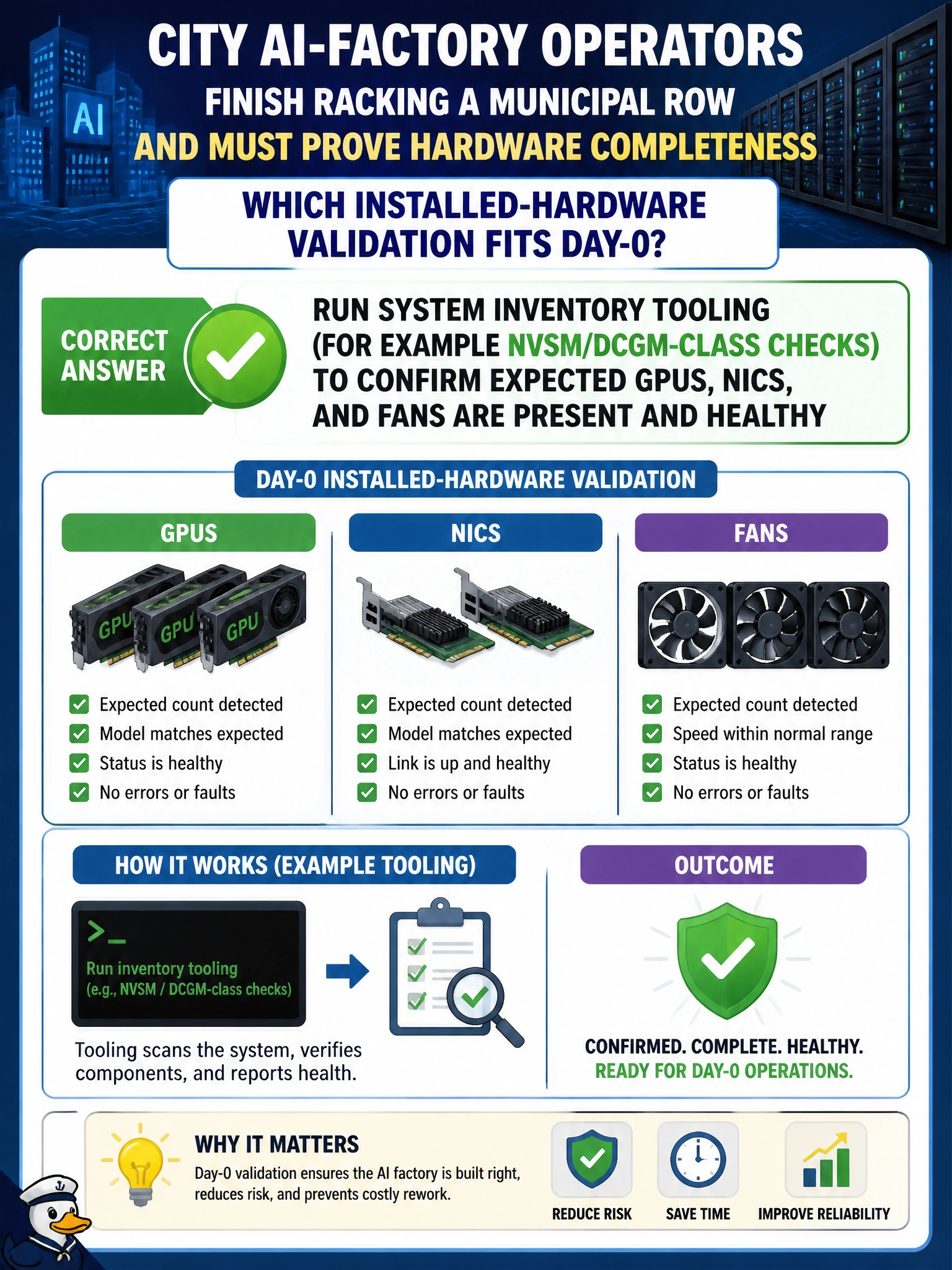
Day-0 inventory is a roll call for GPUs, NICs, and fans—tooling like NVSM or DCGM-class checks does the calling so the city row is not missing a player. Cardboard packing lists are not discovery.
Full Explanation
After city AI-factory operators finish racking a municipal row, day-0 installed-hardware validation should run system inventory tooling (for example NVSM/DCGM-class checks) to confirm expected GPUs, NICs, and fans are present and healthy. Completeness is not proven by a single blinking LED; inventory tooling enumerates the devices the row design assumes and surfaces missing or unhealthy components before workloads arrive. That gate is how operators prove the municipal row matches the hardware plan rather than hoping Slurm will complain later.
Approving the row if only one GPU LED blinks occasionally accepts incomplete discovery and ignores NICs, fans, and remaining GPUs. Relying solely on the cardboard packing checklist without discovery trusts paper logistics over live inventory. Skipping inventory because Slurm will error loudly enough later pushes detection into production scheduling noise instead of day-0 validation.
Exam caveat: day-0 hardware completeness for AI rows means inventory tooling confirming GPUs, NICs, and fans—not LED folklore, packing lists alone, or deferred scheduler failures. Operational check: run NVSM/DCGM-class (or equivalent) inventory on the city municipal row, compare discovered GPUs/NICs/fans to the design BOM, remediate missing or unhealthy devices, and only then clear day-0 hardware completeness.