
County public-health operators must accept new inference hosts into the queue. Which SMI inventory check is an appropriate install gate?
Select an answer to reveal the explanation.
Short Explanation
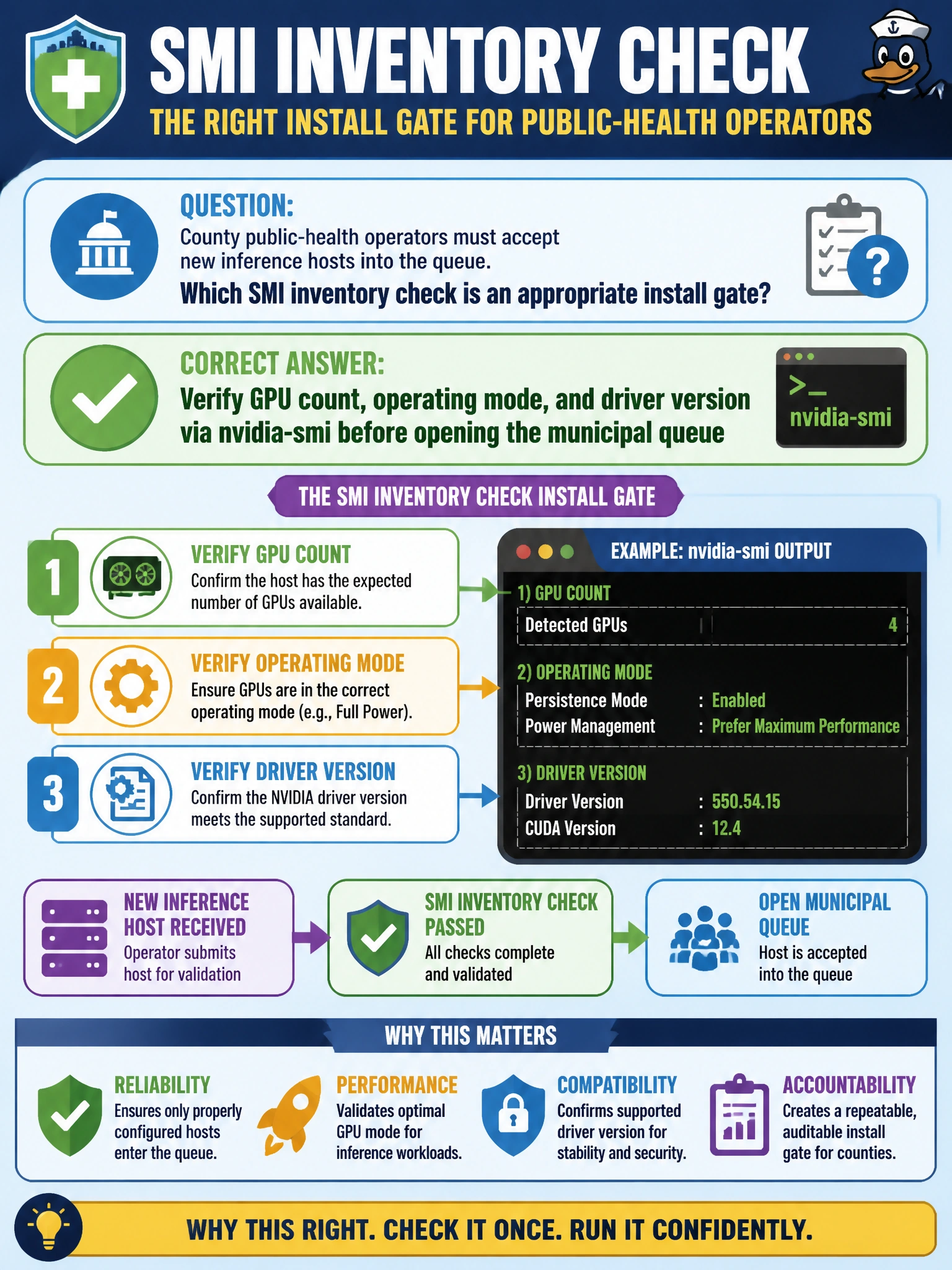
Before public-health jobs land, SMI should read like a clean intake form: right GPU count, sensible mode, and a known driver version. SSH alone with empty SMI is not acceptance—it is a blindfold.
Full Explanation
County public-health operators accepting new inference hosts into the municipal queue should use an SMI inventory gate that verifies GPU count, operating mode, and driver version via nvidia-smi before the queue opens. Public-health inference depends on predictable accelerator inventory and known driver/mode state; confirming those fields before scheduling prevents PHI-adjacent jobs from landing on hosts that look networked but have empty, wrong, or unstandardized GPUs. That gate is an install acceptance control, not an optional curiosity.
Disabling SMI logging so PHI auditors see fewer files removes operational evidence without improving privacy posture and can hide inventory failures. Accepting hosts if SSH works even when SMI lists zero devices confuses remote shell access with accelerator readiness. Randomizing MIG profiles without recording driver versions breaks reproducibility and leaves public-health operators unable to explain which GPU partition and driver combination an inference host actually runs.
Exam caveat: municipal queue acceptance for inference hosts requires nvidia-smi confirmation of count, mode, and driver—SSH success or quieter logs are not inventory proof. Operational check: before opening the county public-health queue, run nvidia-smi on each new host, record GPU count, compute/persistence (or related) mode, and driver version against standard, and keep hosts closed to jobs until those fields match policy.