
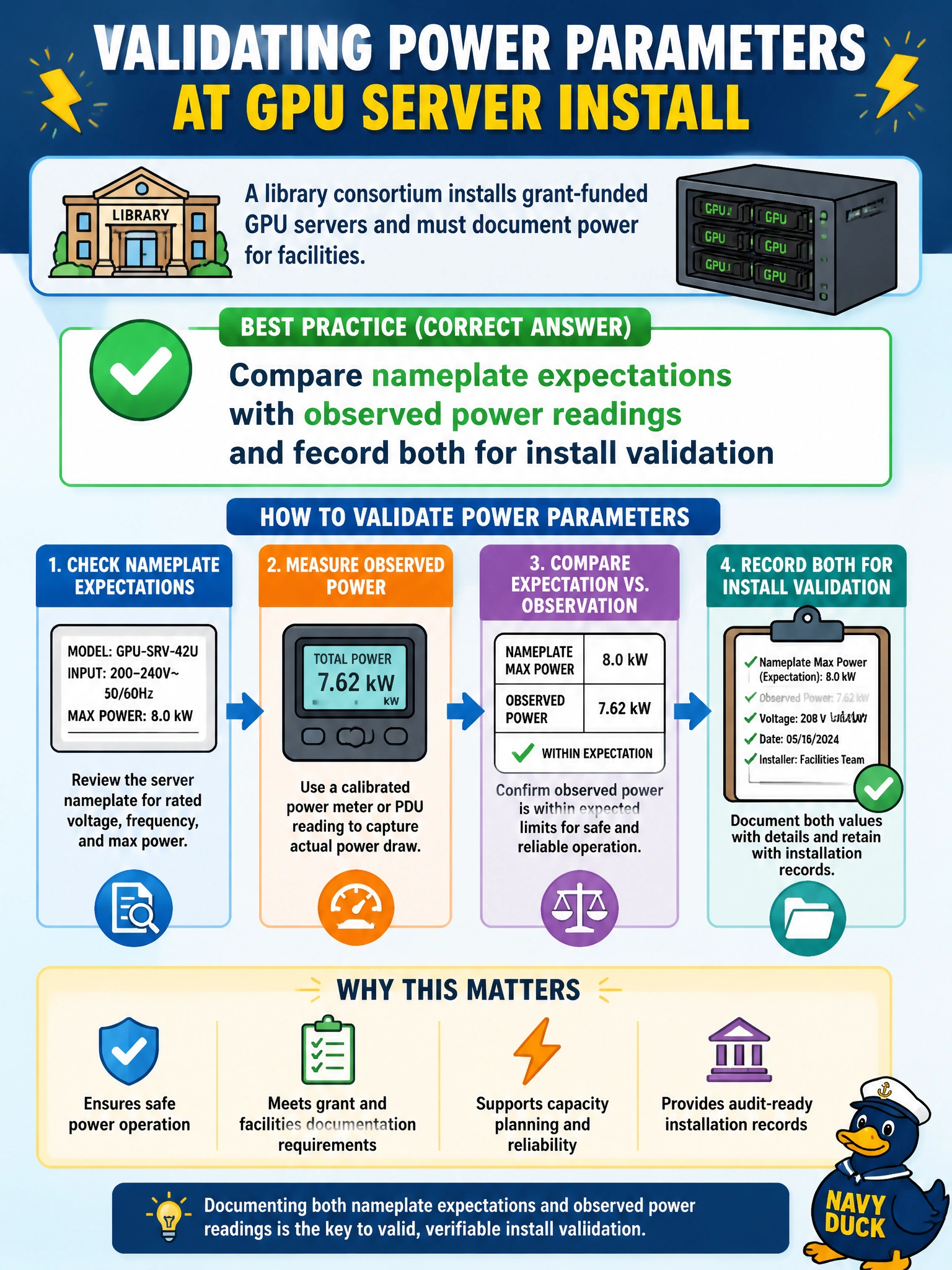
A library consortium installs grant-funded GPU servers and must document power for facilities. Which practice validates power parameters at install?
Select an answer to reveal the explanation.
Short Explanation
Nameplate is the plan; the meter is the truth—like checking what the reading-room HVAC actually draws versus the sticker. Capture both for the library’s GPU install so facilities and auditors share the same power story.
Full Explanation
A library consortium installing grant-funded GPU servers must document power for facilities by comparing nameplate expectations with observed power readings and recording both for install validation. Nameplate values set the planning envelope; meters and PDU readings show what the rack actually draws under idle and load. Capturing both creates an auditable trail for facilities and grant stakeholders and catches surprises when brochure watts diverge from real GPU behavior in the consortium’s room.
Recording only marketing brochure watts and never measuring the rack leaves facilities with fiction instead of validation. Treating UPS LED color as sufficient proof of per-node draw confuses a coarse health indicator with quantified power parameters. Assuming grant auditors only care about GPU serial stickers ignores the facilities documentation the install is supposed to produce and skips the comparison that proves the installation matches power plans.
Exam caveat: install power validation for civic GPU servers requires both nameplate expectations and observed readings—marketing claims or LED colors alone are not proof. Operational check: log nameplate or design watts per node/rack, take PDU or meter readings at install under defined states, record both in the facilities package, and escalate if observed draw exceeds planned headroom before the library consortium marks the GPU servers accepted.