
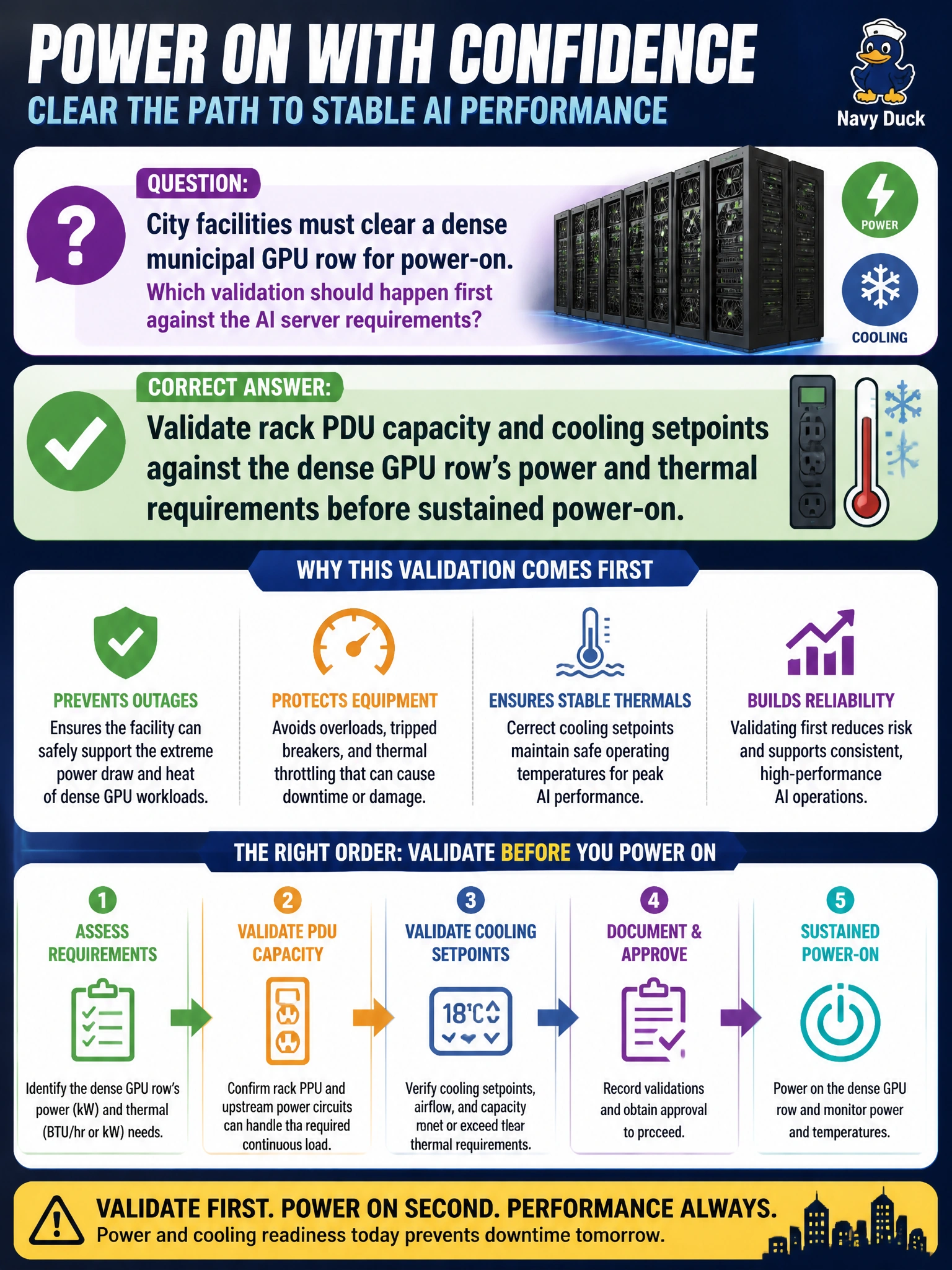
City facilities must clear a dense municipal GPU row for power-on. Which validation should happen first against the AI server requirements?
Select an answer to reveal the explanation.
Short Explanation
Dense GPU rows draw heavy power and release substantial heat, so you need to check PDU capacity and cooling setpoints against the servers’ actual requirements before sustained power-on. Cable-color preferences cannot confirm electrical or thermal headroom.
Full Explanation
Before sustained power-on of a dense municipal GPU row, validate rack PDU capacity and cooling setpoints against the AI servers’ power and thermal requirements. Nameplate and measured loads for HGX-class gear can exhaust circuits and overwhelm cooling if you assume that a successful initial startup proves the rack can support full operating load. Aesthetic cable-color preferences without load measurement provide no evidence of electrical or thermal headroom. Installer media draws far less than training or inference at steady state, so its successful boot does not make server nameplate power irrelevant or confirm capacity for full operation. Powering every chassis to 100% training load before reading PDU ratings reverses the necessary validation sequence and risks tripping breakers or overheating the row during first energization. Exam caveat: temporary low-power discovery boots may be used carefully, but acceptance of a dense GPU row still requires validating PDU capacity and cooling against full AI-load assumptions before sustained power-on. Practical check: total the expected GPU-row draw, include redundancy margin, compare it with PDU and circuit ratings, confirm CRAC/CRAH or CDU setpoints for the heat load, document the results, and authorize sustained power-on only after those checks pass.