
A courts OCR cluster re-runs health checks after firmware upgrades. What problem does that practice catch?
Select an answer to reveal the explanation.
Short Explanation
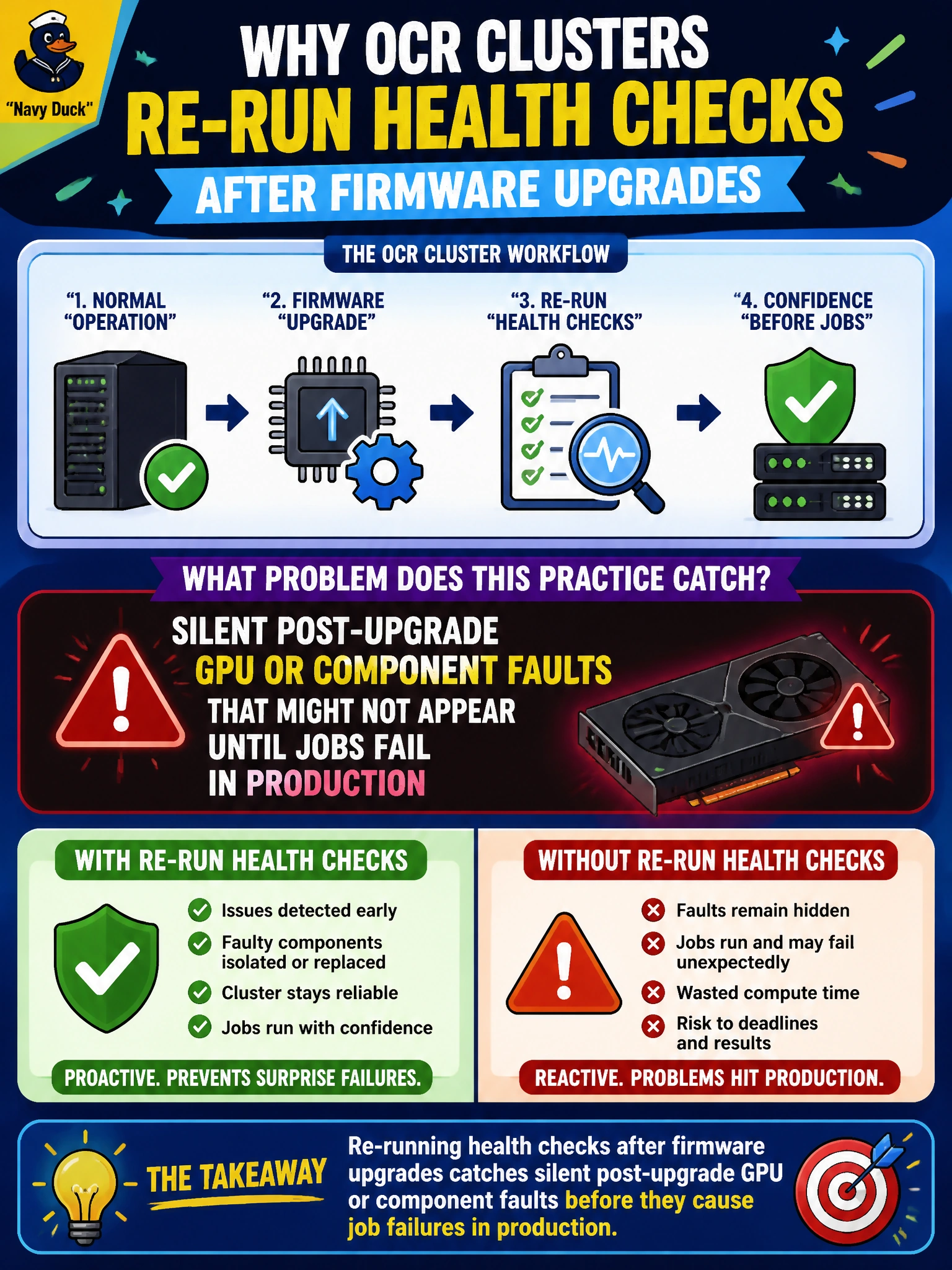
Some firmware faults are quiet until a clerk’s OCR job falls over mid-batch. Re-running health checks after the flash is how the courts cluster catches those silent GPU problems before production leans on them.
Full Explanation
Courts OCR clusters re-run health checks after firmware upgrades to catch silent post-upgrade GPU or component faults that might not surface until production jobs fail mid-batch. Firmware can leave devices enumerated yet unhealthy, shift ECC or Xid rates, or break companions that only vendor health tools and targeted stress probes reveal before clerks depend on OCR throughput. Catching those faults while the node is still drained prevents a bad tray from poisoning a multi-GPU OCR batch that already consumed filing deadlines. Health re-checks are not for catching typos in a municipal press release about the upgrade window—that is communications QA, not platform validation. They also do not verify city email SPF records or library Wi-Fi password rotation; those controls live outside the GPU firmware acceptance path. Exam caveat: passing hardware health checks does not replace application-level OCR smoke tests on representative filings, but skipping post-firmware health is how silent faults reach the clerk-facing queue. Operational check: after firmware on the courts OCR rack, run the vendor fault bundle and nvidia-smi/ECC summaries, compare to pre-upgrade baselines, keep nodes drained until anomalies clear, and attach the health artifacts to the change record.