
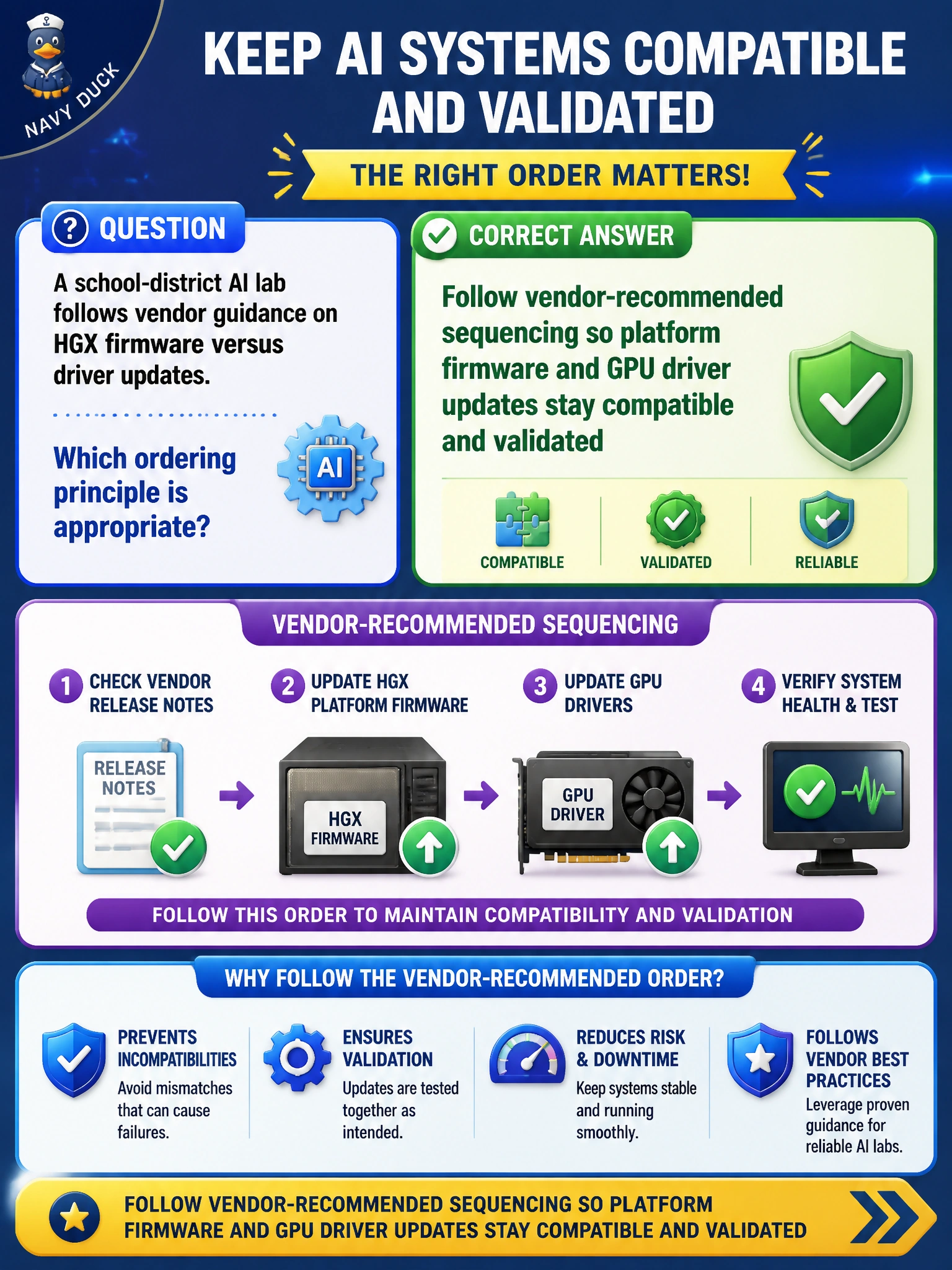
A school-district AI lab follows vendor guidance on HGX firmware versus driver updates. Which ordering principle is appropriate?
Select an answer to reveal the explanation.
Short Explanation
Firmware and drivers are dance partners—if one steps on the wrong beat, the school lab GPUs trip. Stick to the vendor’s recommended order so the platform firmware and driver train stay a matched pair.
Full Explanation
School-district AI labs should follow vendor-recommended sequencing so platform firmware and GPU driver updates remain on a compatible, validated combination. Vendors publish dependency order because firmware exposes devices and interfaces that drivers expect; reversing or randomizing that order produces load failures, missing GPUs, or unstable resets. Always installing the newest community GPU driver before any platform firmware exists risks pairing an unsupported driver with outdated or missing firmware features. Applying drivers and firmware in any random order with no dependency checks treats compatibility as optional and is a common lab self-inflicted outage pattern. Updating only drivers while declaring HGX firmware immutable after the factory ignores security fixes and performance/stability trains vendors expect operators to apply. Exam caveat: “follow vendor sequencing” is not the same as “always newest on day zero”—use the approved matrix and order, including any required intermediate steps. Operational check: for each school-lab maintenance window, pull the vendor sequence for the installed HGX generation, apply firmware and drivers in that order, then confirm nvidia-smi and a short CUDA/health probe before releasing the lab to classes.