
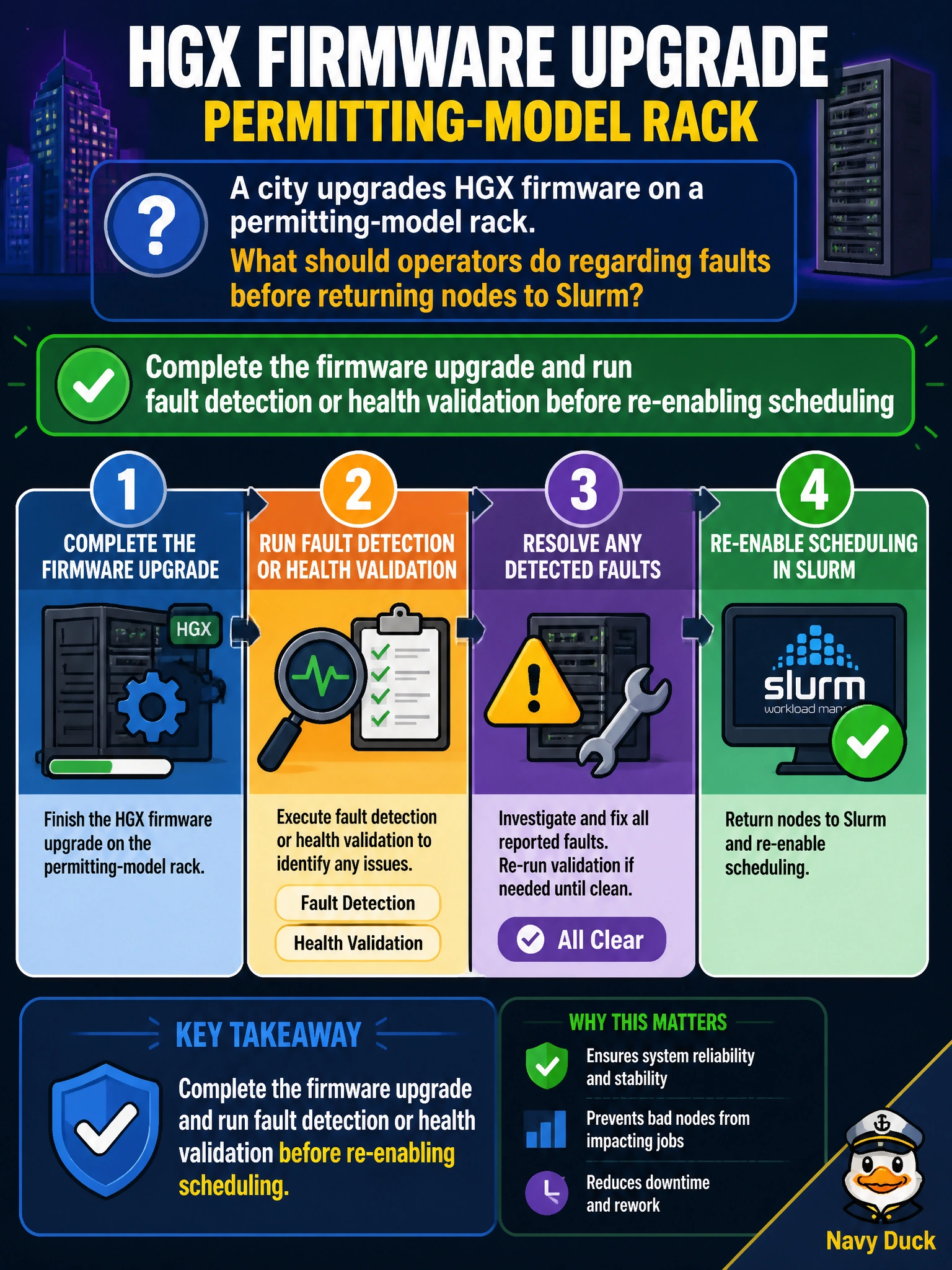
A city upgrades HGX firmware on a permitting-model rack. What should operators do regarding faults before returning nodes to Slurm?
Select an answer to reveal the explanation.
Short Explanation
Flashing HGX firmware without a post-check is like resurfacing a bridge and reopening traffic before anyone walks the deck. Finish the upgrade, look for faults, then and only then let Slurm send permitting jobs back.
Full Explanation
After upgrading HGX firmware on a city permitting-model rack, operators must complete the flash and run fault detection or health validation before re-enabling Slurm scheduling so latent post-flash failures are caught offline. Firmware updates can leave devices in degraded states, trigger new sensor events, or expose incompatible component mixes that only health probes and BMC logs reveal. Returning nodes to Slurm immediately after the flash starts—before verification—lets unfinished or failed updates accept permitting jobs and fail mid-epoch. Disabling all post-flash health checks solely to shorten the window trades a short maintenance delay for longer production incident time. Ignoring BMC event logs because “firmware never fails on HGX” contradicts real failure modes and removes the primary OOB evidence trail. Exam caveat: some upgrades are rolling; the invariant is that each node is validated before it is individually returned to the scheduler, not that the entire city must wait on one chassis forever. Operational check: after firmware reports success, review BMC event logs, run vendor fault/health checks and nvidia-smi inventory, then clear the Slurm drain only for nodes that pass.