
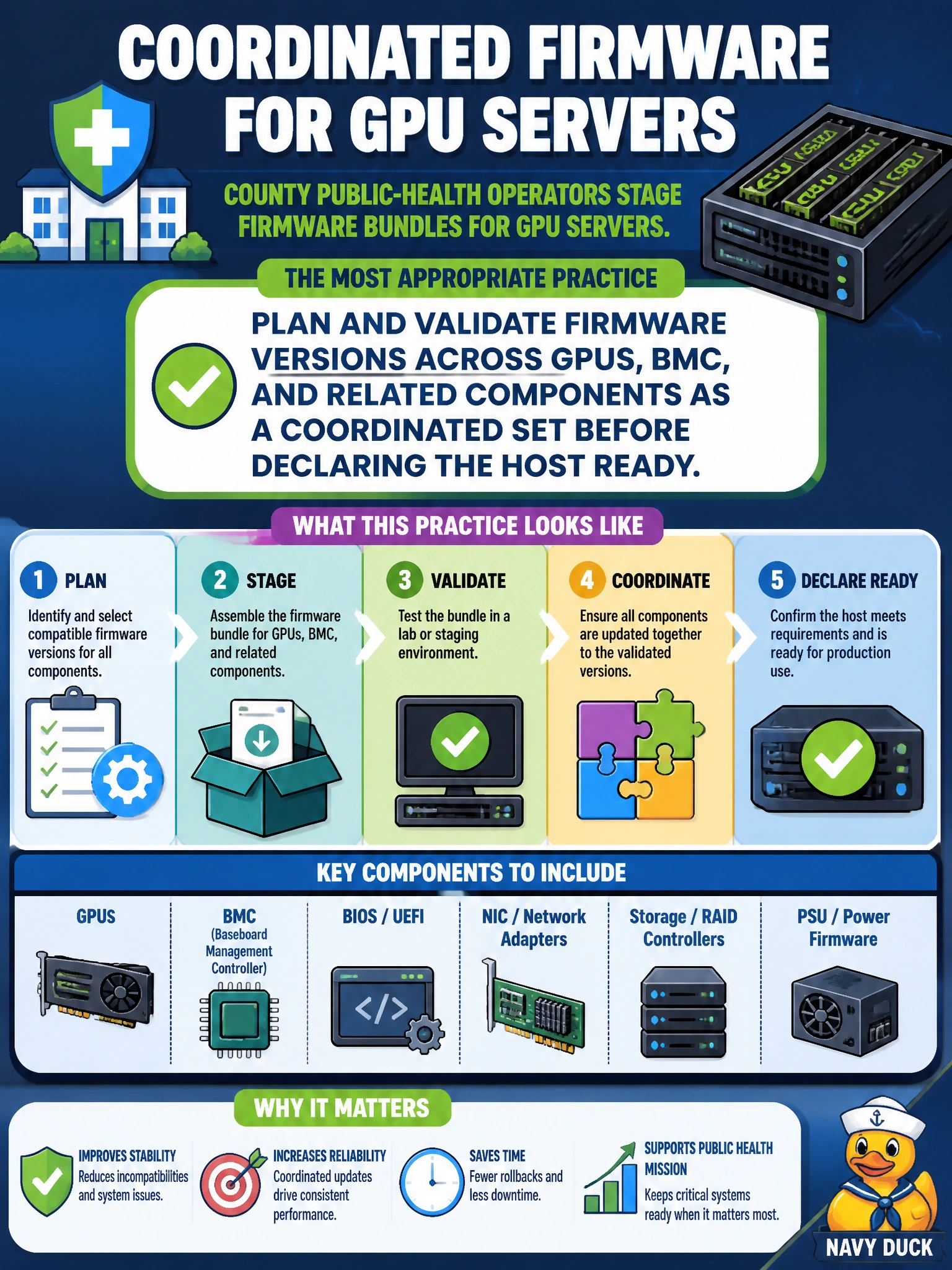
County public-health operators stage firmware bundles for GPU servers. What coordination practice is most appropriate?
Select an answer to reveal the explanation.
Short Explanation
GPU server firmware is a matching set—like keeping ambulance radio, tablet, and vehicle software on compatible trains. Stage and validate GPUs, BMC, and related pieces together so public-health nodes do not end up on a mixed mystery stack.
Full Explanation
County public-health firmware practice treats GPU, BMC, and related component versions as a coordinated set that is planned and validated together before a host is declared ready. Mixed trains across GPUs and BMC are a common source of cryptic failures after partial upgrades; coordination keeps the platform on a vendor-supported combination that support and operations can defend. Upgrading only one random GPU while leaving BMC firmware undocumented forever creates an unsupportable baseline and breaks change accountability. Applying desktop motherboard BIOS recipes that ignore HGX component lists imports the wrong bill of materials into a GPU server context. Letting each researcher flash personal USB images during production inference bypasses change control and risks divergent, untested firmware under live patient-facing or analytics load. Exam caveat: coordination does not mean every chip must jump on the identical calendar second—it means the target version matrix is defined, tested, and verified before readiness. Operational check: publish a county-approved firmware matrix for GPU, BMC, and companions; after staging, collect version inventory from each host and block “ready” status until the matrix matches.