
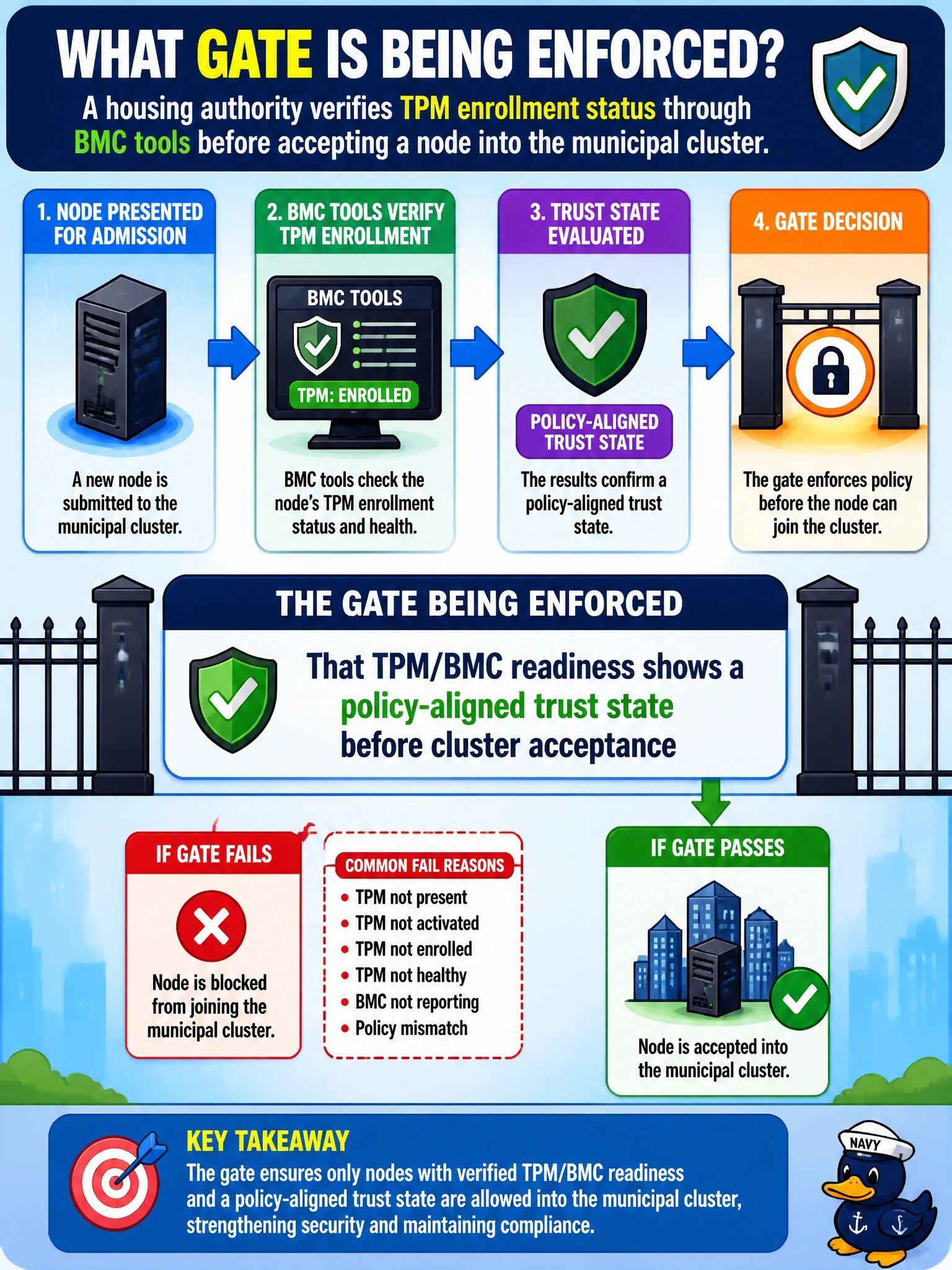
A housing authority verifies TPM enrollment status through BMC tools before accepting a node into the municipal cluster. What gate is being enforced?
Select an answer to reveal the explanation.
Short Explanation
Before the housing cluster stamps a node “accepted,” operators glance at TPM enrollment the way a building inspector checks the foundation tag—via BMC tools, early, before production trust. It is a bring-up readiness gate, not a NeMo burn-in substitute.
Full Explanation
Housing-authority acceptance that verifies TPM enrollment status through BMC tools enforces a policy-aligned trust gate: the node must show an expected TPM/BMC readiness state before it is allowed into the municipal cluster. Checking enrollment via BMC lets operators validate trust posture even before full in-band agent stacks are trusted, binding hardware root-of-trust status to the change ticket. This gate is not proof that a multi-week NeMo production burn-in already finished; burn-in is a separate workload validation track. It also does not require wiping all third-party storage arrays before TPM checks—storage lifecycle and TPM enrollment are different controls. TPM/BMC readiness checks do not demand that nvidia-smi persistence mode be disabled forever; persistence mode is a driver operational setting unrelated to TPM enrollment evidence. Exam caveat: TPM enrollment is necessary for trust acceptance but insufficient alone—firmware, health, and network gates still apply before cluster join. Operational check: in the housing cluster acceptance checklist, pull TPM enrollment/status from BMC tooling, compare to the policy baseline, attach the evidence to the ticket, and only then allow the node into the municipal scheduler pool.