
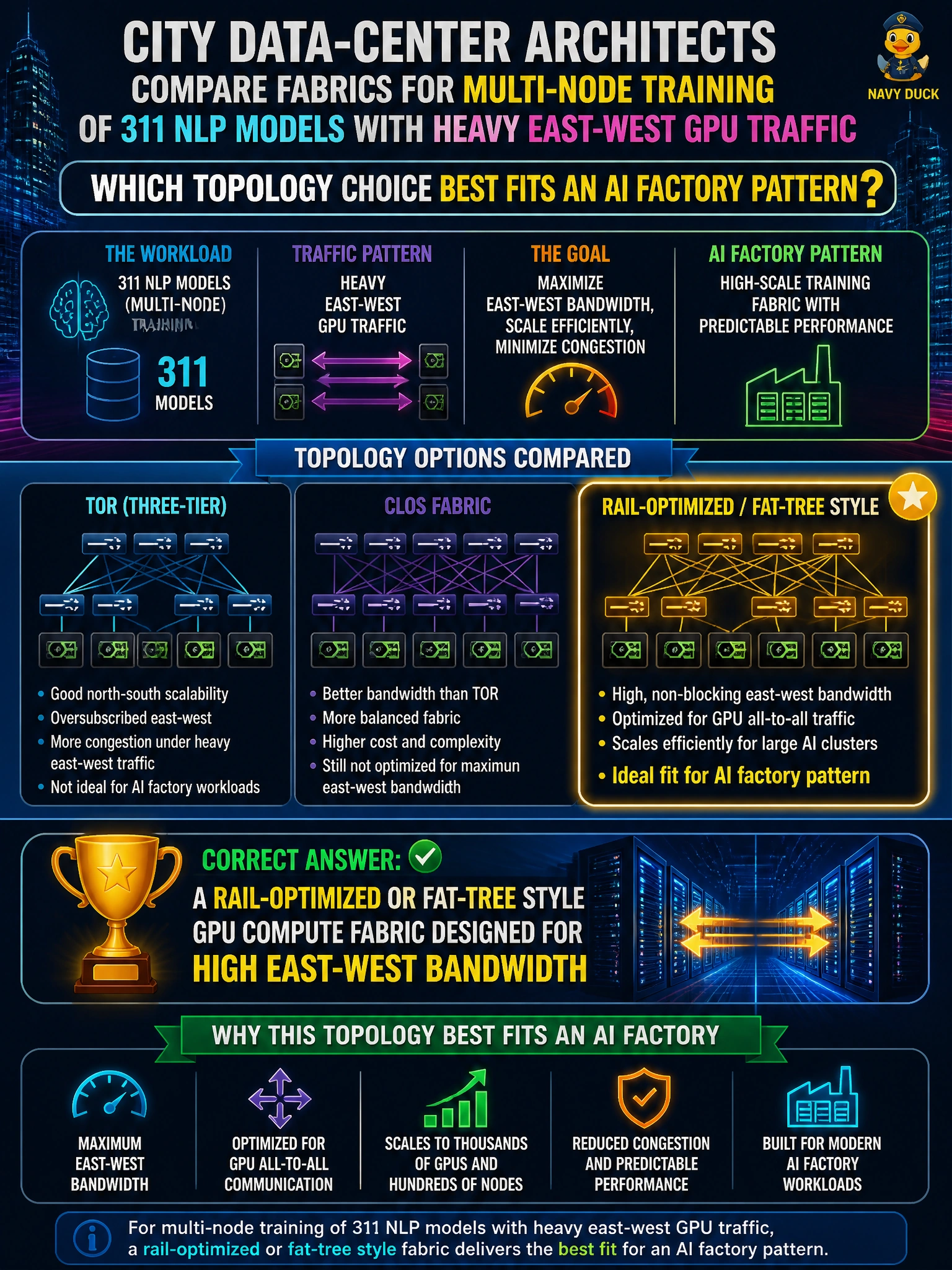
City data-center architects compare fabrics for multi-node training of 311 NLP models with heavy east-west GPU traffic. Which topology choice best fits an AI factory pattern?
Select an answer to reveal the explanation.
Short Explanation
Multi-node training chatters sideways between GPUs like buses weaving across downtown—not like office PCs talking politely north-south through a skinny core. Rail-optimized or fat-tree style fabrics give that east-west room; a desktop VLAN core or Wi-Fi mesh does not.
Full Explanation
Multi-node training of municipal 311 NLP models generates heavy east-west GPU traffic: gradients and activations move sideways across the row far more than classic client-to-server north-south flows. Rail-optimized or fat-tree style GPU compute fabrics are chosen because they provide high bisection bandwidth and predictable paths for collectives such as all-reduce, matching AI factory communication patterns. A single collapsed core shared only with desktop VLAN traffic creates contention and oversubscription that training jobs will hit as soon as node count grows. A hub-and-spoke Wi-Fi mesh between GPU nodes lacks the latency, bandwidth, and reliability required for NCCL-class collectives and is not an AI factory interconnect. A classic three-tier enterprise LAN with no attention to non-blocking GPU paths often oversubscribes aggregation layers that were sized for users and apps, not dense GPU chatter. Exam caveat: Ethernet versus InfiniBand is a separate design choice; the topology principle—east-west capacity without harmful oversubscription—still applies on either media. Operational check: for the city data-center design review, require a fabric diagram and bisection or rail plan that shows non-blocking or intentionally engineered GPU paths before approving multi-node 311 training racks.