
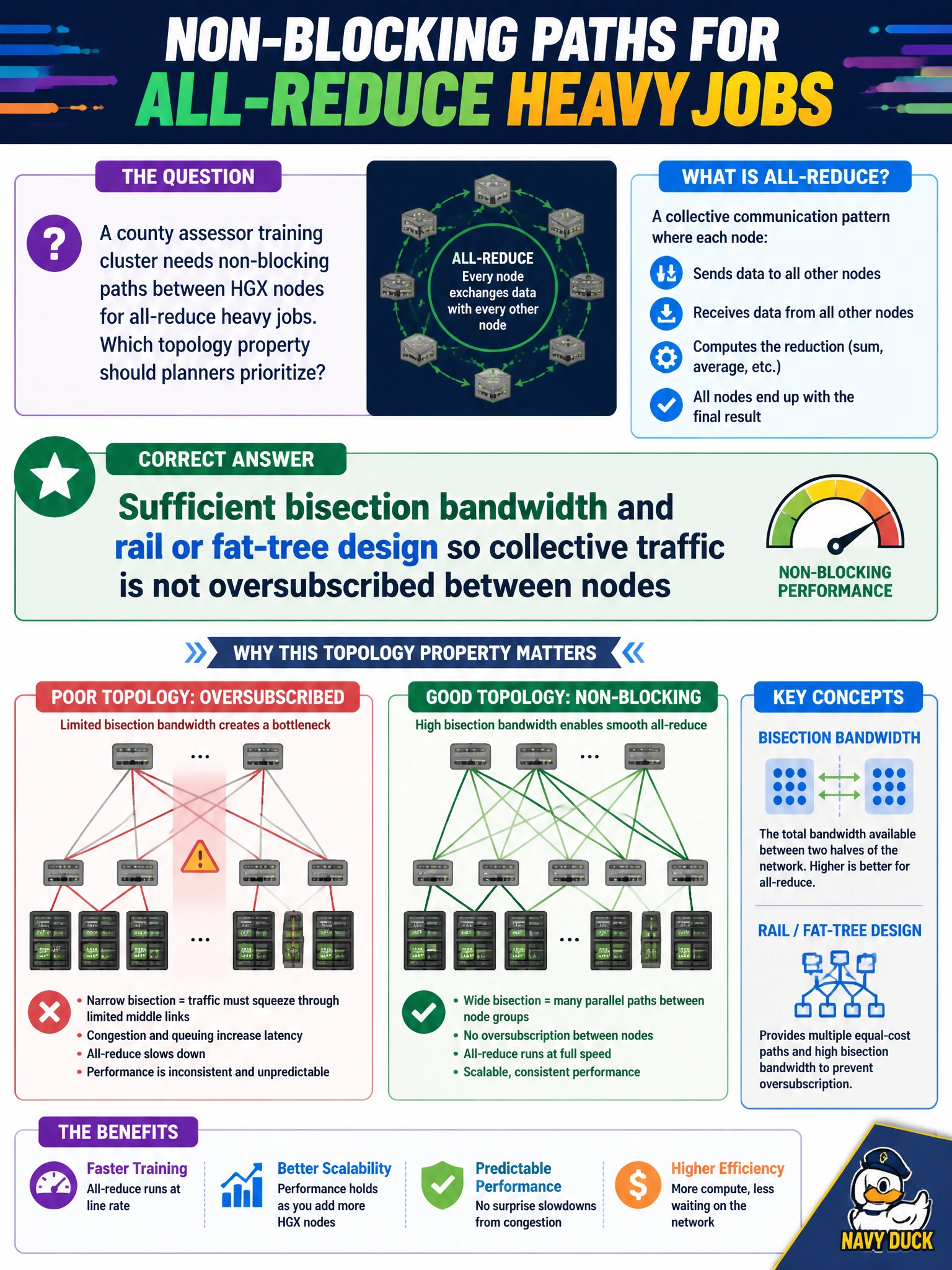
A county assessor training cluster needs non-blocking paths between HGX nodes for all-reduce heavy jobs. Which topology property should planners prioritize?
Select an answer to reveal the explanation.
Short Explanation
All-reduce is a group shout across every GPU—if the fabric pinches in the middle, the whole assessor training job waits. Planners want bisection bandwidth and a rail/fat-tree style layout so those collectives are not oversubscribed.
Full Explanation
All-reduce–heavy jobs on a county assessor training cluster synchronize large tensors across HGX nodes, so planners must prioritize sufficient bisection bandwidth and rail or fat-tree designs that avoid oversubscribing collective paths. When the middle of the fabric pinches, every participating GPU waits, stretching step time and wasting expensive accelerators even if each host looks healthy in isolation. Maximum north-south firewall inspection of every GPU all-reduce packet adds latency and choke points that collectives cannot tolerate as a primary path design; security controls belong on appropriate boundaries, not as a substitute for compute-fabric capacity. A single 1 GbE management uplink used as the only GPU interconnect confuses OOB/management rates with training bandwidth needs by orders of magnitude. NAT hairpinning all NCCL traffic through the municipal DMZ forces east-west flows onto a security edge built for internet exposure, breaking performance and operational isolation. Exam caveat: oversubscription may be acceptable on storage or north-south edges if engineered and measured; the distractor pattern is ignoring bisection for the GPU collective plane itself. Operational check: size and validate bisection or rail capacity against expected all-reduce load, then run a multi-node collective bandwidth test between assessor HGX nodes before production training schedules depend on the fabric.