
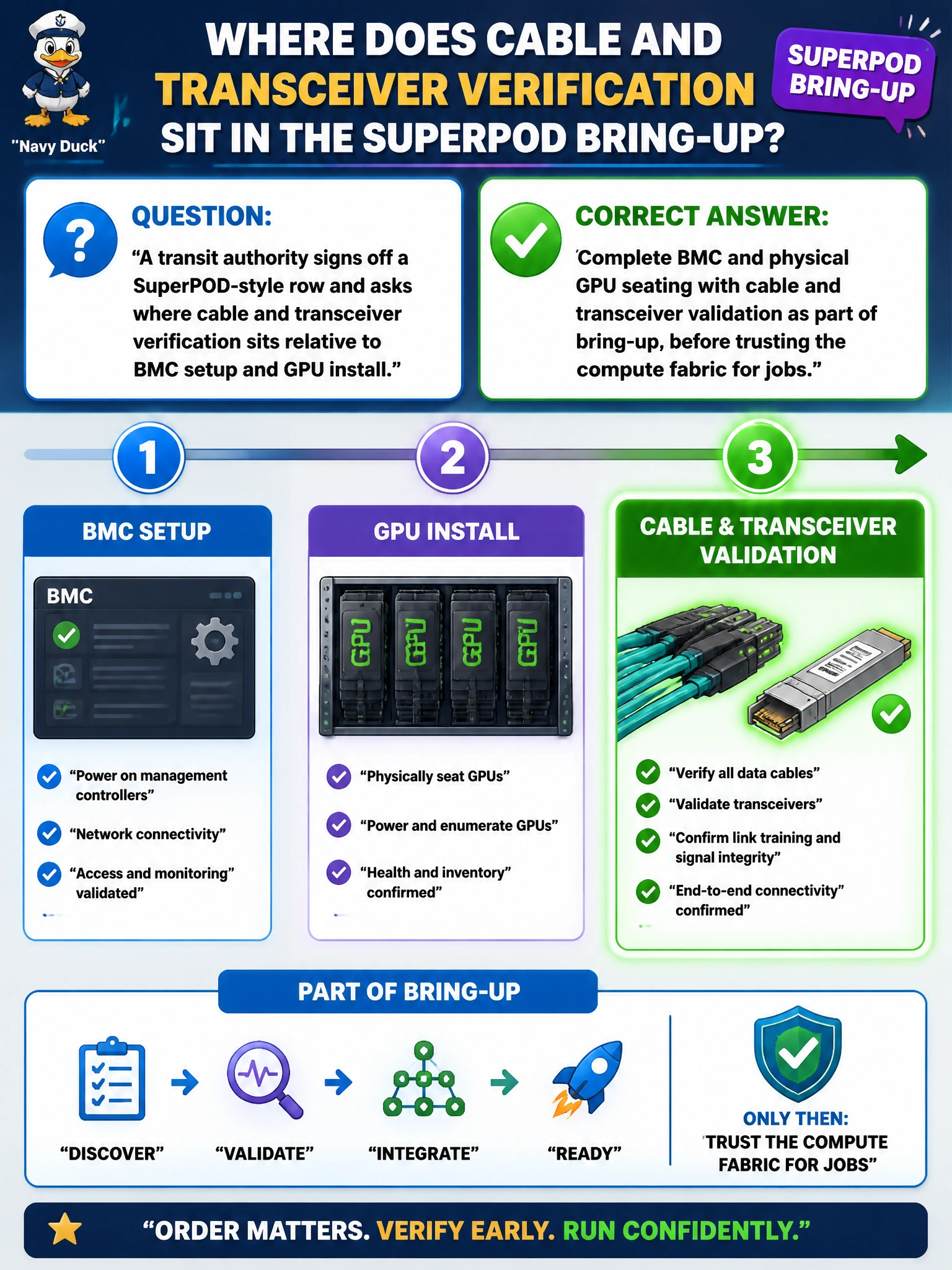
A transit authority signs off a SuperPOD-style row and asks where cable and transceiver verification sits relative to BMC setup and GPU install. What is the correct placement?
Select an answer to reveal the explanation.
Short Explanation
Cabling is the nervous system of the transit GPU row—you do not wait for a rush-hour outage to see if the wires match the plan. BMC and GPU install go with cable/transceiver validation during bring-up so the fabric is trustworthy before jobs ride it.
Full Explanation
In a transit SuperPOD-style row, BMC readiness, physical GPU seating, and cable/transceiver validation form one bring-up package that must complete before the compute fabric is trusted for jobs. BMC provides out-of-band recovery while GPUs and optics are still being seated; cable type and transceiver verification confirms that planned rail or leaf-spine links match what is actually patched and lit. Deferring those checks until a multi-node training job fails turns production riders’ 311 NLP capacity into the discovery mechanism for wrong QSFP, bad DAC/AOC pairs, or mis-seated GPUs. Validating cables only after production models already serve riders likewise leaves fabric defects in the live path during peak demand. Configuring BMC only after GPU workloads “prove” the fabric is healthy reverses manageability order: without early OOB, operators cannot recover nodes when the fabric or OS is the thing that failed. Exam writers often tempt candidates to treat interconnect proof as a post-outage forensic step; for AI factories it is a day-0 acceptance gate alongside BMC and GPU install. Caveat: some sites stage cable certification in phases (intra-rack first, then spine), but none of those phases wait for production failure. Operational check: after BMC is reachable and GPUs are seated, run link training or vendor cable/optics validation end-to-end and retain pass evidence before the transit row’s first multi-node job is scheduled.