
County public-health IT is writing a checklist for new inference nodes. Which validation gates belong before control-plane install and Slurm jobs?
Select an answer to reveal the explanation.
Short Explanation
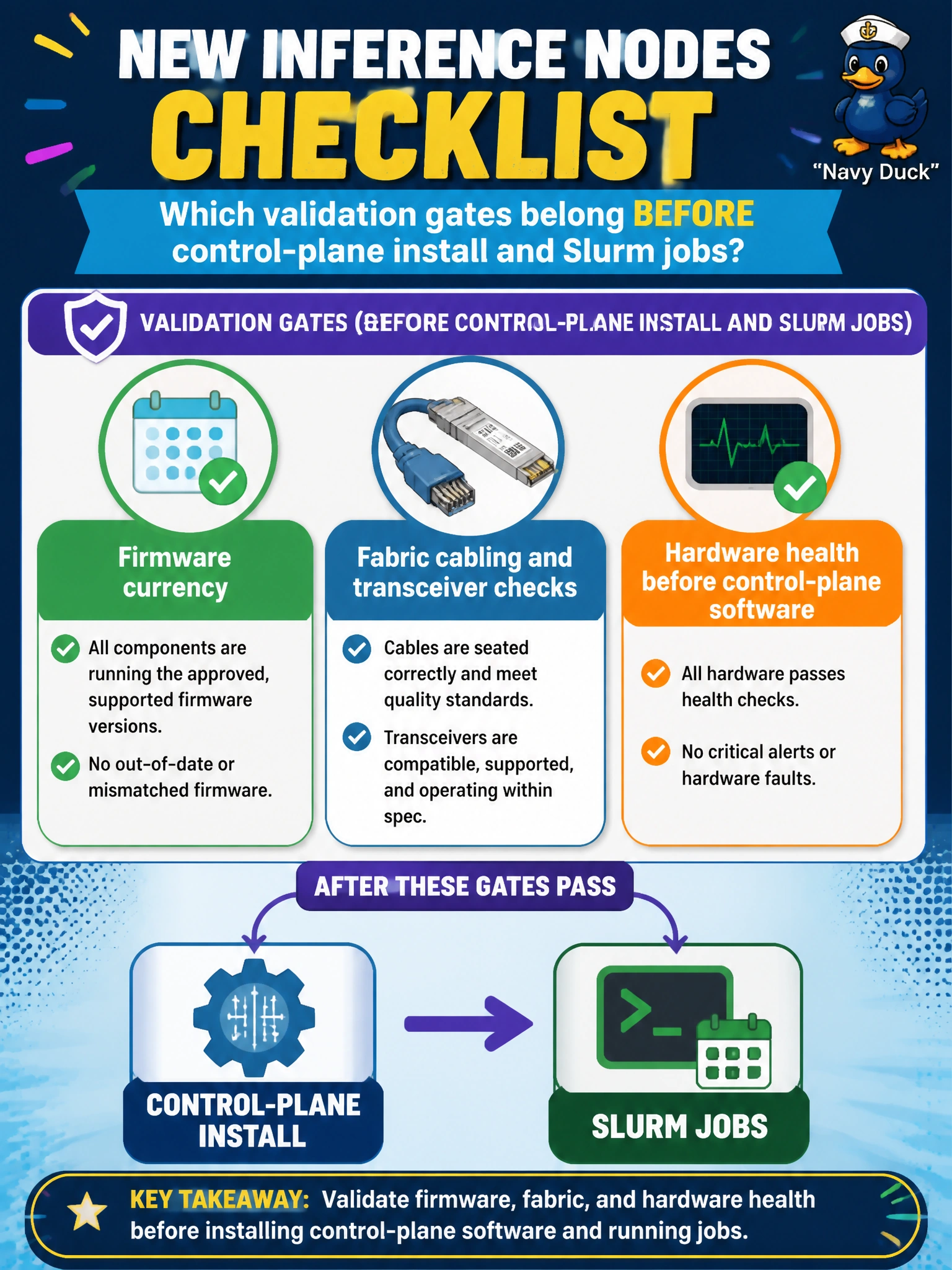
Picture the health-cluster like a clinic that still needs electrical inspection and instrument calibration before opening the waiting room. Firmware, cabling/optics, and basic hardware health have to pass before you hang control-plane software or dump jobs into Slurm.
Full Explanation
County public-health inference nodes must pass platform readiness gates before control-plane software and Slurm workloads assume a stable host. Firmware currency aligns GPUs, BMC, and related components to a supported train so later driver and cluster installs are not chasing mixed baselines. Fabric cabling and transceiver checks prove the east-west paths collectives and multi-node inference will use; hardware health confirms sensors, devices, and power delivery before cluster managers are trusted. Those gates belong before control-plane install because schedulers and agents amplify whatever is wrong underneath them. NGC CLI login tests and production inference smoke tests exercise accounts and applications, not early firmware or interconnect correctness, so they cannot substitute for bring-up validation. Slurm partition creation and Enroot mirroring prepare the software layer and still assume healthy, correctly cabled nodes. NeMo burn-in against live patient-record datasets is a late workload and data-governance activity; running it as the only pre-control-plane gate exposes PHI systems to unvalidated hardware. Exam caveat: later smoke tests remain necessary, but the question asks which gates belong before control-plane install and jobs—not which tests ever happen. Operational check: record firmware versions, cable/optics pass results, and hardware health status in the county runbook, then gate control-plane install on that checklist before any public-health Slurm partition accepts jobs.