
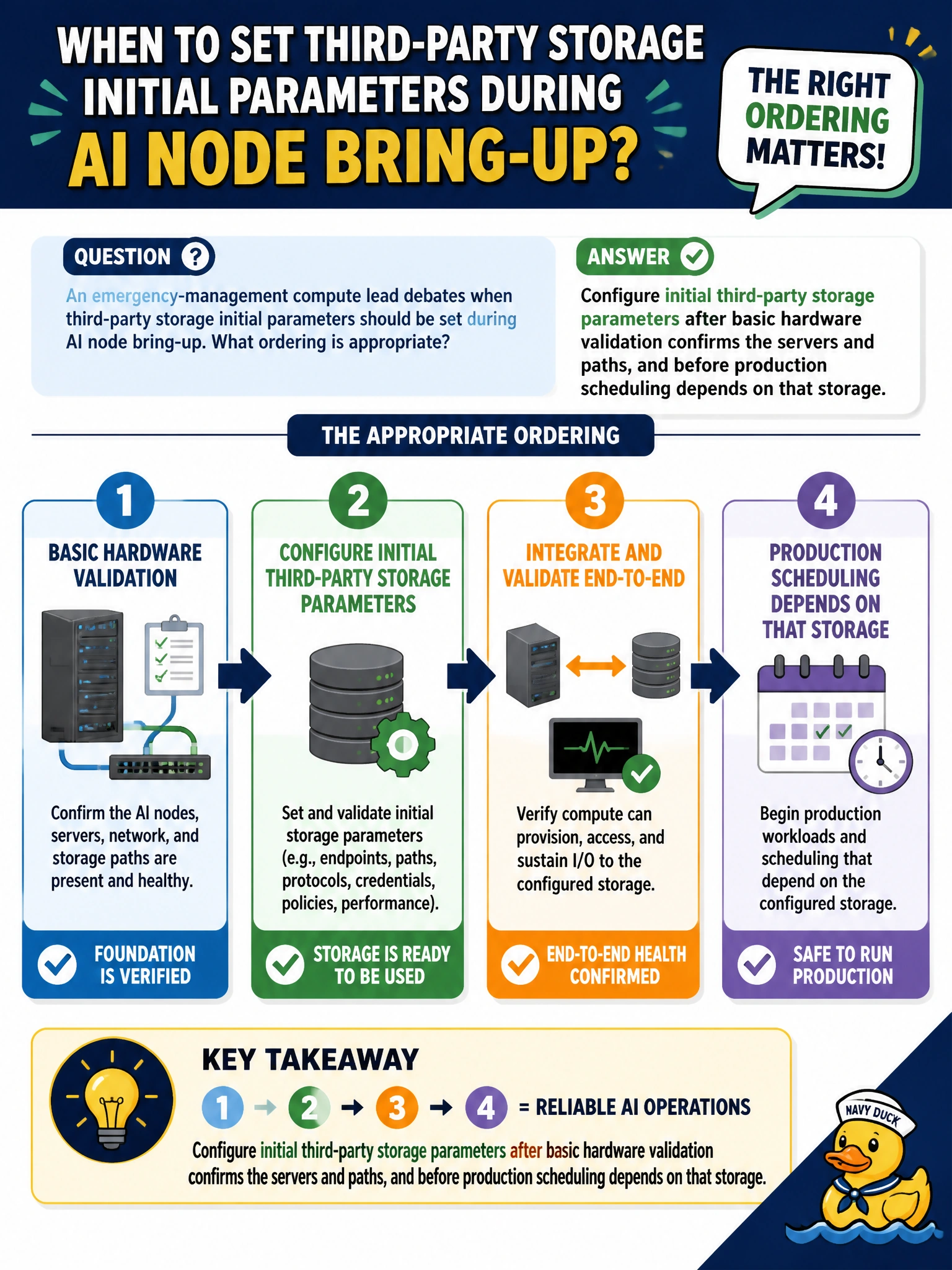
An emergency-management compute lead debates when third-party storage initial parameters should be set during AI node bring-up. What ordering is appropriate?
Select an answer to reveal the explanation.
Short Explanation
You’re right to validate the servers and storage paths first, then set the initial storage parameters before production scheduling depends on them. That gives your emergency-management jobs a reliable place to store data without configuring storage before the hardware is ready.
Full Explanation
Third-party storage initial parameters for emergency-management AI nodes should be set after basic hardware and path validation, but before production scheduling depends on that storage. Once servers are powered, BMCs are reachable, and storage fabric or NIC paths are confirmed, operators can set array endpoints, multipathing, credentials, and mount policies for jobs to inherit. Leaving parameters untouched until weeks of production 911 NLP inference risks discovering missing exports, an incorrect MTU, or broken multipath under operational pressure. Configuring storage separately in each training container after workloads start does not establish platform-level durability, quotas, or shared namespaces across jobs and restarts; it also leaves the platform unconfigured and relies on applications to discover and mount storage independently. Setting parameters before racks are powered or BMCs are reachable is premature: hosts cannot reliably present HBAs or NICs, and operators lack out-of-band recovery if a storage change wedges a node. Exam caveat: “after hardware validation” does not mean waiting until production begins; the key is completing the platform setup before scheduling relies on storage. Practical check: after validating hardware and paths, apply the initial third-party storage settings, verify mounts or block devices from a test host, and only then allow 911 NLP partitions to schedule against that storage.