
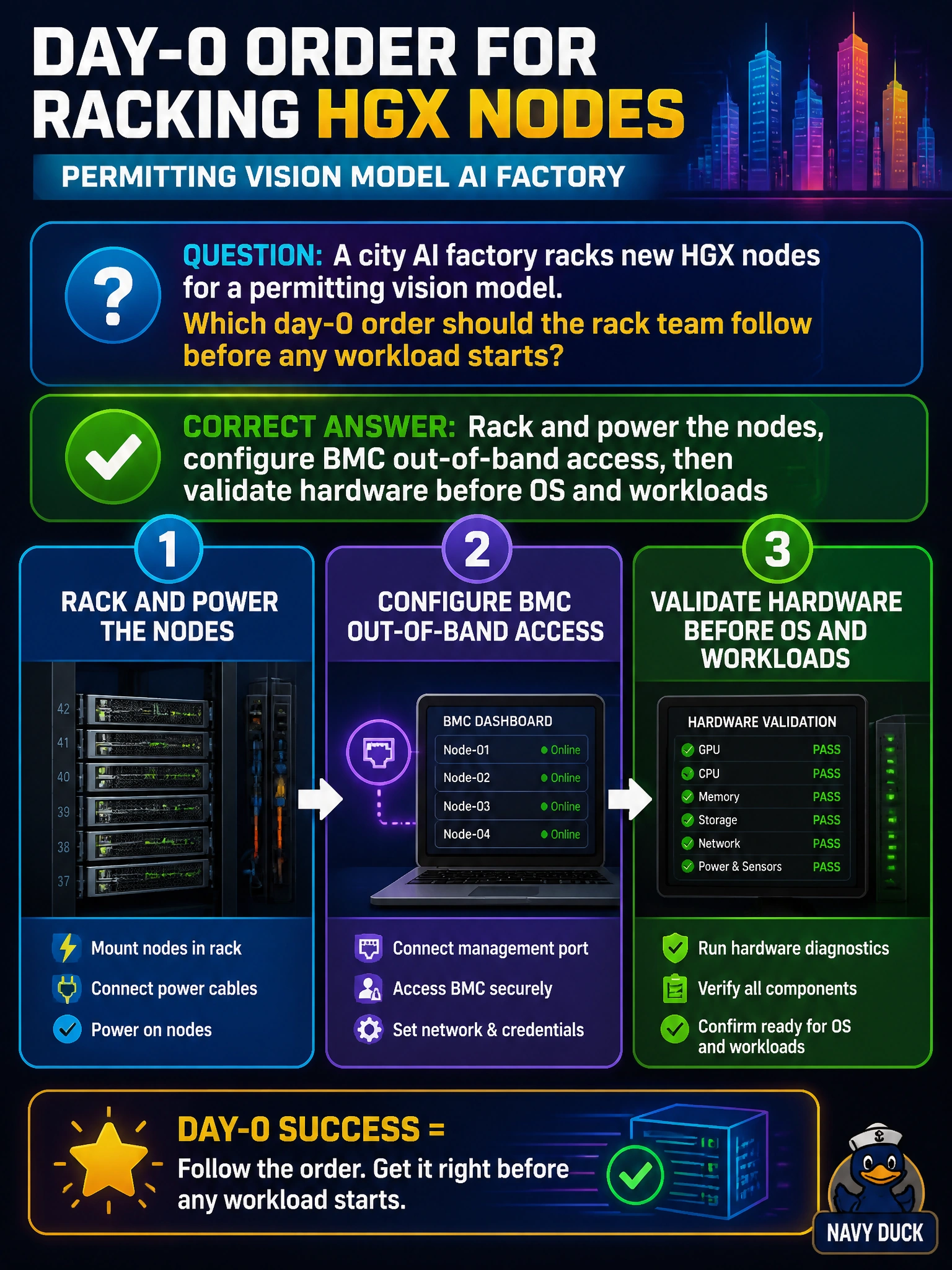
A city AI factory racks new HGX nodes for a permitting vision model. Which day-0 order should the rack team follow before any workload starts?
Select an answer to reveal the explanation.
Short Explanation
Think of a new municipal GPU rack like a firetruck that is not ready until the bay power, radio, and safety checks are done—you do not send it on calls first. Day-0 means rack and power, get BMC out-of-band working, and prove the iron is healthy before any OS image or permitting model job lands on it.
Full Explanation
Day-0 bring-up for municipal HGX capacity exists to make the platform reachable and trustworthy before any permitting-model image or job can touch it. Rack and power establish physical presence and facility feed; BMC out-of-band configuration then gives operators an independent management path when the host OS is missing or broken; hardware validation finally proves inventory, sensors, and basic device health against the city’s acceptance criteria. Only after those gates should imaging and workload scheduling begin, because software on unverified iron hides PDU, cabling, and FRU defects until they are expensive to unwind. Installing a training OS and submitting Slurm dry-runs before the nodes are racked and powered reverses cause and effect: there is nothing durable to image, and schedulers cannot compensate for missing power or manageability. Registering nodes in a municipal Slurm queue before BMC addresses are known creates orphan inventory that operations cannot console or recover when in-band networking fails. Flashing application containers to local NVMe before power and cooling checks treat packaging as proof of facility readiness, which it is not. On the NCP-AII exam, distinguish day-0 physical and out-of-band gates from later control-plane and workload steps; the distractors usually skip manageability or jump straight to jobs. Caveat: vendor runbooks may insert firmware waves or inventory discovery between BMC bring-up and full OS install, but they still keep workloads behind hardware validation. Operational check: from a jump host on the management network, confirm BMC login, power status, and a clean hardware health report for each new city AI-factory node before any OS image or permitting job is allowed.