
Municipal contact-center audio from 311 calls must become text before agents continue. How should the multimodal pipeline be optimized on NVIDIA platforms?
Select an answer to reveal the explanation.
Short Explanation
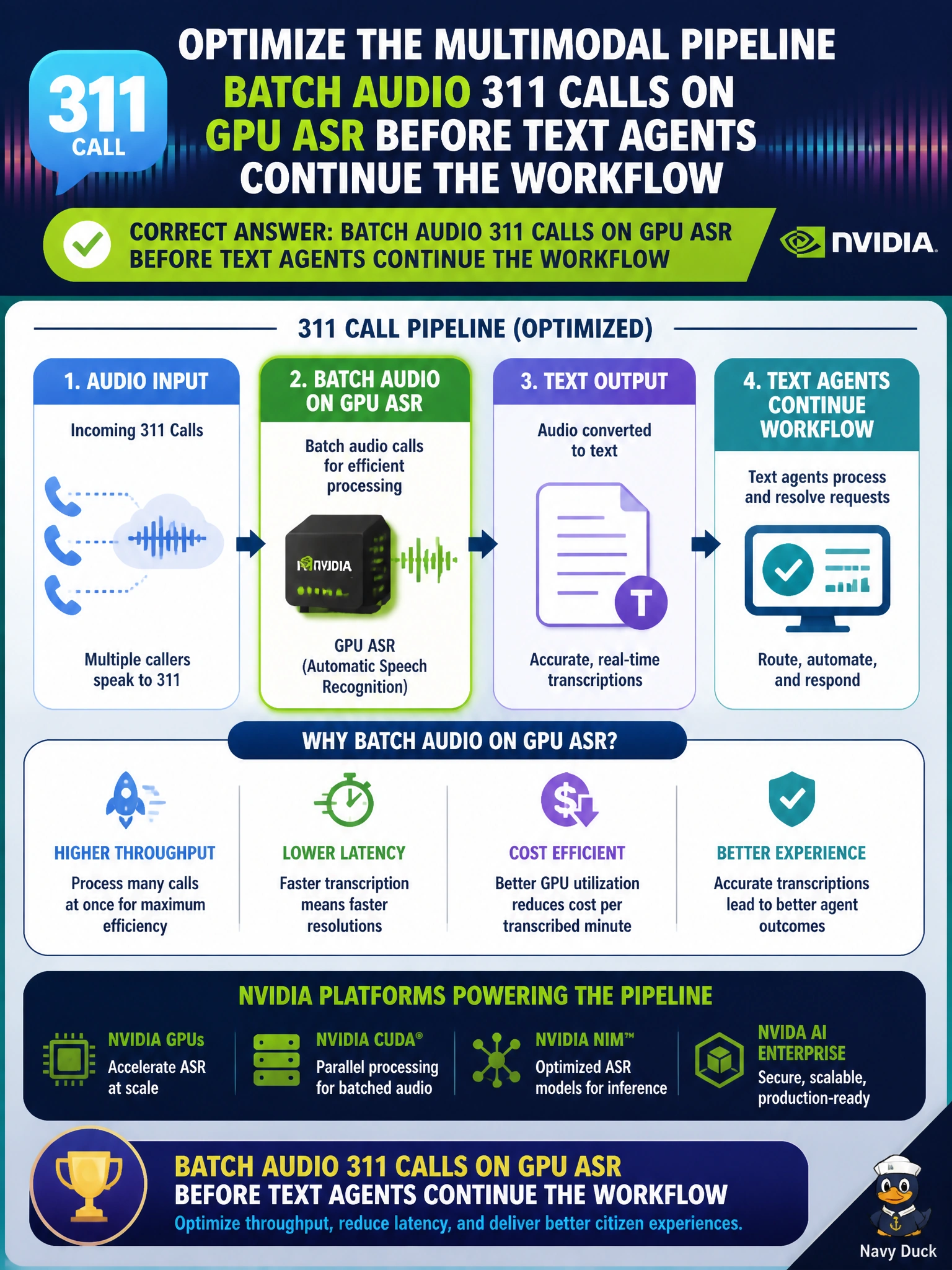
Voice has to become text before the chatty agents can help. Batching 311 audio on GPU ASR, then handing off to text agents, is the optimized multimodal path.
Full Explanation
Municipal contact-center audio from 311 calls must become text before downstream text agents continue. Optimizing that multimodal pipeline on NVIDIA platforms means batching audio 311 calls on GPU ASR before text agents continue the workflow. GPU ASR batching turns voice into timely transcripts at peak call volume so orchestrated text agents, tools, and knowledge retrieval can proceed without waiting on overnight human transcription.
Transcribing each call manually overnight before any agent sees it fails latency and scale for a live 311 operation. Skipping ASR and having text agents guess from call-duration metadata alone fails informationally—duration is not content, and guessing invents resident intent. Storing raw audio forever without transcription to avoid GPU use fails both cost/privacy posture and agent usefulness: without text, language agents cannot act.
Exam caveat: ASR output can err on names, addresses, and language varieties; civic pipelines need confidence thresholds, human review for high-impact actions, and retention limits on raw audio. Optimization does not imply unsupervised execution of irreversible benefits or enforcement steps from a single noisy transcript.
Operational check: batch-evaluate GPU ASR word-error rate on representative 311 accents and noise, measure end-to-end time from call end to text-agent readiness, and gate tool actions that mutate cases on transcript confidence or clerk confirmation.