
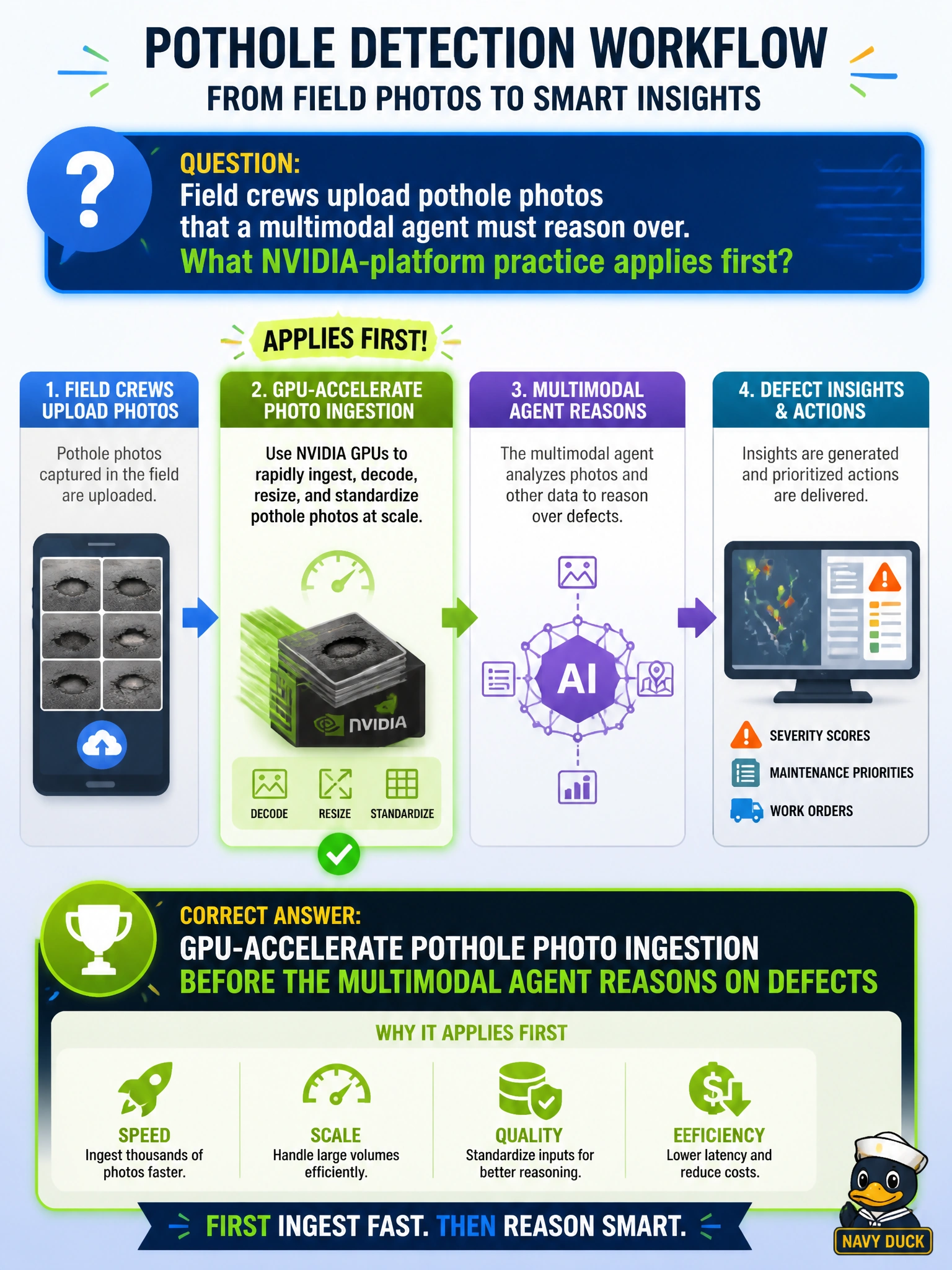
Field crews upload pothole photos that a multimodal agent must reason over. What NVIDIA-platform practice applies first?
Select an answer to reveal the explanation.
Short Explanation
Pothole pictures shouldn’t wait in a slow CPU line. GPU-accelerated photo ingestion feeds the multimodal agent so it can reason on defects promptly.
Full Explanation
Field crews upload pothole photos that a multimodal agent must reason over. The NVIDIA-platform practice that applies first is to GPU-accelerate pothole photo ingestion before the multimodal agent reasons on defects. Image decode, preprocessing, and vision-model inference are GPU-friendly stages; accelerating them keeps the multimodal pipeline timely so street defects can be classified and routed while crews are still in the field.
Downscaling photos to unreadable thumbnails on CPU only, then discarding GPU paths, fails because unreadable inputs destroy defect signal and CPU-only paths typically bottleneck civic image volume. Requiring crews to describe every crack in a 2,000-word email instead of images fails operationally—it burdens field staff and loses visual evidence multimodal models are meant to use. Storing photos offline for annual review with no agent involvement fails the near-term maintenance loop cities need for safety and repair prioritization.
Exam caveat: GPU-accelerated ingestion improves pipeline performance; it does not replace data governance—images may include bystanders, license plates, or private property details that need retention and redaction policy before long-term storage or public release.
Operational check: measure ingest-to-reason latency with GPU preprocessing enabled, confirm defect-reasoning quality on a labeled pothole set, and verify PII/redaction controls run in the same multimodal path before photos land in open dashboards.