
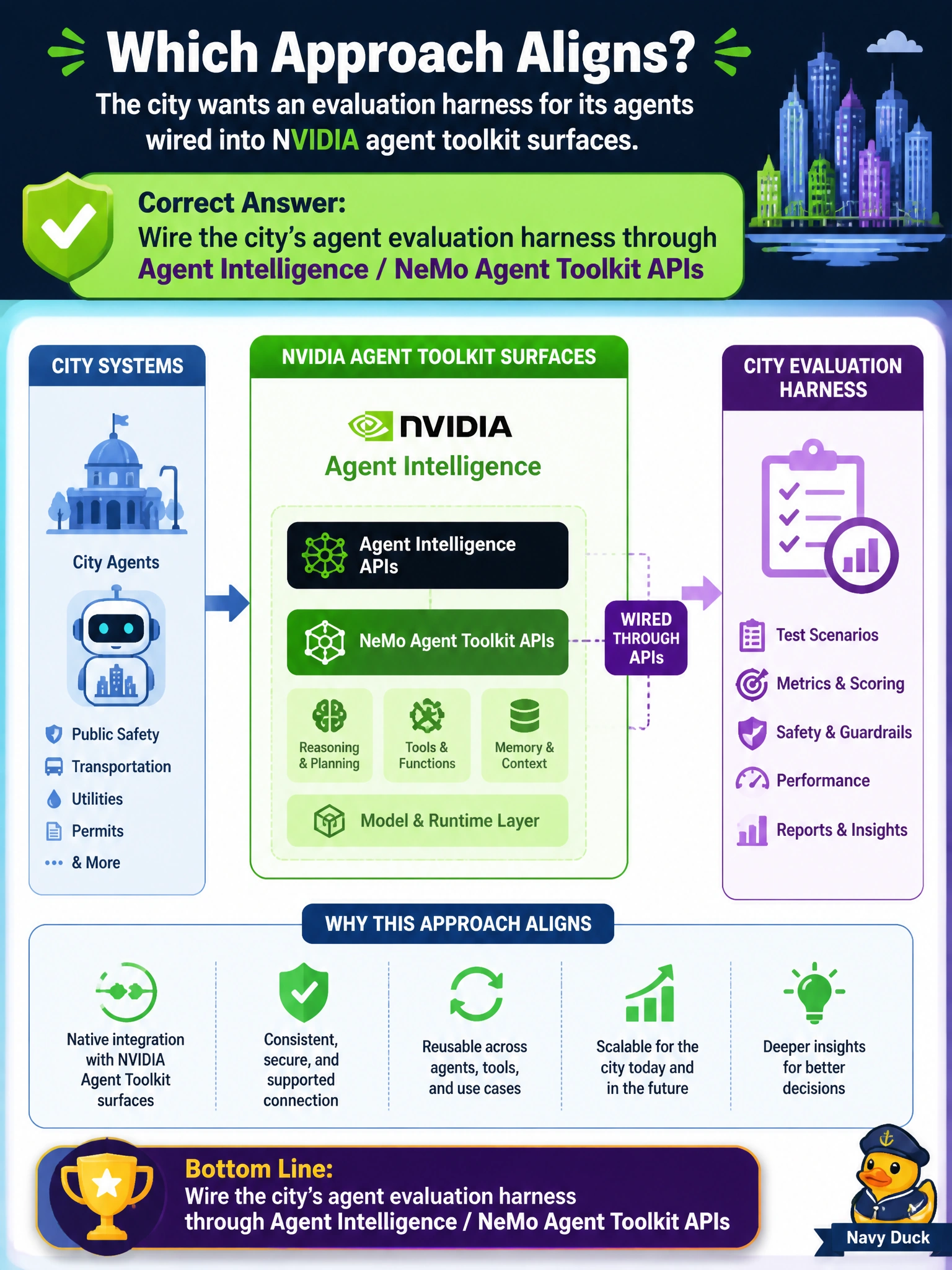
The city wants an evaluation harness for its agents wired into NVIDIA agent toolkit surfaces. Which approach aligns?
Select an answer to reveal the explanation.
Short Explanation
Pretty themes don’t prove the agent works. Wiring the city’s eval harness through Agent Intelligence / NeMo Agent Toolkit APIs puts iteration on measured civic performance.
Full Explanation
Cities that want an evaluation harness for agents should wire it through Agent Intelligence / NeMo Agent Toolkit APIs rather than informal taste tests. That approach aligns measurement with the same NVIDIA agent toolkit surfaces used to build and profile workflows, enabling repeatable scoring, regression detection, and iteration loops tied to civic task performance—not cosmetics.
Scoring agents only by how colorful the UI theme is fails because UI aesthetics are orthogonal to answer correctness, tool success, and safety. Disabling evaluation so releases ship faster without scores fails as governance: unmeasured civic agents regress silently into production. Outsourcing all scoring to anonymous social-media polls fails methodologically—popularity is not faithfulness to ordinances, privacy policy, or 311 procedural accuracy.
Exam caveat: wiring an eval harness to toolkit APIs is necessary but not sufficient. The city still must define gold sets, pass thresholds, and human review for high-risk domains (benefits, public safety guidance). API integration does not invent the rubric.
Operational check: connect the harness to toolkit APIs, run a fixed municipal gold set on each candidate build, block promotion on threshold failure, and store score artifacts with model/prompt/tool versions for audit when council or IT asks why a build shipped.