
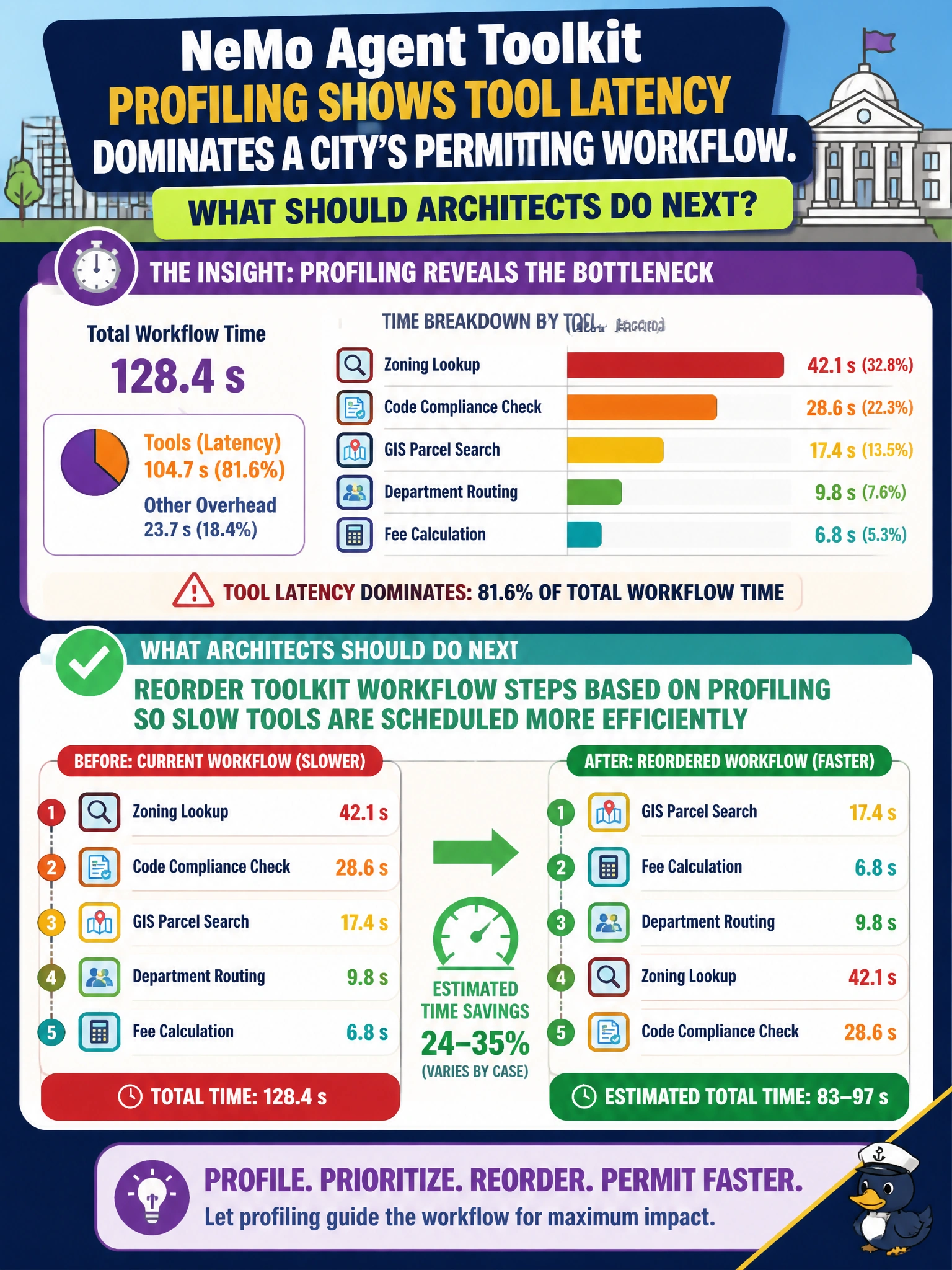
NeMo Agent Toolkit profiling shows tool latency dominates a city’s permitting workflow. What should architects do next?
Select an answer to reveal the explanation.
Short Explanation
If the stopwatch says tools are the bottleneck, reshuffle the assembly line. Profiling-guided reordering of NeMo Agent Toolkit workflow steps tackles permitting latency where it lives.
Full Explanation
When NeMo Agent Toolkit profiling shows tool latency dominates a city’s permitting workflow, architects should reorder toolkit workflow steps based on profiling so slow tools are scheduled more efficiently. Profiling identifies which tool calls, fan-outs, or serial dependencies burn wall-clock time; reordering can parallelize independent checks, defer expensive tools until cheaper prefilters pass, and remove unnecessary round trips—improving resident-facing permitting latency without deleting capability.
Ignoring profiling and adding random sleeps to “smooth” latency charts fails because sleeps hide variance and worsen experience without fixing root delay. Deleting all tools so the agent only chats without acting on permits fails the permitting mission: chat without tools cannot file, validate, or status real applications. Doubling every tool timeout without changing workflow structure fails as a latency strategy—it increases patience for slowness rather than reducing it.
Exam caveat: reordering must preserve business and compliance sequencing. Payment authorization, identity proofing, or legally required notices may be order-constrained even if profiling marks them slow; optimize around constraints, do not violate them for speed.
Operational check: compare p50/p95 step traces before and after reordering on the same permit golden journeys; confirm parallelized tools have no hidden data dependencies; and regress evaluation for correctness so faster paths do not skip mandatory municipal checks.