
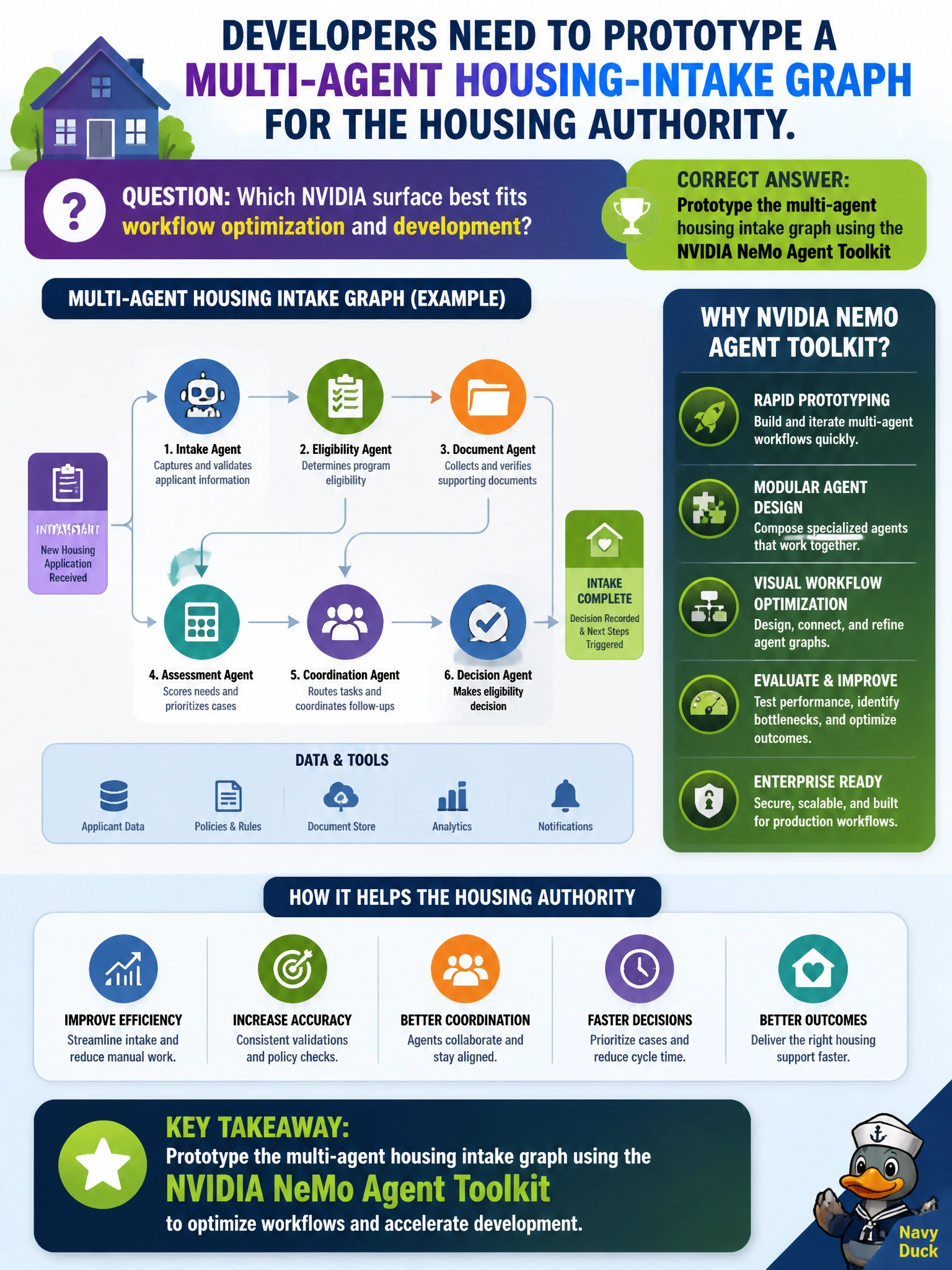
Developers need to prototype a multi-agent housing-intake graph for the housing authority. Which NVIDIA surface best fits workflow optimization and development?
Select an answer to reveal the explanation.
Short Explanation
Housing intake is a graph of handoffs, not a slide deck. Prototyping with the NVIDIA NeMo Agent Toolkit gives developers a real multi-agent workflow to optimize.
Full Explanation
Developers prototyping a multi-agent housing-intake graph for a housing authority need an executable agent workflow surface—not slides or DNS edits. The NVIDIA NeMo Agent Toolkit is the surface that best fits workflow optimization and development: it supports building, profiling, and iterating multi-agent graphs where intake, eligibility checks, document tools, and handoffs can be composed and measured. That matches municipal housing workflows that are inherently multi-step and multi-role.
Hand-editing production DNS records as the primary agent orchestration IDE fails conceptually—DNS is traffic routing, not an agent development environment, and production DNS churn is an availability risk. Prototyping only in presentation slides with no executable agent graph fails because slides cannot validate tool calls, latency, or failure handling. Building the housing intake as a single hard-coded bash script without agent tooling fails maintainability and obscures the multi-agent structure the authority needs to optimize.
Exam caveat: the toolkit accelerates development and optimization; production still requires NIM/inference hosting, guardrails, data access controls for sensitive housing data, and municipal change management before resident-facing cutover.
Operational check: implement the intake graph in the toolkit, run profiling on tool and agent steps with representative housing cases, capture baseline latency and failure modes, and promote only after evaluation harness scores meet the housing authority’s acceptance bar.