
A court clerk agent must answer both “when is the hearing?” and “what did the opinion say?” Which knowledge pattern fits?
Select an answer to reveal the explanation.
Short Explanation
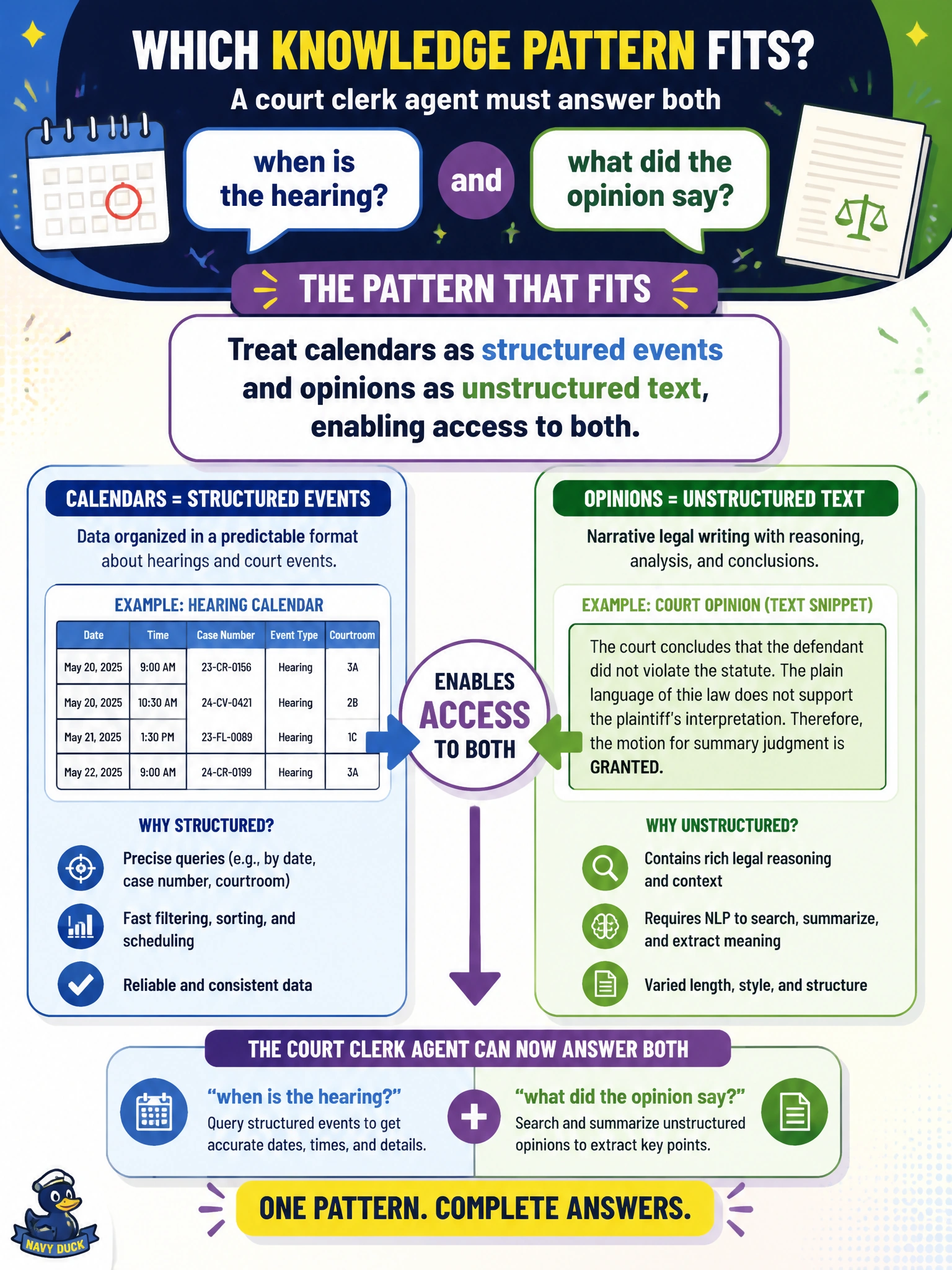
Dockets are clocks; opinions are essays. Structured court calendars plus unstructured opinion text let the clerk agent answer both “when” and “what was said.”
Full Explanation
A court clerk agent must answer both calendaring questions (“when is the hearing?”) and content questions (“what did the opinion say?”). The fitting knowledge pattern treats calendars as structured events and opinions as unstructured text, enabling access to both. Hearing times, courtrooms, and case identifiers belong in structured stores with precise fields; judicial opinions are narrative legal documents best indexed and retrieved as unstructured text with citation metadata. Dual access matches how courts actually operate and how residents and attorneys ask questions.
Converting all opinions into a single calendar cell and discarding narrative reasoning fails because a calendar cell cannot carry holdings, dissents, or ordered remedies. Storing only hearing times and refusing any question about written opinions fails the clerk-agent mission: opinion content is a core judicial knowledge need. Indexing opinions as GPS coordinates so retrieval can ignore legal text fails by concept—geospatial indexing is the wrong modality and strips the semantic content the question requires.
Exam caveat: structured-plus-unstructured design does not authorize the agent to give legal advice beyond published docket facts and opinion text. Privilege, sealing, and redaction rules still gate what may be retrieved; sealed materials must remain out of the public agent path.
Operational check: validate that “when” queries resolve from the calendar/API with timezone-correct times, that “what did it say” queries retrieve the correct opinion passages with docket citations, and that sealed or non-public opinions are excluded by access policy tests.