
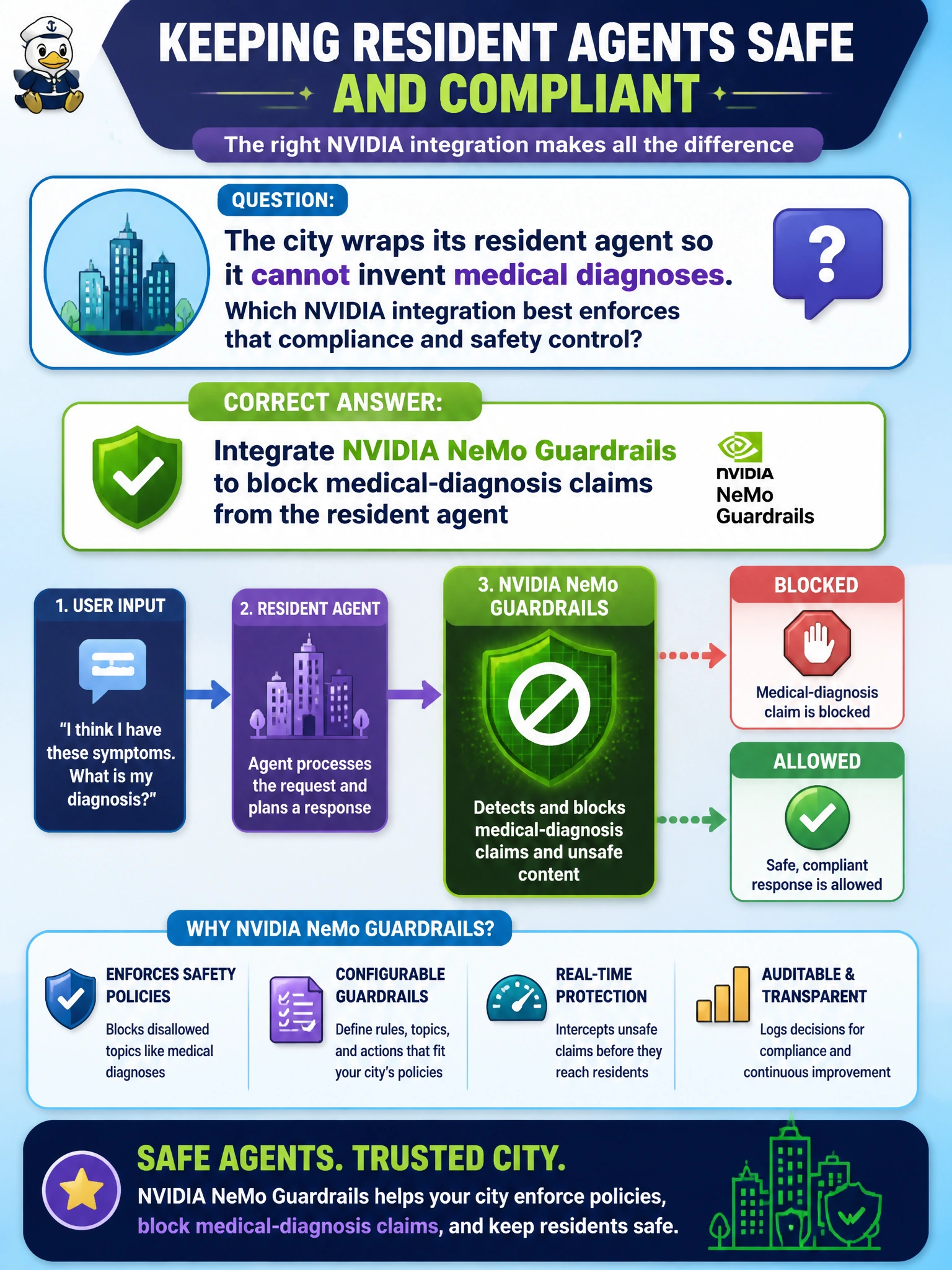
The city wraps its resident agent so it cannot invent medical diagnoses. Which NVIDIA integration best enforces that compliance and safety control?
Select an answer to reveal the explanation.
Short Explanation
A city chatbot isn’t a clinic. Wrapping the resident agent with NVIDIA NeMo Guardrails blocks medical-diagnosis claims before they reach the public.
Full Explanation
Municipal resident agents must not invent medical diagnoses. The NVIDIA integration that best enforces that compliance and safety control is NVIDIA NeMo Guardrails, configured to block medical-diagnosis claims before they reach the public. Guardrails provide dialog and rail policies that constrain topics, force refusals or safe redirects, and keep the city’s chatbot inside civic scope—service navigation, hours, and official public-health notices—rather than clinical judgment.
Disabling all logging so unsafe answers cannot be reviewed later fails because it destroys auditability; safety programs need evidence of blocked and leaked claims, not blindness. Training residents to ignore any health-related answer the agent produces fails conceptually: the burden of safety cannot be shifted to the public after an unsafe utterance is already delivered. Replacing NeMo Guardrails with an unfiltered free-chat model for “friendliness” fails as a compliance choice—friendliness without rails increases diagnosis-like improvisation risk.
Exam caveat: guardrails reduce out-of-scope medical claims; they do not make the agent a clinician, and they are not a substitute for linking residents to official public-health channels. Rails must be tested against paraphrase attacks (“what illness do I have?” variants), not only exact keyword bans.
Operational check: run a red-team health prompt set through the wrapped agent, confirm diagnosis-style outputs are blocked or redirected, verify logs capture rail triggers without storing unnecessary PHI, and re-test after every model or prompt change before production traffic.