
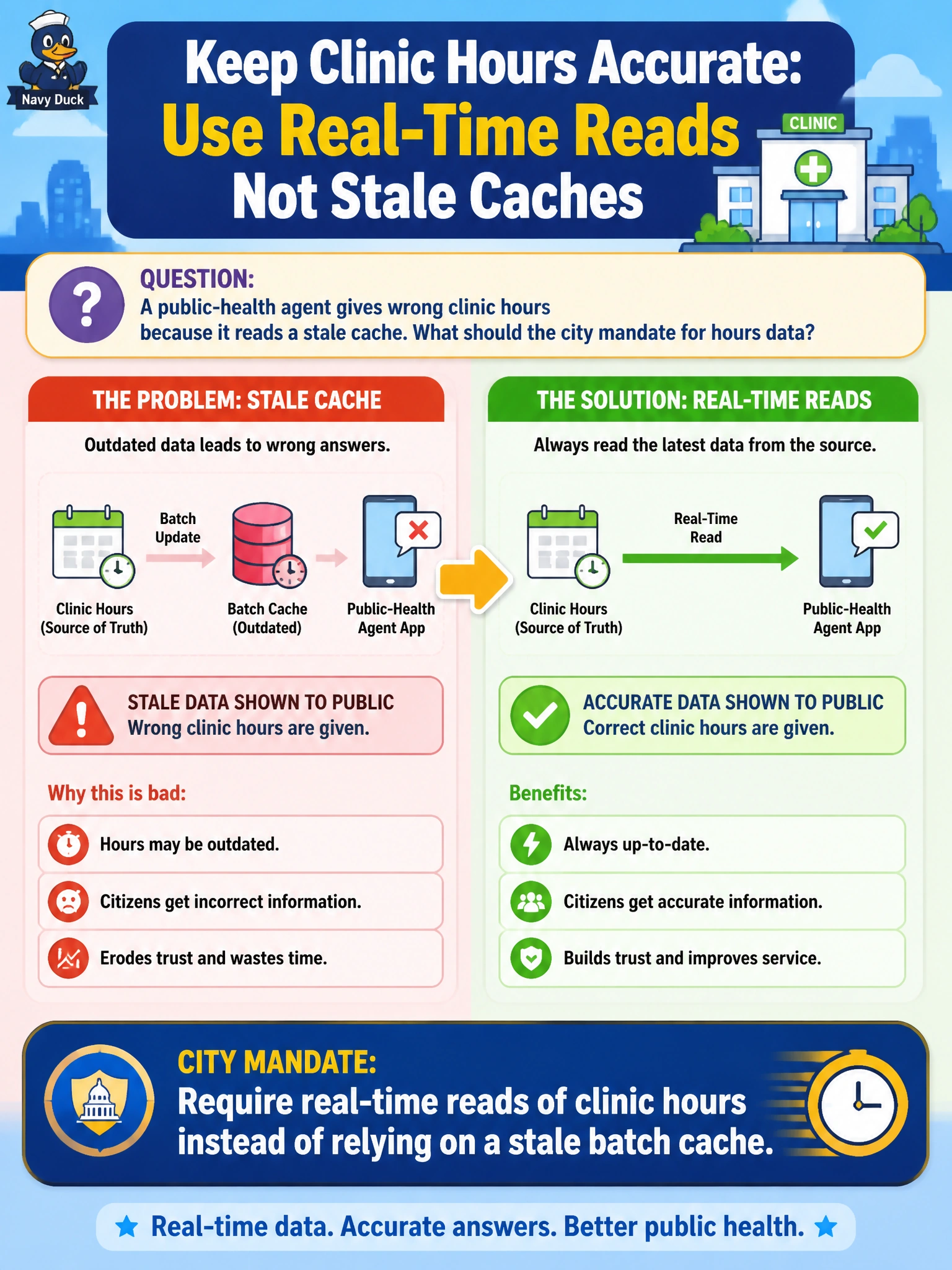
A public-health agent gives wrong clinic hours because it reads a stale cache. What should the city mandate for hours data?
Select an answer to reveal the explanation.
Short Explanation
Clinic hours can change faster than a stale cache, so you want the agent to read them in real time. That helps you avoid sending people to a closed clinic because of outdated information.
Full Explanation
Public-health clinic hours are time-sensitive civic facts. When an agent reads a stale cache and misstates hours, residents may arrive at closed doors—an operational and equity failure. Requiring real-time reads from authoritative clinic systems keeps the agent aligned with temporary closures, holiday schedules, and same-day capacity changes that a batch cache can miss. Storing hours in a quarterly directory and having clerks copy updates from memory fails because both the update cycle and manual transcription can lag reality or introduce errors. Freezing hours in the LLM weights fails because model weights are not a system of record for volatile municipal schedules and cannot be updated with clinic urgency. Preferring a stale cache whenever live systems respond slowly fails as a reliability policy: it institutionalizes wrong answers when systems are stressed and residents need accurate guidance. Exam caveat: real-time reads still need graceful degradation. If live clinic systems are unavailable, the agent should disclose uncertainty and direct residents to a verified contact path rather than silently presenting yesterday’s cache as current. Practical check: test a same-day hours change in staging and confirm the agent reflects it without waiting for a batch job; monitor cache age and log a freshness indicator or source timestamp for answers that state hours.