
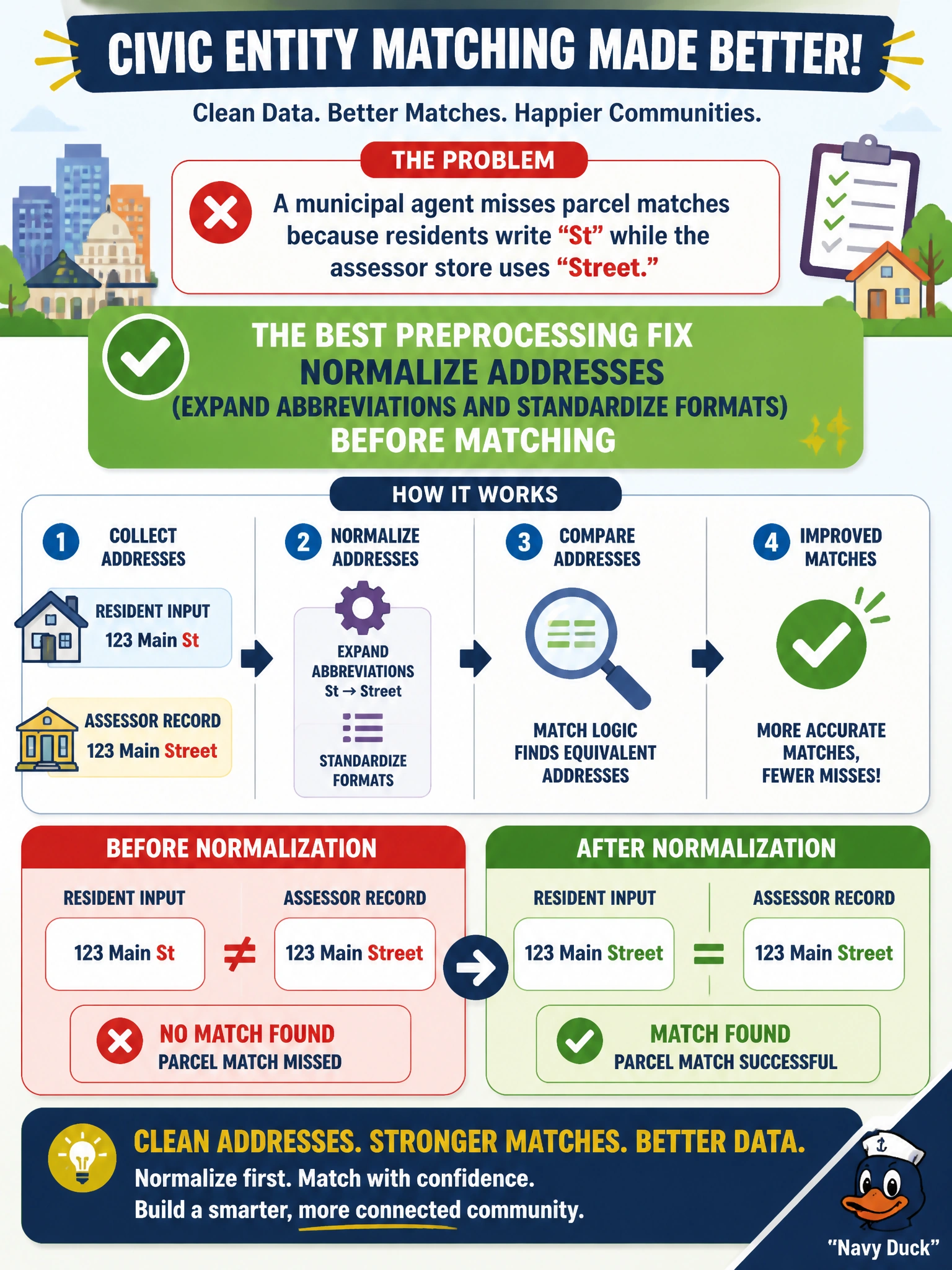
A municipal agent misses parcel matches because residents write “St” while the assessor store uses “Street.” What preprocessing fix best improves civic entity matching?
Select an answer to reveal the explanation.
Short Explanation
“St” and “Street” are the same driveway with different nicknames. Address normalization that expands abbreviations and standardizes formats stops the agent from missing assessor matches.
Full Explanation
Municipal entity matching fails when residents write informal address tokens such as “St” while the assessor store canonicalizes “Street.” The best preprocessing fix is to normalize addresses—expand abbreviations, standardize punctuation and unit formats, and apply consistent casing—before matching so abbreviated and expanded forms resolve to the same parcel. Normalization is a civic data-handling control that preserves resident free-text input while aligning it to authoritative cadastral identifiers the agent needs for accurate service routing and property lookups.
Banning residents from typing street names and forcing map-pin-only submissions fails conceptually because it rejects accessibility and common 311 patterns; many residents cannot or will not use a map UI, and typed addresses remain a first-class civic channel. Ignoring street tokens and matching only on city name fails because city-level matches are far too coarse for parcel identity and produce dangerous false positives across neighborhoods. Storing every spelling variant as a separate unrelated parcel fails because it fragments the assessor truth set, creates duplicate identities, and defeats any consistent join to taxes, permits, or service history.
Exam caveat: normalization improves matching recall and precision; it does not replace authoritative parcel IDs or GIS validation. Ambiguous addresses (similar street names, missing unit numbers) still need human escalation or geocoder confidence thresholds rather than silent best-guess assignment.
Operational check: measure parcel match rate and false-match rate on a municipal address golden set before and after normalization; verify abbreviate/expand tables cover local conventions (St/Ave/Blvd/Cir); and confirm unmatched low-confidence cases route to clerk review instead of inventing a parcel link.