
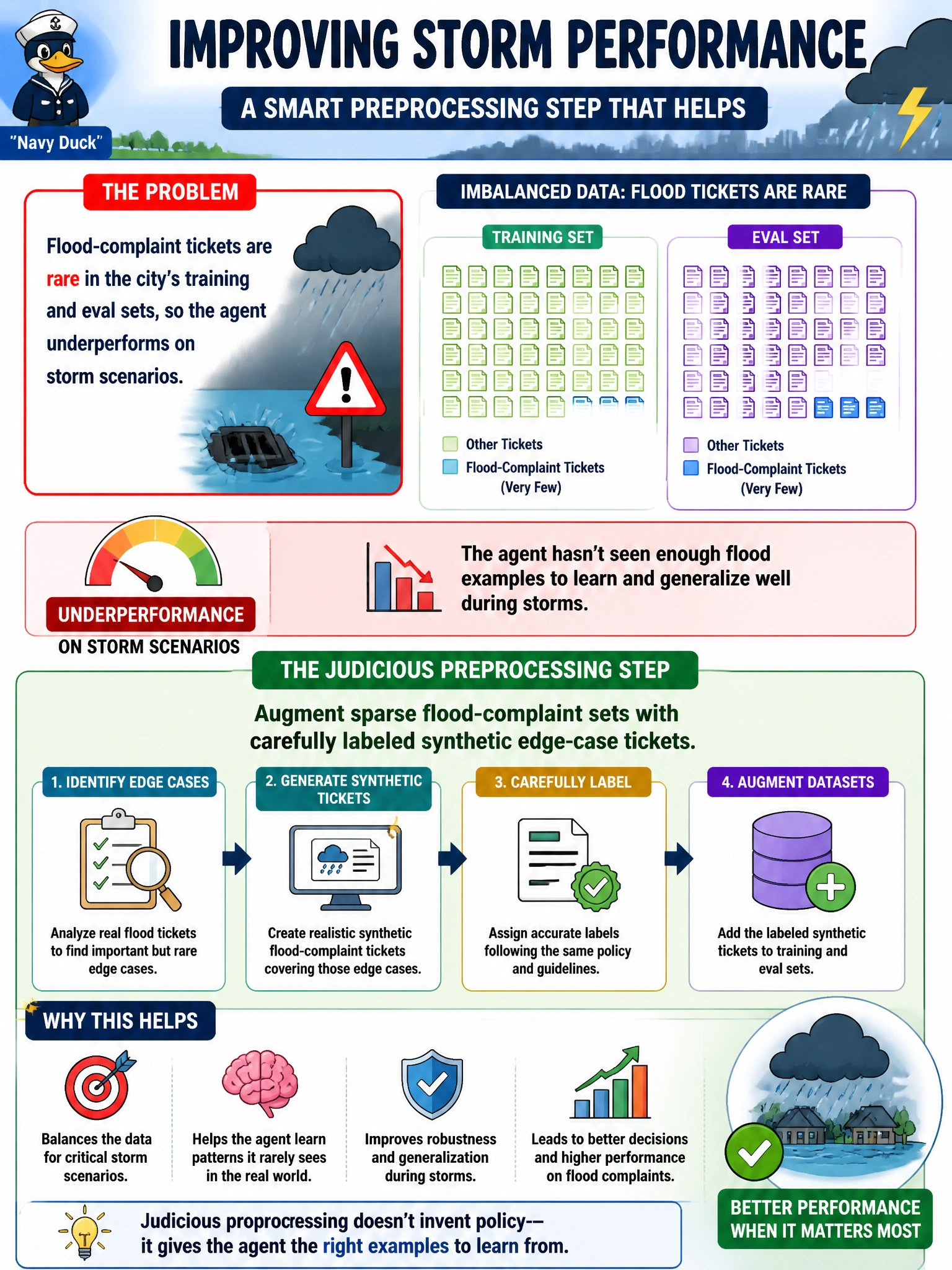
Flood-complaint tickets are rare in the city’s training and eval sets, so the agent underperforms on storm scenarios. What judicious preprocessing step helps without inventing policy?
Select an answer to reveal the explanation.
Short Explanation
Rare floods shouldn’t leave the agent blind—think flight sims for pilots. Carefully labeled synthetic edge-case flood tickets flesh out sparse civic training and eval sets without rewriting city policy.
Full Explanation
Flood-complaint tickets are sparse in many municipal training and evaluation corpora, yet storm events create sudden, high-stakes resident demand. The judicious preprocessing step is to augment those sparse flood-complaint sets with carefully labeled synthetic edge-case tickets so the agent can practice rare civic scenarios without inventing or rewriting city policy. Synthetic tickets should mirror real municipal schemas (location, severity, asset class, escalation path) and carry explicit labels that evaluation harnesses can score. This strengthens coverage of weather-related work while keeping the policy source of truth in official ordinances and SOPs.
Dropping all flood tickets so the agent never trains on weather-related civic work fails conceptually because it removes the very distribution the city must serve during storms; underperformance becomes structural, not accidental. Replacing flood tickets with unrelated parks reservation chats to balance volume fails because volume balance without semantic relevance teaches the wrong skills—parks booking patterns do not transfer to flood triage, liability language, or emergency routing. Overfitting only on the handful of real flood tickets and skipping eval coverage fails because memorizing a tiny set without held-out checks produces brittle behavior and hides regressions until a real storm exposes them.
Exam caveat: data augmentation is not a license to fabricate policy answers. Synthetic examples must be labeled for behavior and retrieval grounding; the agent still cites authoritative municipal sources at answer time. Do not confuse synthetic training support with replacing live GIS, work-order, or emergency-management systems of record.
Operational check: before promoting a flood-augmented build, confirm synthetic tickets are reviewed by domain SMEs, schema-validated against 311/work-order fields, held out from a storm-scenario eval split, and that production answers still retrieve current flood maps and published outage guidance rather than parroting synthetic narratives.