
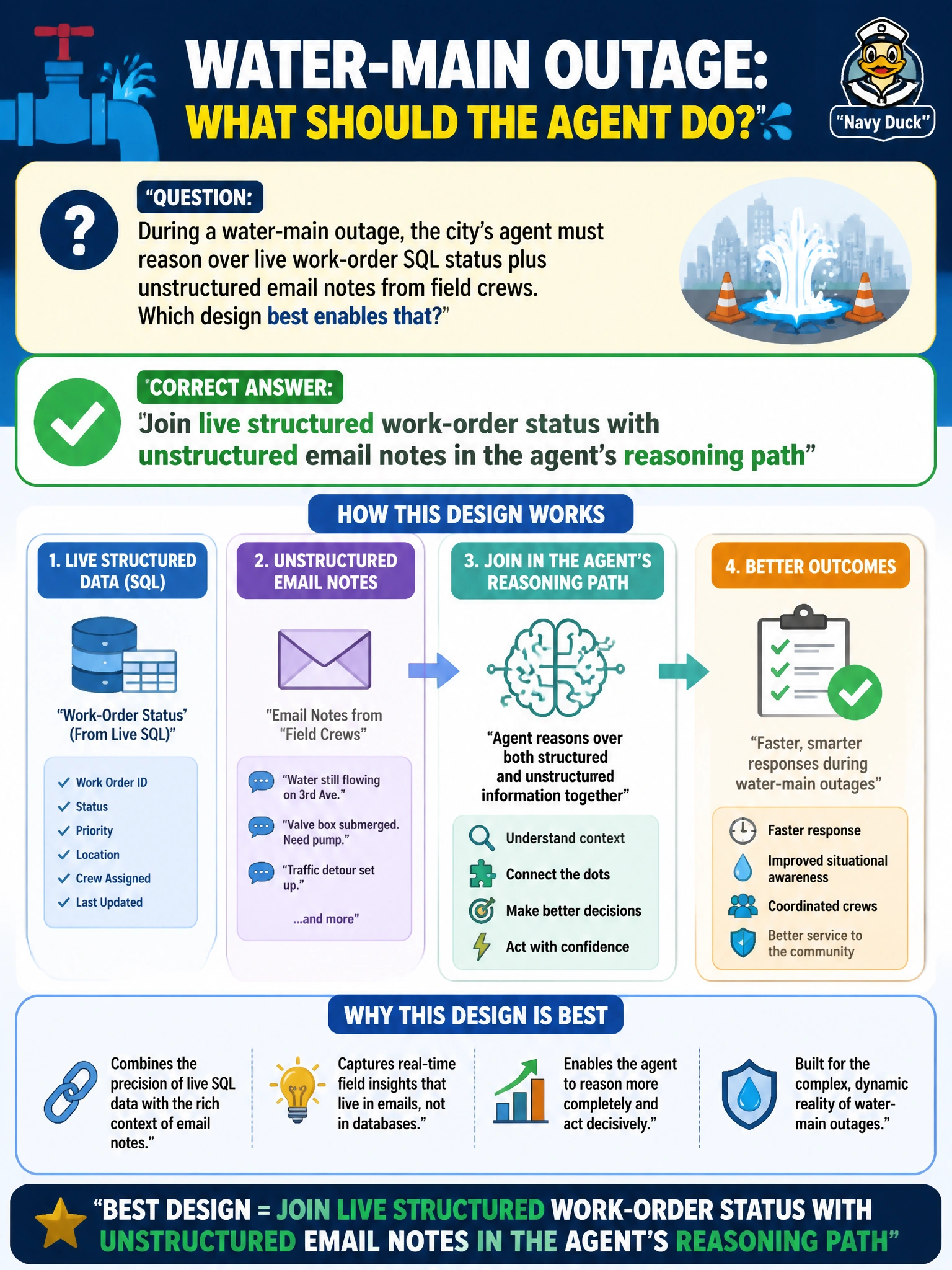
During a water-main outage, the city’s agent must reason over live work-order SQL status plus unstructured email notes from field crews. Which design best enables that?
Select an answer to reveal the explanation.
Short Explanation
Outages move in both databases and messy inbox threads. Letting the agent join live work-order SQL with unstructured crew emails keeps answers grounded in what’s actually happening.
Full Explanation
During a water-main outage, field reality moves faster than any single static document. The design that best enables correct reasoning joins live structured work-order SQL status with unstructured email notes from field crews inside the agent’s reasoning path. Structured status gives machine-readable stage, crew assignment, and estimated restoration; unstructured notes capture nuance that tables miss—valve anomalies, temporary boil-water guidance, blocked access, or coordination with fire and traffic. Combining both modalities keeps resident answers grounded in what is actually happening on the street.
Answering only from last month’s PDF outage report and ignoring live systems fails because historical PDFs are stale relative to an active break and cannot reflect current isolation valves or ETA changes. Queuing every resident question until a clerk pastes both sources into a spreadsheet overnight fails operationally and experientially: emergencies demand near-real-time answers, and manual overnight consolidation creates unsafe lag. Discarding email notes because SQL tables are always complete during emergencies fails conceptually—incident systems are often incomplete under surge, and crew narrative is frequently the earliest signal of blockers.
Exam caveat: joining modalities is not the same as treating every email sentence as policy. Unstructured notes must be attributed, time-stamped, and overridden by official boil-water or restoration notices when those publish. Prefer retrieval with provenance over free hallucination of outage details.
Operational check: in a tabletop water-main drill, verify the agent can cite current work-order state and a recent crew note together, show source timestamps, refuse to invent restoration times when both sources lack them, and escalate when structured and unstructured signals conflict.