
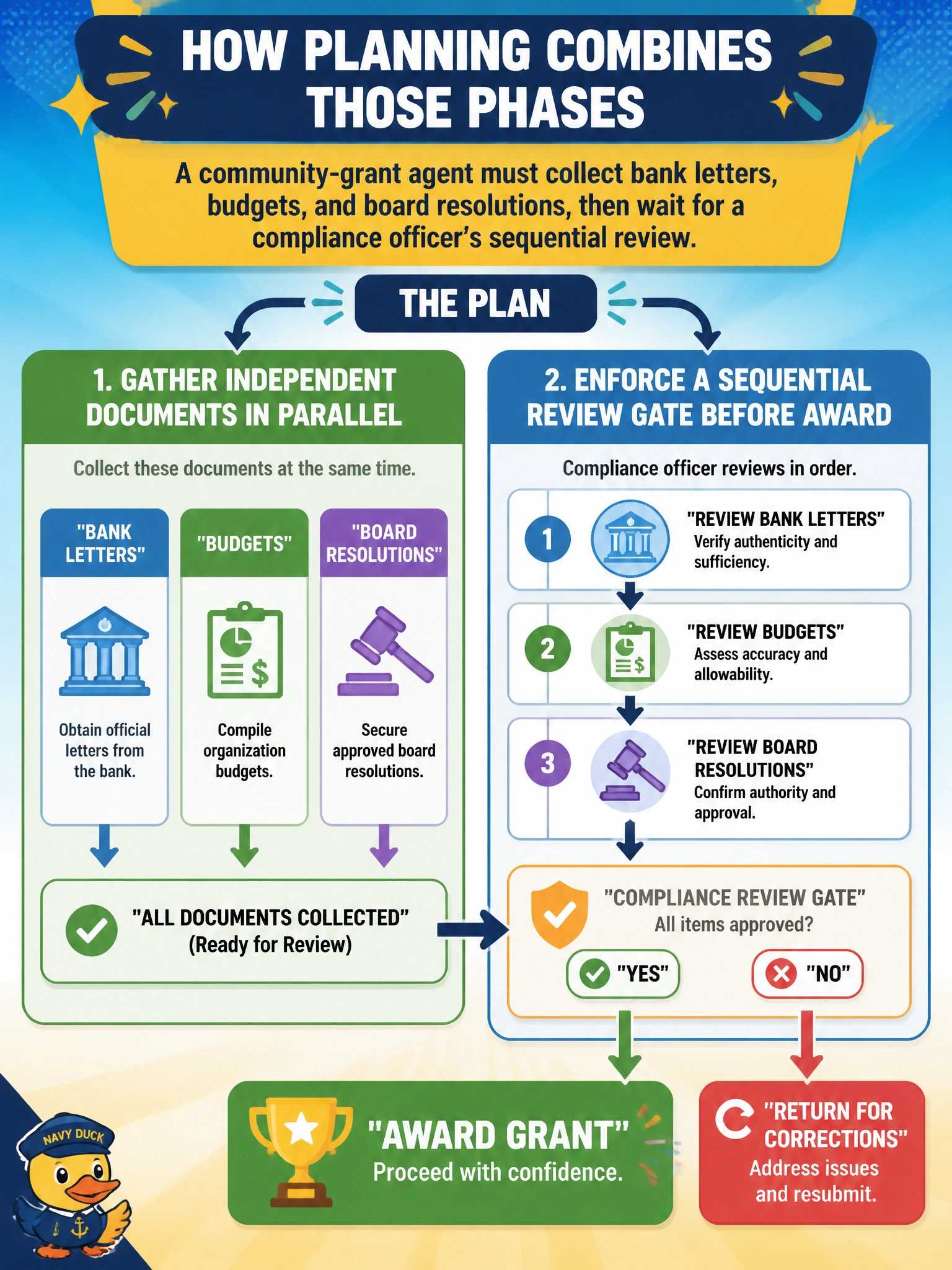
A community-grant agent must collect bank letters, budgets, and board resolutions, then wait for a compliance officer’s sequential review. How should planning combine those phases?
Select an answer to reveal the explanation.
Short Explanation
Picture packing for a trip: toss shirts and toiletries into bags at the same time, then do the security check in order. Independent grant docs can be gathered in parallel; the compliance review still has to be a sequential gate before money moves.
Full Explanation
Community-grant workflows mix independent evidence collection with mandatory control gates. Bank letters, budgets, and board resolutions typically come from different sources and can be requested concurrently to reduce wall-clock latency. The compliance officer’s sequential review, however, is a hard ordering constraint: award issuance must wait until that gate completes. Correct planning therefore gathers independent documents in parallel, then enforces a sequential review gate before any award step proceeds.
Forcing every document request through a single serial queue wastes time when sources are independent and does not improve compliance quality—it only inflates cycle time. Skipping the compliance review so awards issue as soon as any one document arrives violates municipal control requirements and creates improper-payment risk. Running the compliance review in parallel with document gathering assumes reviewers can certify an incomplete packet; that collapses the gate into a race and undermines the sequential assurance the process exists to provide.
Exam caveat: parallelism is appropriate only for independent tasks; dependent gates stay serial. Operational check: instrument the planner so award tools remain blocked until review status is committed, while document-fetch tools may fan out earlier—then verify in staging that an incomplete packet cannot reach disbursement.