
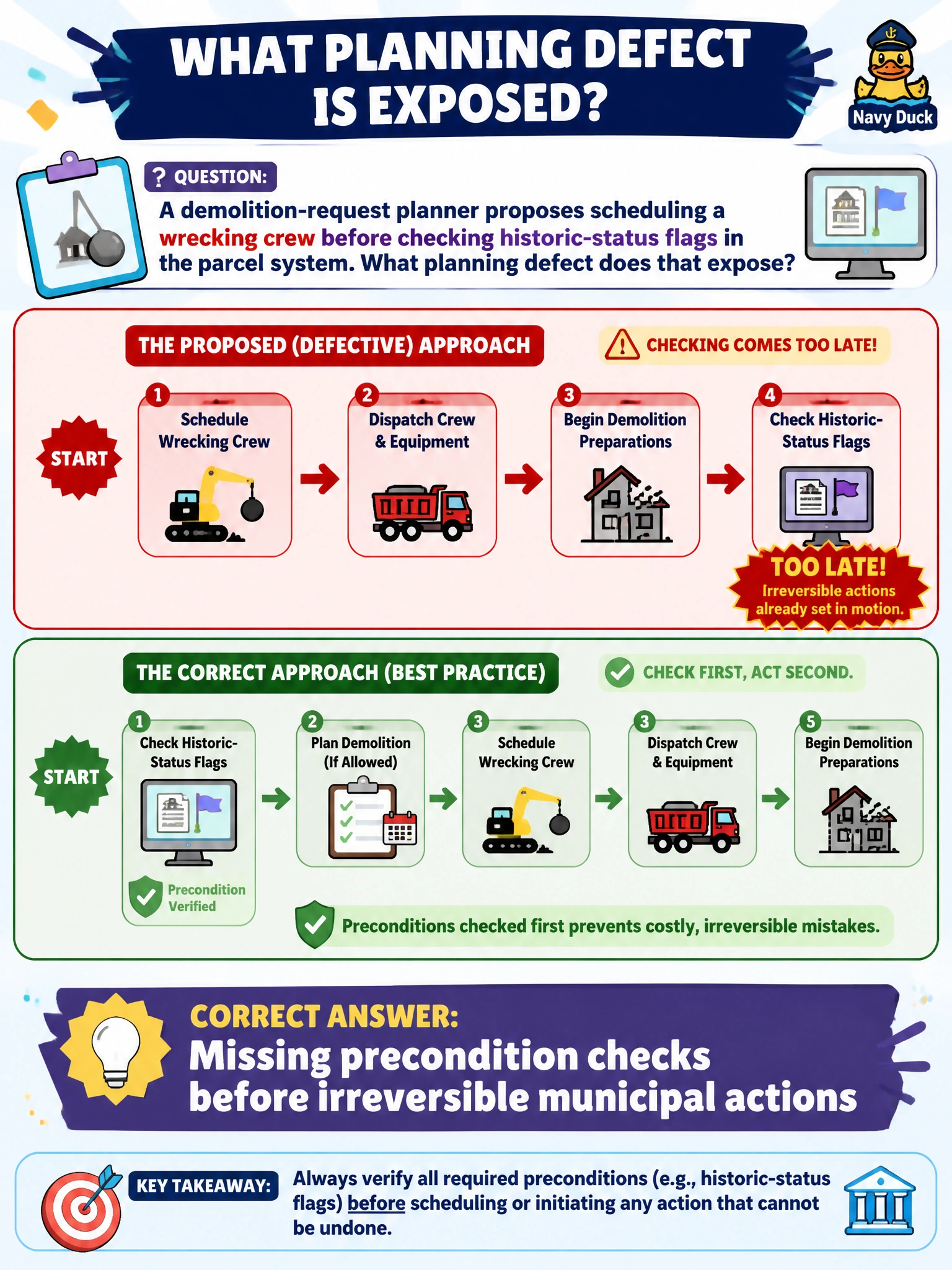
A demolition-request planner proposes scheduling a wrecking crew before checking historic-status flags in the parcel system. What planning defect does that expose?
Select an answer to reveal the explanation.
Short Explanation
You don’t swing the wrecking ball before asking if the house is on the historic register. Planners need precondition checks before irreversible city actions—historic flags first, demolition scheduling second.
Full Explanation
Sequential civic planning must embed precondition checks before irreversible municipal actions. Scheduling a wrecking crew before querying historic-status flags in the parcel system exposes a missing-precondition defect: demolition is hard to undo, and historic designation is a legal gate that must precede crew commitment. Sound planners query parcel historic status (and related holds) first, branch on the result, and only then schedule irreversible fieldwork.
Excessive short-term memory summarization of the wrecking-crew schedule is unrelated—the defect is ordering and gates, not dialogue compression. Overuse of hybrid BM25 retrieval on historic ordinances may affect evidence quality but does not explain proposing demolition before checking the parcel flag. Failure to tokenize PII during nightly ETL of demolition invoices is a privacy/ETL concern in a different pipeline stage; it does not fix a planner that skips civic preconditions.
Exam caveat: distinguish retrieval quality issues from planning-order defects—this item targets missing preconditions. Operational check: require an explicit historic-status tool result (or equivalent parcel hold check) as a committed precondition before any demolition scheduling side effect can fire, and audit plans that schedule irreversible steps without that flag.